
"given to asomeone as a gift" | 2009-11-14 |
| - Reviewed By hanser |
| I gave this book as a gift to someone. They were delighted and saif it was a great book. |
| |
"Sci-fi with a heart and soul" | 2009-09-28 |
| - Reviewed By User: A1OKFQ8GH04Y |
"Speaker for the Dead" -- the sequel to Orson Scott Card's "Ender's Game," a science fiction novel about children being prepared for a great war with an alien race -- is the better of the two, perhaps because it is less of a children's story and appeals more to adults with deeper themes and characters who are more easily identified with.
Card creates an imaginative universe in this series. It's set many years in the future, thousands of years, in fact, after "Ender's Game," already a futuristic tale. Humans have expanded throughout a hundred worlds, founding colonies, like Lusitania, where much of this novel takes place, a world based in Catholicism. Each world has a government, but they're also governed as a whole, with strict rules, especially regarding potential alien species, based mainly on the elimination of the Buggers in the first book.
There's themes of atonement, as Ender seeks redemption for being pivotal in bringing an end to the Buggers. Also in need of personal redemption is Novinha, a new, rich character who keeps secrets from everybody surrounding the death of someone close to her.
Card brings much depth to Novinha. She's distant, even to her children, somewhat afraid to open her heart again. She's stubborn, but she also has a great heart that makes her a little vulnerable.
As Lustiana shares its planet with an alien race known as the pequeninos, Card also explores a culture clash theme. While on the surface it's about humans' contact with aliens, it could also be about any two cultures coming together and the misunderstandings that often surface. Some xenophobia creeps in, as fear of the pequeninos develop from circumstances that take place, circumstances that may be beyond the understanding of human nature.
But, deeper than that, runs the idea of hegemony, an elite culture ensuring its place at the top by limiting knowledge to those it deems inferior. Yet Card also addresses the question of: Can an advanced culture hurt a primitive one by introducing certain ideas and technology to them?
And, while the novel covers such heavy academic ideas, readers don't have to be schooled in such topics to get enjoyment out of it. There's still an engaging story here, of which not much will be said so as not to spoil it for anyone. Despite much depth, "Speaker for the Dead" winds up being a quick read.
Much of what makes the book entertaining is its wonderful cast of characters. Ender's more mature, more layered here; he has an amazing ability to read and understand people even when relatively few words (or none at all) are spoken. It makes a lot of sense for a boy who grew up way too quickly in the first novel. There's also Jane, an AI who has instant access to limitless knowledge, but who also develops a personality that she becomes one of the most human characters; she gets jealous and offended. There's Human, a pequenino whose name becomes fitting as he becomes more human than pequenino. There's Quim, who is devoted to the colony's rules and religion until his world is torn apart. Ela, who resents the fact that her mother doesn't see her talent, something she got from her mom. There's Olhado, who doesn't have eyes but sees more than anyone with the most vivid memories.
And many more. One minor complaint might be that there's too many characters, yet it doesn't prevent attachments from being formed.
"Speaker for the Dead" is "Ender's Game" for adults, with a richer, more complex story; it's sci-fi with a heart and soul, and an exciting story to boot. |
| |
"Speaker for the Dead (Ender series, vol. 2) a triumph." | 2009-07-08 |
| - Reviewed By maxcue |
| I just finished the second of the "Ender" Series by Orson Scott Card, sadly, about 5 years after reading "Ender's Game", which now demands to be re-read. But not before finishing the series! Rest assured, there are no spoilers in this review but let me tell you this: I am a doctor (medical) and admit that although I have read many, many hundreds of books (I'm speaking only of pleasure reading here, not the reading required for any school), am an aspiring author with a 3/4 finished sci-fi novel myself that isn't half so good as the one I'm reviewing now and have a very eclectic taste, I do most enjoy science fiction. But there is so little truly-great science fiction to read; many novels are clever or have a novel twist but few take your breath away. The hugeness of many of Asimov's or Stephen Baxter's novels brings greatness to them and there are some great "hard science-fiction books as well, but this second in the "Ender" series reads more like those of Octavia Butler (I especially admired "Kindred" and all three of the "Xenogenesis" series. If you haven't heard of her, do some reading and read her; you won't be sorry). I hate that I read "Ender"s Game" so long ago but I definitely remember enough of it to know how different "Speaker for the Dead" is. Does that mean you should skip the first book? No! Not at all. Just don't wait to read the second. They are so different, I think in the way science and religion are different: two completely-different ways of examining the world around us. Honest self-disclosure: although born to a Jewish family, I have read the entire bible and spent about 20 years counting myself a Christian. I no longer do so, but rather have come to believe simply that everything is connected (probably in a quantum way) and that it's in a way I don't understand. That's enough for me. This book is similar: there is much science in it but it is a story about people, not necessarily always human, but people nevertheless. What you need to know about the sequel to "Ender" is the poetry and beauty of its prose, the huge expanse of the author's imagination, and how immensely-spiritual the story is. This book is far better, far different than it's prequel and shows an author whose talents and imagination finally brought me to tears near the end of the book. Read it, in its proper place, after "Ender's Game", even knowing it is better. I think you will appreciate it all the more. |
| |
"Well written" | 2009-06-12 |
| - Reviewed By User: AMBCBBTMRW79R |
but there are simply too many implausibilities in the storyline that serve no purpose other than to set up Card for a lot of philosophizing.
|
| |
"Worthy Sequel to Ender's Game" | 2009-06-04 |
| - Reviewed By santhonyatwindstreamdotnet |
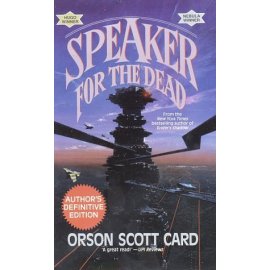
This dual Nebula and Hugo Award winner is a sequel to the award winning Ender's Game. Fast forward 3,000 years after Ender's destruction of the Bugger race. A world hero at the time, he is now viewed as the greatest mass murderer in history and universally abhorred.
Due to the vagaries of interstellar travel, Ender is still alive, incognito, living a life as Speaker For the Dead, a cult like figure who has penned a scriptural work entitled The Hive Queen and the Hegemon. Unknown to anyone else, he also is in possession of a cocoon containing a Bugger hive queen, the genesis for reestablishing the Bugger race.
Now, 3,000 years after destruction of the Bugger, another sentient race has been discovered on planet Lusitania. The Interplanetary Congress, careful not to repeat the mistakes made in the Bugger destruction, very carefully study this new race (Piggies). A combination of events leads Ender to Lusitania and brings together Human, Piggy and Bugger on one planet.
Much like Ursula LeGuin's award winning novel, The Left Hand of Darkness, this is very much a work focusing on anthropology and interaction between members of different species. The lives and customs of the Piggy race are meticulously and painstakingly presented, perhaps to a greater degree than necessary. The status of the human colony as a licensed Catholic conclave is an interesting twist. An enjoyable piece of work, though not up to the level of the original. Also, the book leaves too many loose ends to be tied together in the third book of the series.
|
| |
"Speaking and Healing" | 2009-05-07 |
| - Reviewed By lit_chic |
"A good man out of the good treasure of his heart brings forth good; and an evil man out of the evil treasure of his heart brings forth evil. For out of the abundance of the heart his mouth speaks."
Speaker for the Dead is an unusual novel--it crosses lines back and forth between fantasy, science fiction, spirituality, psychology, philosophy, history--there is no genre for this book. While Ender's Game is an intense work, it is clearly what it is. As much as I enjoyed Ender's Game, I like Speaker for the Dead more because it is undefinable; and yet, it is clear as day.
Orson Scott Card must be an incredible person, because when I read his introductions to both Ender's Game and Speaker for the Dead, I felt like he was inviting me into his home. We had a fantastic conversation through these introductions as he explained to me the genesis of the works and issued me a blanket invitation to make the stories my own!
Imagine my astonishment when I realized--more than 24 hours after having finished Speaker for the Dead--that I actually accepted his invitation. I identified so completely with Ender in his struggles and his pain that I marvelled--I don't usually empathize with a character so completely, so wholeheartedly.
I can see how a million separate, individual stories can be spun from these works--they are profoundly introspective. Underneath it all, however, is the desire for healing from brokenness. In some way, we are each broken, and in some capacity, our Creator has enabled us to have the ability to soothe, and through His ability, to even heal each other's brokenness. After reading Speaker for the Dead it crystallized for me in a new way that there exists a Christian mandate to speak healing for others' hurts.
Card explained in his introduction Ender's desire to move beyond his personal adolescent stage and to step into a role of anchoring, but I think Card overachieved his goal, and gave us a glimpse into the potential that adults have as heroes in stories--as anchors. We see many, many novels about brokenness, but rarely do we see stories of healing. I doubt there are many skilled authors capable of presenting this kind of reversal. However, it is so much more interesting as a story, and much more fulfilling for the reader.
Of course, I only touched on one small aspect of the story. The creativity is teeming over, but it never gets *weird.* It is refreshing without getting bizarre. Cliches are avoided, but I recognized how completely Card was an influence on Stephenie Meyer's writing.
This is not a work for everyone, but it is a work for anyone who wants to read it. I do recommend that Ender's Game is read first, as it is the first part of the story. Highly recommended.
|
| |