

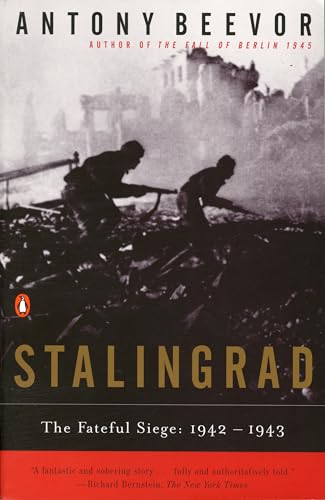
"How totalitarian dictatorships mishandle leadership" | 2008-08-05 |
| - Reviewed By User: A2G3U6AM951P6D |
Matter-of-fact telling of a fantastic story--the double disaster of Stalingrad in during World War II, where the German army crushed the Russians (army and civilians alike) and drove them back into the destroyed city, then were themselves surrounded, besieged, and crushed by an encircling Russian force that cut them off from Germany and its supply lines.
Not always pleasant reading, but instructive in the way in which totalitarian dictatorships mishandle leadership. |
| |
"A Haunting Story" | 2008-06-28 |
| - Reviewed By rickm10 |
| Beevor has written a tour de force here. Two things I'd like to add: once you begin this book, it's impossible to put it down. Another is that the scenes linger in your head long after you've read it. A haunting, unforgettable, tragic story, beautifully told. |
| |
"Awesome Book" | 2008-05-07 |
| - Reviewed By chazind |
This is a great book that tells the story of probably the most significant and decisive battle of World War II. I could not put it down. The story telling, anecdotes, and research are all first class.
I saw another review that complained that the book took a German perspective on the setting and consequences and there is probably a little truth to that. However I felt it did not detract from the overall impact of this book. To get a little better sense of the Soviet perspective of the times in relation to the battle of Stalingrad, I would highly recommend reading "Life and Fate" by Vasily Grossman (who Beevor quotes extensively). Although this is a work of fiction, it really gives you a sense of what was at stake here for the Soviet Union and how they rose to the challenge. |
| |
"The Fateful Siege" | 2008-04-13 |
| - Reviewed By User: A3BY0O5ZK0HQTI |
I thought this was an excellent look at the battle of Stalingrad. Antony Beevor covers all the bases from countless accounts from soldiers in the trenches (& ruins) - both German & Russian, to events involving a few soldiers to entire divisions. Then he explains how some of the major players on the Russian front made their decisions & acted under pressure.
The detailed information doesn't stop there - much of the book details the almost personal battle between Stalin & Hitler and all that Stalingrad represented to both sides. Antony Beevor does a great job of describing what was going on in other parts of the European theater of war & how they tied into this great battle. This was a pivital battle that affected the future of every country touched by world war 2. Worth reading.
|
| |
"Academic, yet accessible" | 2008-03-31 |
| - Reviewed By anathema_jones |
One of the things I like best about Antony Beevor's books is that, while he goes into great detail, his writing style is so well constructed and accessible that you could recommend his books to someone who's not usually a history reader and expect that they would still enjoy them.
Beevor conveys the details of the Stalingrad battle front's strategies and tactics; politics; environmental and medical factors; and samples of both German and Soviet viewpoints taken from letters, journal entries, and post-war interviews into a well blended narrative. He also relates some lesser known facts about the battle without dwelling on them at the expense of the larger picture and conventional information.
Highly recommended; if you wanted to gain a good understanding of Stalingrad and the Russian front in WWII, and were to read only one book about it, then this is what I'd recommend. |
| |
"Outstanding" | 2008-03-02 |
| - Reviewed By User: A1S88S04YX1ZT5 |
A very good read. Solid history at the same time easy to read.
You live it! |
| |
"Great Book!" | 2008-02-01 |
| - Reviewed By User: A1L7KICDC7VPMK |
Very very nice book, maybe not for everyone but certainly a very enjoyable read for military and/or history buffs. It is a very objective narration of one of the battles that decided WWII, with good, fact-supported un-biased analysis. Comes with illustrations and maps that really help during the read (couple of more maps would have been the icing on the cake), plus the order of battle at the end of the book is an invaluable reference.
The best book by Beevor I have read. |
| |
"Analytically shallow but a good read" | 2007-12-23 |
| - Reviewed By malone_syndrome |
I went to see Antony Beevor during Sydney Writer's Festival this year. Near the end of the talk he brought up something interesting. Beevor explained that the famous German historian Joachim Fest had once written a highly critical three-page article on him in which Fest stated: "Beevor has no leading thought." "Well," Beevor told the audience, "I know some historians who do have a leading thought - like Goldhagen - and they don't budge from it even if they encounter evidence which contradicts it."
It was a non-rebuttal of Fest's point. Although it's interesting to note that Daniel Jonah Goldhagen remains the serious historian's benchmark for poor scholarship, it was impossible not to also notice that Beevor used the bogey of Goldhagen to duck the issue. When you have finished reading Stalingrad, you begin to understand that Fest is essentially correct: Beevor is great at giving an account, but seems constitutionally incapable of reaching a conclusion. The narrative moves along nicely and then just stops once the boundary of the story has been reached. There were no remarks on the historiographical debate, no analysis of the ideologies of either side, little insight into Hitler or Stalin's motives, no passage beginning with the words like "And so, in summary ...". The chronicle just seems to stop by crash-landing on the last page.
Beevor is certainly correct to say in his preface that "a purely military history of such a titanic struggle fails to convey its reality on the ground" - and indeed he does a very good job of rendering the phenomenological reality of war as experienced by soldiers on either side. The horrors of military conflict are not lost in abstract descriptions of troop movements and battlefield tactics. Herein we learn that when the Germans ran out of planks to ford mud-soaked trenches with, they simply lined up Russian corpses and drove their vehicles over them [p. 36]; that Russian POWs were left to sleep out in the open during snowdrifts and tried to huddle together in holes in the ground which they dug with their bare hands [p. 178]; that mice chewed off the frostbitten toes of sleeping soldiers [p. 337]; and that the encircled servicemen eventually resorted to cannibalism [p. 315, 350]. There's nothing to indicate that Beevor wilfully sought out lurid details: he seems to state them out of a need to genuinely convey "the reality on the ground".
But for me, the reality above ground is equally important, and herein it is given scarcely a mention. Nazi Germany and Stalinist Russia were the world's foremost totalitarian powers at the time. In discussing the only conflict they fought against one another, it is remarkable that their ideologies were given such scant treatment by Beevor. Hannah Arendt once argued that the scale of the Nazi-Soviet conflict masked the fact that both regimes had far more in common than they were mutually distinguished by. Beevor has written a book about Vassily Grossman: he is surely aware of the passage in Grossman's book "Life and Fate" (which is all about the siege of Stalingrad) where the Nazi officer tells the captured orthodox Communist that the two movements do not differ in their essentials and whichever one wins will not extirpate the other, but merely absorb its essence [See Robert Conquest's book on Stalin]. This was Arendt's point in a nutshell. Amazingly, Beevor never found time to explore such an interesting issue. And many others simply fell by the wayside.
I bought this book because it came enshrouded in a cloud of gushing compliments from the press. And indeed it does tell a good tale. We learn a great deal about *what* happened in Stalingrad: but I left the book with something of an empty feeling: I didn't learn much about *why* it happened. |
| |
"world class, great sense of narrative" | 2007-11-21 |
| - Reviewed By andrewtheamericaninparis |
I found this book excellent, there are several strong points :
* strong sense of narrative that gives the reader a sense of why events were occurring, how they interrelate with one another, and where the key mistakes were made
* good insights into the decision making on both sides, how personalities, both of the military staff and the dictators, had an impact on events and outcomes
* fair in its treatment of both armies, who were both incredibly brutal to each other as well as the civilian population. This book does not subscribe to any heroic narrative or myth
* book gives you a real idea of the suffering and misery that occurred during the battle, both for the combatants and the civilians |
| |
"Engrossing" | 2007-08-29 |
| - Reviewed By User: A13QR696FB2KW1 |
Stalingrad . . . The greatest battle of World War Two. The very name evokes images of horror, suffering and inhuman endurance that no man who sleeps comfortably in his bed every night could ever imagine. But imagine it we do, and Anthony Beevor's vivid narrative still haunts my dreams. The first hand accounts of the fighting, of the surviving, both German and Russian, are riveting. As an anecdotal history of the soldiers who fought and bled, died or survived, often to live through further suffering, this book is a page-turner, though not the kind you would bring to the beach. For the serious historian, Mr. Beevor's documentation of the Nazi and Communist attitudes regarding the ideological struggle, especially as it relates to their actions at the front, are eye-opening and invaluable.
A great book.
|
| |