
"Must read" | 2008-08-10 |
| - Reviewed By saulk11 |
| This is a truly remarkable memoir describing the depression-era South. A must read, even if you are not a fan of Jimmy Carter. |
| |
"Easy to read" | 2007-11-08 |
| - Reviewed By annelewellen |
This is a very enjoyable book. I love to read about the true
South. Jimmy Carter is a man to be admired. He grew up learning
to work for what he wanted. He shows great respect for others.
A very good read. |
| |
"A book filled with memories of a boyhood during the Depression" | 2007-10-29 |
| - Reviewed By ratmammy |
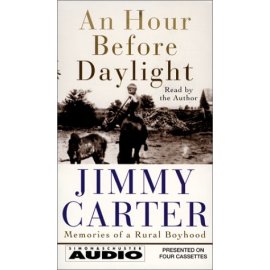
AN HOUR BEFORE DAYLIGHT by Jimmy Carter
October 29, 2007
Rating: 4/5 Stars
I've now read several books written by President Jimmy Carter and I've enjoyed them all. What I love about his books is his personal touch he lends to them. AN HOUR BEFORE DAYLIGHT however is the first full memoir that I've read by Jimmy Carter (the other books were books on Faith), and seeing the world of his childhood, depression era Georgia, has been insightful. This childhood he had is what shaped him into the giving person he is today.
Living in the South during this time meant that blacks were separate from whites, and whites were superior to blacks. And while some of these attitudes may have prevailed even in the Carter household, he was also taught to treat blacks with respect, and most of his childhood friends were the black children of the hired hands they had on their farm. The Carters, compared to many of their neighbors at the time, did well in farming and were very resourceful in all they endeavored. Hard work was the ethic they lived by, but Jimmy Carter also had stories to tell about childhood antics and enjoying life on the farm. Carter also talks about his siblings, mostly referring to his sisters Ruth and Gloria (Billy came along much later, but he is mentioned in the book, in particular in regards to his tragic early death). He looked up to his father, and greatly admired his mother, a woman who did so much in her later years and became famous in her own right (some of the stories Jimmy relates are quite humorous, including her love of the Brooklyn Dodgers, later the LA dodgers and her friendship with the team).
AN HOUR BEFORE DAYLIGHT is not the perfect book. I found a lot of it to be rather dry reading, but I still enjoyed the anecdotes and stories that Jimmy Carter wrote about his growing up years. He's seen a lot in his life and has used what he learned to enrich others and help those who need it. I am slowly going through Carter's library of books and look forward to the next one. |
| |
"Interesting, quick read but tedious in spots" | 2007-10-25 |
| - Reviewed By teddybird |
I've been wanting to read one or more of President Carter's books for a long time and decided to begin with this one. While I agree that it is well-executed in the main, it doesn't score higher with me on a few grounds.
One: I felt there was a need for more fastidious editing. The book was by no means too long, but there was repetition and disordered content.
Two: Way too much detail in some of the more mundane and unpleasant sections, in particular discussions of minutiae of small-town agribusiness dealings as well as graphic detail of livestock issues including slaughtering and castrating. TMI.
Three: This is a half-hearted complaint, for I realize this isn't the book where these matters would likely be discussed considering the author has several other memoirs addressing other periods of his life (doesn't he?) In any case, I felt like the President did not discuss enough how his upbringing resulted in his being the man he is today as far as race relations are concerned. Lots of discussion about the relatively tolerant household in which he was raised, but lots of apology at the same time about how racism was ubiquitous at the time and not really perceived by his family or by others as a wrong to be righted. I don't know, I guess I'm rambling here, but I would have liked to have read content along the lines of "and these boyhood experiences shaped my perceptions in such a way that I wanted to make a difference in my public service career" and also I woulda liked to have read about how he connects his religious beliefs with his liberal leanings. Flesh out that relationship a bit more.
Just my 2 cents.
In any event, the book was a quick read and I am very glad I got around to reading it. |
| |
"wonderful memoir of a country boy who became President" | 2007-06-29 |
| - Reviewed By User: AC744LW4D4U9G |
After reading this book it is easy to understand why Jimmy Carter was denigrated as a weak Leader who let America's enemies walk all over him. As he looks back with affection & describes his childhood in a strict, hardworking, but loving family on a farm in back country Depression-Era Georgia, Mr Carter comes across as a genuinely kind and good man who respects his fellow-men & women - regardless of color or creed; who is tolerant of - though not entirely blind to -- the shortcomings & foibles of others, and truly incapable of seeing evil in anyone. In short, he is the Ideal Christian. This also goes a long way to explain why subsequently he became so widely respected on the International stage in his second career as Humanitarian & Fixer of the World's Problems.
Mr Carter paints a colourful word-picture of his boyhood home, the close-knit community, the Carter farm, the livestock, the hunting dogs, his family, and his neighbours, the black tenant farmers and their children with whom he worked and played. There is nostalgia for a time and way of life that largely disappeared from this continent half a century ago, when children worked harder & shouldered more responsibility than today's young people can even imagine, but which was the making of them as responsible adults. Yet his writing style is innocent & light-hearted, and occasionally down-right laughable as, for example, when he gives us some examples of his rural childhood diction. It is hard to imagine the urbane, educated Mr Carter uttering the words "We et a bait of plums" or, having travelled 30 miles to see the flooding Flint River, "Wheh de ribber, Daddy? Is it down in dat creek?"
This book touched me on a more personal level as well. I was not far into it before I realised it reminded me so much of the spell-binding stories my mother used to tell us children around the dinner table, stories of her life growing up on a 240 acre Clay Belt farm as one of 15 children of Ukrainian immigrants. The climate, the geography and the neighbours' ethnicity may have been worlds away from the Carters, but her life and her experiences could just as well have happened down the dusty road from Plains, Georgia.
Attention Jimmy Carter: If you read this - I asked my mother about the sound made by the metal clicker on the handle of the milk separator. She is an expert: one of her chores was to operate the milk separator; and afterward to disassemble, clean & reassemble all its the component parts, which she could perform as rapidly as a soldier does with his rifle. Mother says you have to turn the handle faster & faster until it reaches the speed necessary for the cream to separate from the milk inside the machine. The change in the tone of the "clicker" is determined by the speed of the turning handle & occurs when the required speed has been reached for the separation to occur.
Mr Carter is one of only a handful of public figures with whom I would care to be acquainted. Such an interesting Life; such an interesting man! |
| |
"I like Cater, but can't cotton his writing" | 2007-06-08 |
| - Reviewed By pacificbook |
| Why is it that ex-presidents make poor writers? Is it that they have had to hide their feeing so long they are afraid to loosen up afterward because we might think less of them? I was looking forward to reading about a boy growing up in Georgia while I was growing up in Iowa, but his writing is so stiff and lifeless that I quit halfway through. |
| |
"Excellent!!!" | 2006-10-01 |
| - Reviewed By User: A2FRH2K5RNAJ4P |
This is one of the best books I've read the past year and one of the best biographies I've ever read. Jimmy Cater, whether you like/respect the man or not, is an excellent storyteller and he takes you back to the years of growing up on a rural Georgia farm during the Great Depression and segregation. The descriptions are so clear it seems like you're actually there. Quite a contrast to the middle class/suburban upbringing I experienced. I also read Carter's Presidential biography, which is also very good, but he's not as long-winded here so the book reads very fast. Also some interesting photos. Overall excellent.
|
| |
"Worth the time" | 2006-04-07 |
| - Reviewed By gnilsen5 |
President Carter discusses his experiences growing up in rural Georgia during the depression and how it influenced his future public life. Despite the institutionalized segregation that formally kept the races apart, many of the people that shaped the future President's young life were not white. It is amazing to compare the changes in American society from 70 years ago, some for the better (institutionalized segregation and racism), but mostly for the worse. Even though segregation is now gone, it is ironic that the informal happy-go-lucky youthful mixing of the races that President Carter claims helped shape his young life is probably gone now as well; but cynically, I believe Carter over emphasizes this point for political profit. Also, Americans were very frugal, resourceful, and resilient in those days. I don't think today's wasteful, whiney, latte entitlement generation could go through such economic hardship.
I was disappointed that Carter didn't talk much about aspirations of political life. Mainly, his youthful ambition was concerned with getting into the Naval Academy, and the book ends there. |
| |
"The boy behind the man" | 2006-03-03 |
| - Reviewed By lavaliere |
| This is one of the best books I have ever read in any genre. I've always liked Jimmy Carter as a human being, and now I know what made this intelligent, unassuming, hardworking, humorous, and compassionate public figure the man he is. And in addition to that, the book gives a wonderfully rich view of rural life earlier in the 20th century. I would recommend this book to anyone. |
| |
"My grandma loved this book" | 2004-04-04 |
| - Reviewed By Anonymous |
| My grandma sure seemed to like this book a hell of alot. She mentions it everytime we see her. I figres it must be worth 3 stars at least. |
| |