
"Perhaps one of the greatest records ever made -- if not, definitely one of the greatest jazz records ever made" | 2009-05-22 |
| - Reviewed By tellrabbit2 |
Ornette Coleman was 29 years of age in 1959. He had made his debut album in 1958, entitled 'Something Else!!!!,' released on the Contemporary label. Coleman released two other albums for the Contemporary label before leaving to sign with Atlantic Records.
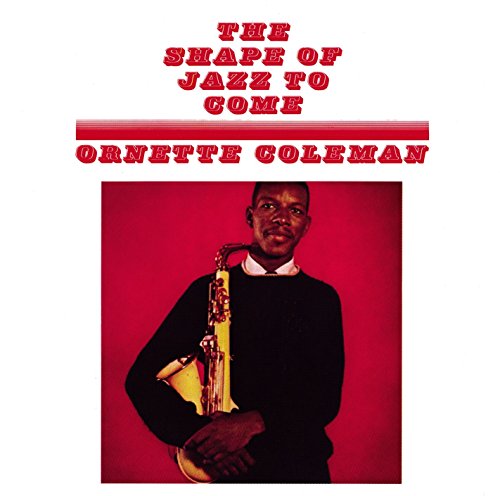
The result was 'The Shape of Jazz to Come,' his first album to be released on the label and to this day, his finest. Produced by Atlantic Records executive Nesuhi Ertegun, the record featured six songs including what many consider to be his standout piece, 'Lonely Woman.'
But believe me when I tell you, 'The Shape of Jazz to Come' is FAR more than just 'Lonely Woman.' All six songs are jazz masterpieces with Coleman blowing away at his saxophone, and featuring Don Cherry on cornet, Charlie Haden on the double bass, and Billy Higgins on drums.
The record's six tracks are all masterpieces in their own right, but my favorite track would be the nine minute 'Peace.' Coleman is at his finest here, as is his backing group, in my opinion.
So for people who haven't heard 'The Shape of Jazz to Come,' or have heard it but don't own it, BUY IT RIGHT NOW. This album is not only one of the finest jazz records ever to be made, but it is one of the finest records to be made PERIOD.
This is an avant-garde jazz masterpiece. I can't say it enough, you don't have a jazz record collection until you have 'The Shape of Jazz to Come' in it.
Overall, I recommend this album to anybody. It's an amazing record. If you like jazz even a little bit, than you'll love this album.
Highly, highly recommended. This is a must-own for any jazz fan or any music fan in general.
ENJOY!!! |
| |
"Redefining the word, redefining the music... " | 2009-03-19 |
| - Reviewed By User: A20Z1PKIH0PFUF |
"Look at them! Just look at them! throwing their hips this way, that way while I, my muscles, stone, the marrow of my spine, plaster, my back supported by decorated paper, stand here as goofy as a Dumb Dora Lord, if I can't dance, No one shall."
Ishmael Reed "Mumbo Jumbo"
It is all about the moment! That is essentially what improvisation is - living freely in the moment. And that's what Ornette and his trio were doing when they cut this revolutionary recording back in 59 (arguably the greatest year for jazz music ever). Lock the doors, hide the kids, and by all means, be afraid, be very afraid, because this music was not created for the faint of heart. Stan Getz has left the building!
Think you can really define Jazz music? Think again. Because after listening to this album, you might wish to reconsider your definition, for O.C. and the boys truly redefined the word. And it has never been the same since. A major breakthrough recording, this quartet - Coleman (alto sax), Don Cherry (cornet), Billy Higgins (drums) & Charlie Haden (bass) - almost completely abandon the use of chord structures and all conventionality as well. They just let it all rip! And as my Amazon amico Unlucky Frank recently scribed in his excellent review regarding Sonny Rollins & co.'s live classic "Night at the Village Vanguard" - `this music requires active participation on the part of the listener. If you are attentive, you're in for a real treat.' Couldn't have said it better, this is not music you are going to want to play at your next cocktail party (unless you want to shock the you-know-what out of them all!) or when you are placidly perusing a book or the morning paper. See Chet Baker, Dave Brubeck, Bill Evans, et al... for those sits.
I am not going to pretend to even remotely have as much knowledge about music as many of the reviewers here possess. Just got into jazz music about seven years ago and my addiction continues to grow hourly. It took me a while to truly appreciate and comprehend this avant-garde classic. What I love the most about this music is that every time I listen to this one I hear something new and fresh that I didn't pick up on the times before. EVERYTIME! One of the characteristics of great art in my opinion - it challenges you to use that little ball in between your ears!
If nothing else, I urge you music fans out there to listen to this recording just to hear how absolutely amazing Charlie Haden is on bass. I believe this was his debut, and what a debut it was. Just caught Charlie last year live at a local jazz show and I was absolutely floored. The cat still has the chops!!! One of the most unique bass players you will ever hear, and this is where it all began folks.
The jazz world's "The Rite of Spring". Enjoy it, but remember, you have been warned!
|
| |
"Sorry But I Didn't Dig This At All" | 2008-09-16 |
| - Reviewed By ejfan19 |
Ornette Coleman is a revoluationary musician. I do not like his approach to music. I do not like the way he plays the saxophone nor do I dig his tone. There is one thing I do respect about him: he opened the doors for many musicians and sparked an evolution in this music we call jazz. He opened many people's ears to start exploring.
"The Shape Of Jazz To Come" isn't my kind of jazz album. I came to the music with no pre-conceived notions and a clear and open mind, but yet I still couldn't get the vibe. For one thing, I like chords. I like to hear harmony. This recording just didn't really draw me in. I love horn players and a great rhythm section, but I would have liked to hear chords being played by a pianist or guitarist.
Free jazz is something that always bothered me, because the music itself is chaotic. It's not very interesting or melodic. It doesn't have anything a listener or even musician can grab onto. It's just totally "up in the air" so to speak. You can't make heads or tails out of it. It's something that just hasn't ever appealed to me. I have listened to Coleman, Cecil Taylor, John Zorn (he's actually done some good music), Coltrane's free period, Derek Bailey, Evan Parker, Anthony Braxton, etc. I'm sorry but this music just doesn't do anything for me.
"The Shape Of Jazz To Come" was a milestone in the beginnings of free jazz, but I have yet to hear a single free jazz recording that makes me want to keep listening.
I would only buy this album for its historical purposes. I'll always listen to Miles, Monk, Blakey, Clifford Brown, Gillespie, etc, because their art is timeless and can be enjoyed by everyone.
|
| |
"10 Most Dangerous Albums of All Time (Entry Four)" | 2008-08-21 |
| - Reviewed By User: ADL6AMKXSXILM |
1959 is to jazz what 1977 is to punk rock: glorious. John Coltrane's Giant Steps. Miles Davis recording Kind of Blue. Charles Mingus and his eponymous Mingus Ah Um. And my personal favorite, Time Out by the Dave Brubeck Quartet. 1959 also introduced one man whose debut album shook the foundations of jazz and introduced a shift in jazz music that is still felt today.
The young man with the plastic horn. Unprecedented.
Ornette Coleman's The Shape of Jazz to Come
Jazz had not seen anything like it. It would be safe to assume that no one thought anything of this caliber would be possible. With its apparent lack of chords, its atonality, and its complete disregard for traditional jazz conventions, Ornette Coleman's debut album angered many. It was easily dismissed as junk, noise, garbage. This isn't music, many said. For them, this wasn't jazz.
But it was. And is.
The Shape of Jazz to Come is prophetic in its title. This album would immensely influence John Coltrane, Eric Dolphy and countless other musicians, both within and outside of jazz. And its verberations can still be felt in jazz. John Zorn has taken much from Coleman. Pat Methany has worked alongside Coleman.
With this debut, Coleman paved the way not just for avant-garde jazz, but for free jazz as well. Such a possibility must have been unforeseeable in 1959. The Shape of Jazz to Come established a path for those seeking a new take on jazz to follow. In this way, the album served as an exodus, the music contained within serving as aural guideposts to jazz's new land.
There is a story that details how Ornette Coleman performed a show in front of a crowd to whom he was a relative unknown. Halfway through Coleman's performance, the crowd, unable to process the new jazz they were listening to, chased Coleman off the stage, seized his plastic horn, and destroyed it. I imagine The Shape of Jazz to Come elicited the same dangerous reaction from others.
A necessary reaction. |
| |
"Diametrically Opposed Forces" | 2008-06-25 |
| - Reviewed By jimiles3 |
| Two of the albums most influential to my understanding of jazz both came in 1959. Bill Evans masteripiece Portrait in Jazz and Ornette Coleman's The Shape of Jazz to Come. Bill defined the piano as the well-spring of jazz, Ornette thought the piano was the whole problem. Ornette's frentic solos were a stark contrast Bill's cyborg-like restraint. For all their differences, one thing on which the could agree was that traditional chord voicing had to go. These are both great ablums in their own right, but its all the more exciting to listen to them in context with full knowelge of all that they would inspire in other artists. To be sure, there are a great number of other highly influential albums of that time, but for me, these two stand apart from the pack. |
| |
"SNAFS thinks of Coleman's early detractors *snickers*" | 2008-06-16 |
| - Reviewed By mwarren122 |
I think a lynching (at least verbal) would be appropriate for the people who said he should be burned and destroyed for messing with the precious jazz formula. I think the risks Ornette Coleman took are VERY appropriate. Besides, unpredictability can be fun, and Ornette Coleman demonstrates this with glee. He does know too much is just _________ annoying and it doesn't sound daring or challenging, it just sounds bad, or _____. Unlike his most famous album (maybe, Free jazz, there isn't two seperate quartets for each channel. There are also only four members. The sound is very clean on this album, but there is a sense of adventure on this album.
Whenever I listen to it, there's always something to listen to. This is one of those albums like that, but this album really is just FUN. Now, introspection is awesome. But I appreciate music on pretty much all of it's fronts, those deep meanings, those messages, the dancing, or just plain on listening how people use their voices as instruments. Such as this. Don Cherry and Ornette Coleman do that, but they really just seem to have fun. The drums and bass are focused and run like the wind. Only in Lonely and Lonely Women are they toned down to beauty and melancholy, respectfully. The rest just rip, glide, and go insane.
Ornette Coleman and company deliver a well rounded, excellent, focused jazz album, not bound by any scales or time signatures. They build on the bebop/hardbop and modal jazz and add a bit of raw, addicting dissonants, and a great sense of freedom. That's my favorite thing about this album, is that it has plenty of that, but there is a great sense of freedom and very tuneful.
It's really not just a great way to slowly get into the world of free jazz and noisy music (everything from later Coleman to John Zorn's Naked City). Besides, it's not one album you'll forget after using as a stepping stone. It's not really a stepping stone, it's just an album that happens to be a good introduction for some people. I don't care what your excuse is (as long as it's not to be "cool". If so, your a _________ moron), get it.
9/10 |
| |