
"Smaller than the paperback edition; hard to read" | 2008-03-29 |
| - Reviewed By User: A2KNSB4ME91I9 |
I'd give 5 stars for the storyline and 1 for the size. Average = 3.
I bought this 3-in-1 for the cheap price. When it arrived I found it to be smaller than the paperback single editions and harder to read. I say buy the paperbacks. |
| |
"Great book" | 2007-12-16 |
| - Reviewed By User: A271GLHSPVAJSW |
| Since I read the first tale of Tintin thirty years ago, a can't stop doing so anymore. It's an amazing book. |
| |
"Three more classic Tintin adventures" | 2007-10-11 |
| - Reviewed By tigerbuck |
Many of us grew up on Tintin and love them for their great nostalgia value, and reminisces of childhood, as well as the brave values of a simpler, more clarified world of yesteryear.
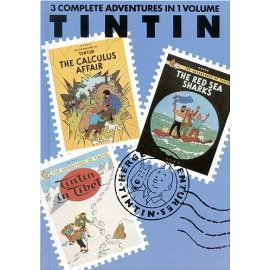
This volume brings together three of the best loved Tintin classic in one handy volume- and for not much more than the price of one.
They are:
The Calculus Affair
Strange things are happening at Captain Haddock's estate at Marlinspike.
Thugs are up to something, and all the glass is mysteriously exploding.
Soon Tintin and the Captain discover that Professor Calculus had been kidnapped.
Their investigation leads them to Switzerland and then to Borduria, ruled by the iron grip of the Stalinist Kurvi Tasch regime.
The Bordurians, it turns, out have kidnapped the Professor, to develop nuclear weapons and thus enable them to attain world domination.
This is quite eerily prophetic, being written in 1956, when it seemed quite impossible for a tinpot dictatorship to acquire such weapons of mass destruction, but we now we see these very same devices being developed by tyrannies such as Libya, Syria, Iran and North Korea.
The Calculus Affair is filled with espionage and gripping adventure.
The Red Sea Sharks
After a strange encounter with General Alcazar of San Theodoros, and then getting home to see that Emir Ben Kalish Ezab, has sent his thoroughly obnoxious son, Prince Abdullah, to stay at Marlinspike, the Emir is deposed by the evil Revolutionary thug, Sheik Bab El Er.
Tintin and the Captain fly to Khemed, to try to get to the bottom of an illegal arms buying racket and if they can, to help their friend, the Emir.
There they take a boat to Mecca , where they must battle several enemies , in a high adventure on the Red Sea. Before the adventure is through , they will break a slave smuggling ring and ensure the defeat of several villains.
The issue of slave trade by Arabs , of Africans , was not only still going on when this book was written in 1958 , but is still endemic today , in places such as the Sudan.
These adventures are always full, of life and colour.
Tintin in Tibet
Firmly convinced that his friend Chang, has survived the plane crash in Nepal, Tintin, accompanied by Captain Haddock, sets off for Nepal to rescue Chang.
After passing through New Deli and Nepal (where we explore the sights and sounds of these wonderful places, Tintin and the reluctant Captain set off for the Tibetan Himalayas for the mission impossible.
This is one of Herges best works as he explores the , hazards of Himalayan mountain climbing, the gentle Tibetan Buddhist monasteries and the truth about the Yeti , commonly known as the abominable snowman.
The only thing left out, is the brutal Chinese occupation of Tibet which still continues today .The book was recently released in China, on condition that the name Tibet was left out of the title, another example that after the holocaust of 2 million Tibetans, the Red Chinese are still not content in their drive to wipe out the beautiful culture and memory of Tibet.
A particular interesting scene is the psychedelic delirium of Captain Haddock during his sunstroke.
The strong 60s flavour of this is interesting considering that the book was written at the ver dawn of this era-1960.
|
| |
"Great fun!" | 2007-10-10 |
| - Reviewed By estherstiff |
| This series of Tintin anthologies is a great buy--the durable hardback cover and the high-quality paper means these books will last a long, long time. |
| |
"great stories" | 2007-03-10 |
| - Reviewed By User: A2K56S73XHXF32 |
| As usual, my 7 years old loved to read Tintin, and I loved to rediscover the stories too ! It is a great book to transport you and your little ones into new adventures. Calculus and Captain Haddock are hilarious. Tintin is adventurous, smart and a good example to my kid. |
| |
"1956-1960" | 2007-02-07 |
| - Reviewed By User: AAEP8YFERQ8FC |
Comic #6 of "The Adventures of Tintin" 3-in-1s has "The Calculus Affair" (1956), "The Red Sea Sharks" (1958) and "Tintin and Tibet" (1960). There's some fine stuff here, but it's not my favorite time in the series. Tough times for Herge too.
"The Calculus Affair" features a new invention and a kidnapping, set in Switzerland and "Borduria". From me, 3 stars.
"Red Sea Sharks" is set in the Middle East, and features Abdullah. From me, 4 stars.
"Tintin in Tibet" is pretty famous in the series, and sees Tintin go out to find his old friend Chang, stranded in the Himalayas. From me, 5 stars.
Kind of like his later stuff a bit better. Worth a look for fans though. |
| |
"Glad to See Tintin again" | 2007-01-19 |
| - Reviewed By heinri23 |
| I grew up reading The Adventures of Tintin and recently purchased this volume for a young cousin in an effort to turn him on to these great stories. I like the new hard cover 3 story format as my old paperback copies have begun to come apart, from repeated reading of course. One thing that I noticed is that unlike the original versions which each had exactly 62 pages, the new format has not preserved this... now I know that's a little nerotic but that's something I always remembered from reading them as a young boy, the fact that each was exactly 62 pages. Herge is a very talented artist and story teller, I would recommend the complete collection to anyone who is looking for a quality adventure story! |
| |
"Great stories, well executed" | 2007-01-14 |
| - Reviewed By User: A3EYY1AXUFZXX |
I grew up with Tintin books, and my kids are now at an age where they are beyond "See Spot Run" but don't always have the patience for a full-length book. The stories are always great, and the research is meticulous. Most of the story subjects were highly topical at the time, and reading the books regularly provide history refresher.
"The Calculus Affair" is a typical cold-war cloak-and-dagger story of espionage and intrigue. How the world has changed, but the Litvinenko Affair is a reminder that the Cold War was a reality not so long ago.
"The Red Sea Sharks" deals with gun-running and slavery in the Middle East, a subject that is still topical (as the UN's efforts attest).
"Tintin in Tibet" is one of my favourites, a great Tintin story used by Herge to draw attention to Red China's invasion and annexation of Tibet, and the cultural heritage the Communists set about to destroy. |
| |
"TinTin rules" | 2006-11-07 |
| - Reviewed By gkai6057 |
| It is the top cartoon of all time. And with 3 episodes in one book, what else can you ask? |
| |
"A rich part of this bilingual Canadian's heritage" | 2006-09-09 |
| - Reviewed By jrbleau |
My highest recommendation goes to this volume.
Volume 6: The Calculus Affair (1956), The Red Sea Sharks (1958), Tintin in Tibet (1960). This is the sixth instalment of my reviews of each of the seven volumes.
Oh, what a trifecta in this volume! Tintin is not so well-known in the USA and the American who might give it a try would do well with this volume. The artwork has become draftsman-like, the lines are clean and brisk, the composition of the panels is endlessly pleasing, and the pace of each adventure always just right. The bottom right panel is the teaser panel, inciting us to turn the page and read on. Bear in mind that before being in book form, these adventures came out two pages at a time in Tintin magazine, with the teaser keeping us in suspense until the following week's edition.
"The Calculus Affair" was, for a child, a dauntingly adult-sounding title, and the story a little less accessible than the others. But what a cold war story! - with a plausible scientific gizmo, kidnappings, car chases, an Eastern bloc-style military junta set in fictional Borduria with an iconography based on the régime's founder (just look at the cars' bumpers), and with Tintin's determined aplomb and Haddock's ever-entertaining slapstick, riding a crackling plot from beginning to end. Castafiore earns an added dimension for her character and the insufferable Jolyon Wagg takes his first bows. Regarded by many as the best of the series.
The cover of The Red Sea Sharks shows the heroes marooned on a raft in the eponymous setting, seen through a telescope. What brought them there and what lies next is an adventure that involves depth charges, jet attacks, torpedoes, a burning ship, clandestine commerce handled by a villain we've seen before. The French title (Coke en Stock) gives a clue as to what this commerce is, but I won't give it away. A great adventure with a tremendous amount of action and some hilarious moments, showing Hergé's mastery of the visual narrative, but the author's own favourite comes next...
Tintin in Tibet. Hergé's personal favourite; the cover shows the explorers confronted with huge humanoid footprints in the Himalayan snows. The teaser is already set for an adventure that shows the deep bond between friends, the loneliness of conviction against all odds, a surreal dream sequence, misunderstanding, Eastern mysticism, and intense solitude. In my review for Volume 4, I said that the Temple of the Sun was a pinnacle in the Tintin series, but this may be THE pinnacle of the whole series. The settings and drawings are positively stunning. I also mentioned elsewhere that Haddock took some of the limelight off Snowy, but in this story, after character parallels are drawn between the two, with some tension, a panel of surpassing sensitivity shows the Captain's deep affection for the dog, after Snowy himself showed the extent of his own devotion to Tintin. Humour is superbly developed, in one notable case around a theme of making faces as a greeting and, of course, the irascible Haddock's misinterpretation of this. The final, poignant panel strikes a chord of empathy in anyone with feeling. This is a story to read to your children: the richness, the interconnectedness, and the humanity of the whole are a stimulus to any child's experience. |
| |