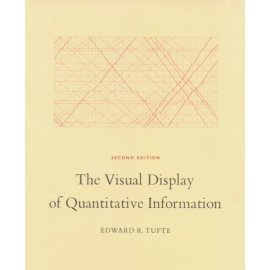

"A must!" | 2009-10-25 |
| - Reviewed By User: A3KFP8J0HH1RWJ |
| See the world through the eyes of someone who has seen it before... and discover how much time you can save! |
| |
"Readable reference" | 2009-10-18 |
| - Reviewed By User: A12M5VU90ZW3TR |
| Very good book about how to display statistics in charts and graphs. I wish there had been more examples of what makes a good graph, but overall it's a great reference for anyone who's looking to make a chart or graph. |
| |
"The negative review make no sense to me" | 2009-09-15 |
| - Reviewed By User: AJNXV91V2EZQ5 |
I am a working scientist. As such, I make my living conveying information to others. Tufte's books are all great, but this one is the most important and is a must read for ANYONE whose business involves the use of numerical data.
Tufte does a great job of stressing making graphics that tell the story efficiently and clearly. Display of quantitative data is all about making data accessible to the audience. Graphs are used because they make the data come alive in ways that tables simply cannot. When we are successful, our audience relates to plotted data and is drawn to the conclusions we have drawn. Creativity in reaching the audience is possible with both quill pen and computer.
Those critics who criticize the book as lacking state-of-the-art computer graphics have really missed the point. Tufte is agnostic to the tools used to craft the message. What he shows is that effective graphics resonate with an audience, they don't confuse it. That message transcends any particular technology. This isn't a book on how to use Excel to make plots, it is about the thought process required to make the plots better whether using Excel or graph paper. |
| |
"Insightful and inspiring" | 2009-09-13 |
| - Reviewed By User: A2T58C4HKJUNSQ |
| His explanations of "small multiples", the "data-ink ratio", and the proper aspect ratio for graphs have made my academic/professional presentations more effective. |
| |
"Towards Legibility Standards for the Display of Data" | 2009-07-01 |
| - Reviewed By User: A13JWL3PTL0D2E |
Tufte's volumes is an iconic volume for graphic design that unites legibility with efficiency and beauty in a cogent and stimulating manner. While it's reputation and overwhelming authority may hurt it a bit, it is actually a worth read with a well develop and constructed analysis - with a breakdown of some "best and worst" practices" - and an intriguing attempt to develop a theory for data graphics, which for the most part is worth carrying around and promoting.
Among some of the most obvious defects is a repetition of some trends and examples, a patronizing sense that permeated the narrative here and there, and with that, touches that may seem that the critique is trying to be too final, and offers little room for debate. But all in all these touches are minor and the volume withstands as a pivotal critical point to develop legible and useful graphic information. Something that I would recommend to anyone involved with, or interested in these aspects. |
| |
"Dissapointed Scientist" | 2009-06-12 |
| - Reviewed By User: A2JS50C123KLBB |
Because of the reviews, I was really excited to read this book. I am a scientist with a graphic arts background that I am told I use to great effect. I was hoping that this book would provide new ideas for presenting my own work and would help me learn to effectively communicate with my graduate students about their graphics. Unfortunately, this book did neither and instead, left me frustrated with the outdated information, overly dramatic characterizations of scientific graphics, and overly reductionist approach.
I could find few graphs that were published after 1980 and not many more than that published after 1960. There are repeated references to drawing plots with a ruler and pen which few, if any, scientists use to produce graphs today. As a result, the information is not of much use. Even the examples used to illustrate the problems with graphics produced electronically look to have been produced with a first generation Mac and bear no resemblence to the scientific graphics of today. While I agree with some of the points made about the graphics used in the text, they are so out of date that it makes it difficult to relate these points to my students.
Another reviewer commented quite clearly about the derogatory tone - with statistics and graphics called "lies" in more places than I can count so I'll leave that point alone.
The biggest flaw for me was the overly reductionist approach used throughout. For example, Tufte presents several alternatives to the venerable box plot. While I agree in principle that reducing useless ink is a good idea, many of these proposed graphs miss the point - conveying information clearly and honestly to the reader. The traditional box plot does a few things very well - it presents the mean of the data as a strong line with the majority of the data presented in an open box, providing visual weight somewhat proportional to the number of data points represented while showing the full range (or some statistical description of the data range) as whiskers which are visually reduced in weight relative to the box, again, relatively proportional to the number of data points they represent. Tufte's proposed alternatives may convey the same amount of data but they are difficult to interpret and do not provide the same visual weight to data but rather provide equal weight to all values represented in the best cases or in the worst, make the viewer focus on the ends of the data distribution instead of the mean value and majority of the data surrounding it. I think this reductionist approach misses how the human brain perceives information in its quest for simplicity and reduced ink. By the time one finishes this book, you'll believe that Tufte pays for graphic ink by the drop. However, text ink is apparently free as the text is often redundant and ovely verbose.
I had hoped to find a book that would be a great resource for myself and my students. I'm still looking. |
| |