

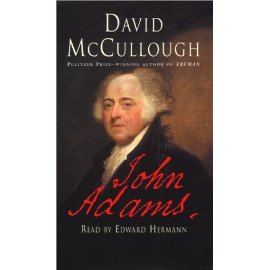
"New admiration for Adams, McCullough, and the reader Nelson Runger" | 2009-09-30 |
| - Reviewed By User: A2QWQXDQEV1VRI |
Let me first say that I am no historian, nor do I particularly enjoy reading. This review is for those people like me. I love history -- especially American -- and I love great books, but I often find myself falling asleep when trying to read after a long day of work and getting the kids ready for bed.
So I read audiobooks. I've listened to over 40 in the last few years on my drive to and from work. And I believe this one to have the greatest delivery of them all. I can see why some reviewers of the hardcover copy of this book might think that McCullough fails to bring Adams to life. That would probably be my sentiment as well, if I were forced to read it on paper. But Nelson Runger truly brings the character of John Adams to life. So much so that he does invaluable justice to McCullough's great work, which, in my opinion, provided the most solid foundation for what became, once recorded, a beautiful masterpiece.
More than once this audiobook has nearly brought tears to my eyes. Before now I barely knew who John Adams was. I could have told you only one thing about him -- that he was our second President. Now I feel that I can relate to him more than any of our founding fathers as I know them. I feel that he is the model that America should follow today: virtuous, principled, solid. Yes, he made his mistakes, and he acknowledged them. His wife Abigail was the strong, supportive, industrious woman that he needed in this strenuous time. On quite a few occasions he had to make the decision to leave her and their children for unknown lengths of time to serve his country. Each time the challenge was even greater for the family, but each time the decision was more decisive than the last.
Yes I recommend this audiobook, wholeheartedly, to anyone who wants to know more about the birth of this country and our founding fathers. And I know you will enjoy it!
|
| |
"John Adams by David McCullough" | 2009-09-23 |
| - Reviewed By User: A1RC30R83C74IH |
| Having this great desire in my latter years to learn more and refresh my mind concerning the gentlemen, statesmen, scholars and learned' who were also traitors - to the Crown - but founders of this great Republic. I am in the middle of another book at the moment so I haven't read this one. So accordingly, I will address the condition and posting of the book. It was in exceptional condition, indeed, almost brand "spankin" new. Their shipment was very, very expeditious. Wonderful job, once again, Amazon! |
| |
"Life of a patriot" | 2009-09-22 |
| - Reviewed By warecornell |
If fourteen hours of John Adams [Blu-ray] wasn't enough, then take home the brilliant biography by David McCullough from which the miniseries was adopted. Adams is perhaps the most enigmatic of the founding fathers-the Harvard educated son of a Yankee farmer, brilliant trial lawyer, and reluctant politician sees himself as obnoxious and disliked. Yet he serves his country upon her every call from the Continental Congresses to diplomatic assignments to the first Vice President and second President of the United States. He feuded with some of his contemporaries yet tried to resolve feuds between others which were injurious of the cause.
Fiery in his political life, he feuded with Jefferson, his successor in the new Executive Mansion (it wasn't the White House until it was restored and painted white following the British burning of it during the War of 1812). These old friends reconciled in their old age, both dying on July 4, 1826, the fiftieth anniversary of the signing of the Declaration of Independence. Adam's alleged last words, "Thomas Jefferson still lives" were in error for the third President had died at dawn.
Mostly this is a story of the origins of a very public family whose influence begins with Adams largely successful defense of the British officers and men involved in the Boston Massacre. From their his son went on to become the sixth President (and only President to serve in the House following his term in office), his grandson Charles Francis Adams, Sr, as ambassador to the Court of St. James during the Civil War was instrumental in keeping the British from intervening on behalf of the Confederacy, and his great grandson Henry Adams was a great American novelist and writer.
In John Adams we see how a generation of patriots pledged "our lives, our fortunes and our sacred honor" to separate from England, to form a government whose structure has endured for well over two hundred years, and to serve that government and its people.
This is a long book, but not just one history geeks will admire. Adams is a perfect vehicle to stand at the center of the study of the new republic, because of his flaws, his brilliance, his passions, and his very humanity. |
| |
"Easy to read and interesting style" | 2009-09-19 |
| - Reviewed By User: A2Y07EQRFMRD3B |
| John Adams the book was written in a easy to read and interesting style. This book is one of my favorite books and the longest books I have read. One should tackle this book in sections. This book becomes part of your life and you don't want it to end. In showing John Adams life, one sees from the book the main intentions of the US government and the reasons that it was built. The book also shows that from the beginning of the US government politics and the press were not much different than today. In going into John Adams personal life, one sees how different life was in the 1750s to 1820s. This book is for anyone who has ever wondered how the US government was created, why it was created, how the US broke from the British, and to see what the people involved had to go through. |
| |
"A Masterpiece" | 2009-09-18 |
| - Reviewed By gambit21 |
| McCullough created a jem with this work and a must read for any student of history. For anyone who just thinks of John Adams as the 2nd President who was sandwitched between two greater presidents will have their eyes open to the life of perhaps one of the two most important men to survival of American Republic. What Washington did on the battlefield, Adams did in diplomacy, eclipsing anything done by Franklin or Jefferson. While one must make natural allowances for McCullough championing the subject of the biography he was writing, the letters and historical record that McCullough relies upon makes his assessment of Adams beyond reproach. Often thought of as hot tempered and vain, Adams was beyond everything a human being who rose above his challenges and from a farmer's son, of whom he was very proud, rose to be the key to American liberty - in sharp contrast to most other founding fathers, most notably Washington and Jefferson, both of whom were landed elites who continued owning slaves until their deaths. Adams abhored the concept and was a true liberal of his time, both in thought and more importantly, in action. While some may view McCullough's writing style plodding, I disagree as his employment of letters provides the needed burst of color that far from being plodding, pushes the pasing along. Recommend. |
| |
"Great Book!" | 2009-09-12 |
| - Reviewed By User: A31PCUY3V3FQC2 |
The author of this book draws on the incredible number of surviving letters that John Adams, Abigail Adams, Thomas Jefferson, and others wrote during this time. Using these letters and the portraits reproduced in the book, these people are all brought to life in a way that I have never before seen in a history book. I felt that I could actually know these people for the first time as real, breathing individuals--not the idealized representation that we sometimes get from the necessarily superficial treatment given in textbooks. Of course, this is true because the author is writing in detail about only one small, though extremely important, part of history. I treasured getting to know John Adams' life and, by extension, the life of all early Americans. The thought processes that resulted in the Declaration of Independence is more fully understood by reading this book.
In the process, we get to share in the events that shaped early US history, but these events are mostly filtered through the experiences of John Adams. For examples, though we get insights as to how it was like for US citizens to live through the events of the time, we don't get any real feel for the military difficulties and campaigns fought by George Washington, the fight against the Barbary Pirates is barely mentioned, and the War of 1812 seems over in an instant.
However, we do get to see John and Abigail move into the new White House in the final months of his presidency, even as that great building is still being built and the rest of the capital is still under construction. We get to know Abigail's feelings about the injustice of slavery, and her first real look at it when they arrive in Washington, DC. We also get to know a lot about Thomas Jefferson, and the contradictions in his life. He denounced the institution of slavery and yet kept slaves, he preached economy, but was a spendthrift.
John Adams was in Europe during most of the Revolutionary War. What we miss about the war by being with him (through his letters) we gain in insight about European affairs during and just after the war. So, we can see something of what France was like in the years just prior to their own Revolution, and we see what the court and person of America's nemesis King George III was like when John Adams goes to Great Britain as America's first ambassador there after the war is over.
I wish that the author could have given better insight into John Adam's seemingly inexplicable support for the very contentious Alien and Sedition Acts while he was president. Perhaps the author cannot be faulted, since there are times when Adams did not attend to his diaries and letter writings. These lapses are a loss to us now, for I would very much like to know why he supported the Acts, in his own words.
In the end, when Adams and Jefferson both die on the 50th anniversary of the initial signing of the Declaration of Independence, we are awed by the coincidence and timing of their deaths, but we are even more saddened at the passing of these great men and at the ending of their families too that we have lived through. We get to see John Adam's son (John Quincy) become the 6th President of the United States just months before John Adam's death. But we also see how ephemeral life is even for great people. The death of Adams' daughter, Nabby, was for me the saddest part of the whole book. She was only 49 when she died, but John Adams lived to be 90, outliving most of his children and his wife. Similarly, Thomas Jefferson also outlived by many years his only wife and most of his children.
If you want to actually feel part of the early history of the United States, then read this book. |
| |