
"Insane!" | 2009-10-14 |
| - Reviewed By User: A390B7P7SUK5JS |
This book is insane and so is Robert. Sorry I never reviewed this book. It was my first film making book.
A great inspiration and a wonderful read. Gets you all stirred up, you'll be ready to shoot your own film, you'll be so pumped.
Get it, read it. You'll love it. |
| |
"Entertaining & Inspiring" | 2009-08-08 |
| - Reviewed By User: ANMCER904ZALG |
| The story of how one man went from an amateur film-maker to a Hollywood superstar. A thoroughly entertaining and inspiring story. A must for any budding film-maker. |
| |
"Funny, smart and humorously smart aleck!" | 2009-07-18 |
| - Reviewed By User: A3REB794S25FPC |
This is a wonderfully engaging book! It is written like a diary and as such I didn't feel like I had to complete the chapter in order to get the information in tangible pieces.
Funny, smart and humorously smart aleck! A real window into the process from start to finish!
"Rebel Without A Crew" has inspired me to go film anything once a week with a friend. We just go out find something and then shoot it - of course we spend the rest of the day thinking of other places to go the next week! We edit our video during the week and show what we came up with with the same material.
We discuss screenplays and documentaries we'd like to do as well as movies and shows we should see during the week. |
| |
"A must for those interested in film" | 2009-06-12 |
| - Reviewed By User: A2CCDFW5XF8G5F |
Being that I am not an avid reader, I cannot say that I have read too many memoirs in my lifetime. In fact, Robert Rodriguez's Rebel Without a Crew is the first memoir to have graced my eyes. Fortunately, I found Rodriguez's novel to be a rather enjoyable read.
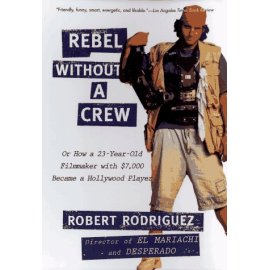
The novel follows Rodriguez's journey on how he was able to make his first full-length feature movie and how he successfully became one of Hollywood's most popular filmmakers. More specifically, the first third of the book retells Robert's quest to make his film, El Mariachi under a budget of $8,000. To me, this was the most interesting part of the novel. This is because it shows the reader the day by day process in which Robert manages to film his movie with the limited amount of resources at his disposal. The remaining two-thirds of the novel recount Robert's interactions with Hollywood's representatives. I personally found this potion of the book to be more confusing that interesting. This is because of the overwhelming amount of names and sums of money that Robert is presented by various filming companies. In other words, the portion is less interesting because of how it revolves around the financial aspect of filmmaking rather than the creative side of filming.
One thing that I found unique about Rodriguez's memoir was his style of writing. For example, he writes exclusively in the first person, lacking any dialogue (with a few exceptions) from other characters in the novel. Because of this, there is unnoticeably any character development throughout the course of the novel. Robert's writing also lacks any extravagant details to describing the characters and locations he mentions. While most would consider this lack of character development, descriptive details and dialogue as a poor decision, I actually found that it helps support the novel's its first person narration. Without the detail, dialogue and development of characters Rodriguez is able to keep the focus of the novel strictly on him, exposing the reader to his perspective.
The overall message that Rodriguez's memoir promotes is that people should follow their goals and do what they love, ignoring whatever opposition that they meet. After reading this memoir, I myself was inspired to go out and make my own movies despite my lack of experience in the field. And despite the confusion I experienced while reading the majority of the novel, I still managed to enjoy reading the filmmaker's unique retelling of his winding road to fame. While the book might not be the greatest memoir ever written, it is still an inspiring tale that all people interested in film should read.
|
| |
"enlightening for filmmaker wannabes and entertaining for everyone" | 2009-05-15 |
| - Reviewed By leo1cat2 |
This book is interesting in two ways. In the first he provides quite a bit of useful advise/information/inspiration to those interested in making films. In the second he provides an entertaining description of his rise as a filmmaker from his childhood to big name film maker (at least as of 1995).
With respect to his development as a filmmaker, he starts out by describing how he was first inspired to make films, as a child, after watching John Carpenter's "Escape from New York". He tells of his childhood tales working with claymation, 8mm and VHS video. He then goes on to his film school days and how he made, while still in school, two films that he used as a basis to launch his career, "Bedhead" and "El Mariachi" (the latter of which can be rented on DVD from Netflix).
The story of the making of Mariachi is quite interesting. He uses almost no money ($7,000 to be exact) to make his film and describes, in detail, this adventure. For anyone involved in filmmaking a very interesting tale. Then he goes on about going to LA to market this product to Latino video makers and how, instead, the film was picked up by a major studio thus launching his career. The whole tale is well written, entertaining and interesting.
There are also important lessons for any filmmaker in this book. One is the need for passion, something that flows throughout the book. The second is perseverance, again another theme that flows throughout the text. Lastly, and possibly most important to aspiring filmmakers, is the very very important need to have a masterly knowledge of just about all aspects of filmmaking. Today's film schools tend to force students into specialized niches such as sound, cimematography, etc. His story emphasizes (and he states explicitely) one must be a master of all crafts of filmmaking to successfully become one. This means not only being a master of photography and videography, but also editing, sound, etc.
The lesson from his story (and his explicit advice) is not to "waste" money on film school but to instead master the art of filmmaking then use the saved money to go on and actually make a film as opposed to working as a niche technician on someone else's. Mastering everything in a book such as Pincus's "The Filmmaker's Handbook: A Comprehensive Guide for the Digital Age" and Long's "The Digital Filmmaking Handbook " should provide one a more useful background than almost $80,000 spent on film school. This knowledge, combined with passion and persaverance, was the key to Rodriguez's success. His story (and he explicitely) emphasize, this is absolutely essential to becoming a successful filmmaker. |
| |
"Great read for filmmakers or anyone who enjoys a "take life by the horns" tale" | 2009-04-09 |
| - Reviewed By truthteller |
Robert Rodriguez has wanted to make movies since he was little kid. At 23, he decided to make a feature film. He would sell it as a direct to video release for the Mexican film market.
And so he made his movie with $7,000, a bunch of amateur actors and no crew.
The results? A winner at Sundance and other film festivals. A box-office smash and an open door to Hollywood.
Rodriguez records his odyssey in journal fashion, which is very helpful. Ups and downs, hints and tricks, tips and techniques. Lots of great stuff for budding filmmakers, though some of it is now obsolete because of the advent of digital video.
Rodriguez intends his book to be inspirational and it is. He's gone on to what appears to be at least a moderately successful career in Hollywood.
His Ten-Minute Film School as Appendix 1 is a delight. "So you don't want to be a filmmaker, you are a filmmaker. Go make yourself a business card. Next." Again, a lo of the information is out of date, but Rodriguez is still convincing in his argument: you don't have to dream about becoming a filmmaker - just do it.
Even though it is getting old, "Rebel Without A Crew" is still an inspiring read, whether you want to be a filmmaker or not.
Jerry |
| |