
"Reflections on the Meaning of Life" | 2009-11-05 |
| - Reviewed By User: A23YLA4J1KQZDD |
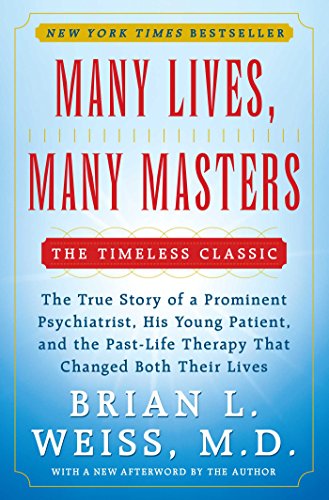
Perhaps it was serendipity that I discovered MANY LIVES, MANY MASTERS just now (it was written about 25 gears ago), especially at a time when I've been pondering the meaning of my life and the point of humankind on earth in general. This book begins to shed some light on these issues.
In 1982, a psychiatrist named Brian Weiss took on a client named Catherine who was having all sorts of personal problems. She suffered from extreme phobias (everything from fear of water to closed spaces to swallowing pills) and also experienced anxiety attacks on a daily basis. Something was clearly wrong with her, so she was referred by her physician to Dr. Weiss to see if his psychiatric practices could shed any light on the situation.
Initially, Weiss attempted basic psychoanalysis to try and get at the root of Catherine's problems, hoping to pinpoint childhood traumas that would explain her phobias. But with the exception of a few minor improvements, Catherine's phobias persisted.
Weiss then took things a step further and tried regression therapy, hoping this would tap into Catherine's subconscious and reveal a repressed trauma or other incident that would explain the phobias. But something unexpected occurred when he did this. Instead of accessing Catherine's subconscious, he accessed something else: what he refers to as her "super-conscious".
While under hypnosis, Catherine started experiencing strange memories that didn't pertain to her current life in any way. She remembered being a girl in Ancient Egypt who embalmed the dead, and then being a little boy in the Ukraine who's father was wrongfully executed in prison, and then being a prostitute in Spain, and even being a Nazi German soldier who died in WWII. Weiss eventually concluded that these memories were of past lives - what he eventually determined to be a whopping 86 lives in total!
But what was even more interesting about the regression sessions was that Catherine would remember the time in between her many lives: that is, she would re-experience floating out of her body after a death, going into a bright light, becoming a spirit in the spirit world and evaluating her life from beginning to end - what she learned, what she did right...and where she went wrong.
And that's not it: to make things even more amazing, Catherine found herself able to convey super-intelligent spirit messages to Dr. Weiss during these "in-between-life" experiences - messages dictated to her from highly evolved spirits (what Weiss refers to as being "the masters"). In other words, she acted as a medium, helping Dr. Weiss communicate with the spirit world. The messages to Weiss were spoken poetically, and they described a spirit world comprised of seven levels, where the lowest levels were for poorly evolved spirits and the highest levels were for the highest evolved spirits. Life, the masters explained, is about learning, and each soul comes to earth to learn a particular lesson that can only be learned in human form. We choose when we want to live and what kind of life we are going to live and what we need to learn during that particular life. The overall meaning of our lives on earth is to obtain as much wisdom and knowledge as we can, so as to become as "God-like" as possible. Each soul grows during each life, and - eventually - everybody reaches the highest spirit levels in the spirit world, as long as we learn what we need to during our various human incarnations.
After several of her regressions, Catherine ultimately freed herself from her fears, phobias, and anxieties. Weiss determined that her dramatic improvements were due to a combination of pinpointing certain past-life traumas and also becoming more spiritually aware through the process of her regression. She came to realize that our souls live forever, and that there is nothing to be afraid of in life, because we never die. There is a greater purpose to our existence: to evolve to the highest level possible.
All in all, Many Lives, Many Masters is an incredibly intriguing book, even if you're skeptical of whether it's all true. One particularly interesting discovery Weiss makes during his time with Catherine is that souls "hang out" in groups and manifest themselves as human beings at similar points in time. This means that people we know in our present life most likely played a role in a past life, but not necessarily the same role. In Catherine's case, her lover in her present life (a man named Stuart) was a father in one of her past lives, and in another past life he was actually her murderer. Yes, it seems strange that a murderer in one life would be a father in another life, but Weiss learns from "the masters" that this occurs because a soul becomes indebted to people they are unjust to in another life. Catherine's murderer, in other words, wanted to repay her for his injustice, so he appeared as a more nurturing father in another one of Catherine's lives.
This all seems very far out, but one can't help but wonder if there is any truth to Weiss' discoveries. After all, why is it that we seem to gravitate towards certain people in our lives? What makes us choose our friends? Lovers? Colleagues? Is it because we know them from another life? Or from several other lives? Do we keep on befriending the same people over and over again? Are we all a part of a greater spiritual journey where we're trying to help each other evolve spiritually?
Overall, MANY LIVES, MANY MASTERS is an incredibly interesting book. It sheds a brighter light on the human identity and the meaning of life in general. According to Weiss' discoveries, we are placed on earth in several different incarnations to learn several different lessons, and we learn these through trials, tribulations and - most importantly - a lot of pain. In a culture where we are supposed to be happy all the time, where we're conditioned by happy-ending Hollywood movies and books like The Secret that teach us to ignore negativity and "think positive", Weiss' book suggests the complete opposite: that it's our PURPOSE on earth to experience hardship and painful times, as it's through these difficulties that our spirits grow and evolve. Only through pain do we become more highly evolved spirits, and, thus, closer to God. What a radical way to look at life. |
| |
"great book" | 2009-10-14 |
| - Reviewed By User: AB373XKLHI8AM |
| overall great transaction, book is in great condition, was an awesome price, and came very quickly. Its really great to go on Amazon because I've always found what I'm looking for, they have very competitive pricing and all the used merchandise always is as says if not better. All the many sellers I've purchased from have finalized the transaction quickly and I've received my purchase quickly, thanks Amazon and to all of you sellers I've purchased from. |
| |
"Like the book better than the author's attitude" | 2009-10-03 |
| - Reviewed By User: A3IDVS6TTPX6C1 |
Very useful if you are interested in the subject. But the attitude of the author is less interesting.
He seems to almost have a narcissistic need to state how important he is; there is no humbleness.
A contrast to Raymond Moody, who also is a science man, who also had no previous notion on the matter of what happens to us after we die, but has a very different attitude.
While Raymond's attitude is more like: "this is what I was living, this is what I witnessed, and these are the possible explanations these occurrences inspired. So this is what I am believing so far", Weiss has an attitude more like: "this is how important I am, the titles I have, so you will not think I am some kind of moron. This is the sequence of events and now I know for sure what the truth is". Also, some form of vanity from the author seems to transpire when he describes how the patient, "a simple technician" was a student and he a master in previous lives. It seems from this book that she taught him and opened his mind, transforming his life even more than he was able to transform hers. Yes, he helped her overcome her fears and anxieties, but she was the vehicle that helped him overcome his ignorance on the matter. The biggest compliment he makes to her seems to be about her appearance.
I think scientists should always be humble, no matter if they are analyzing the material or the spiritual realm.
There are some small inconsistencies in this book. He says he was completely surprised when the hypnosis session seemed to be bringing up a past life, but right away he asks the patient what was her name. If he did not know what was coming up, why did he presume he was talking to someone whose name he did not already know? It is not clear.
Even the messages of the previous reincarnations seem to have some holes. At page 83, the master spirit states we choose when we come and when we leave life, but in another part of the book it says no one should, even if possible, take someone else's life. But if killing is an option of the killer, where is the option of the one who is killed? Also nothing is said about suicide.
In page 85 the past life person says he has no control over his life, although he wanted to, that he should have put his faith in the masters but had doubts. Then in page 172/3 it says you choose the life you will have. So what is it, is there control or no control? Do we make our lives or do we follow the masters directions?
Then there are predictions that our world will finish and only plants will survive. Any scientist knows this is highly unlikely. If plants survive, at least some bugs will too. It also conflicts with the visions of one of his following books, "Same souls, many bodies".
Anyway, in general I liked the book. Buy it, read it, but do not get too attached to its "final" affirmations or explanations. Weiss is probably still learning too. And who knows, maybe some of the masters where more like substitute teachers than PhDs in spiritual wisdom. Maybe they too have some wise explanations, but still do not know it all. At least there seems to be a good indication of the right direction. But what do I know? I'm still learning too.
|
| |
"Exiting Story!!" | 2009-09-28 |
| - Reviewed By User: AZW492HGEN8EE |
A really good story into the past lives mystery. Mr. Weiss relates the jounrey back in time well, clear and concise in his descriptions. Allows you to make your own conclussions. I give it five stars.
Ron |
| |
"One nagging question" | 2009-09-02 |
| - Reviewed By User: A2MQ88V4P2YDTG |
Although I'm not new to the examination of reincarnation, I haven't taken a look at the literature in years, and I found this an interesting read. I hit a stumbling block early in this book, however. Catherine quickly identifies a couple of the first lifetimes she enters as BC-- one was 1651, I believe. People who lived BC didn't know, of course, that they were living BC. This method of dividing time was devised about 500 years after Christ was here. At first I'm thinking, maybe this is her higher self or something, figuring this out somehow. But in other lifetimes, the psychiatrist asks her for a year and she is looking around trying to find a clue--once he suggested she look for a newspaper. What possible clue could she have seen for BC dates?
Big question, because unless there is a plausible explanation for this, it casts doubt on everything that he writes--and there's not much point in critiquing anything else. I'm just going for the middle to be fair. |
| |
"Can't go wrong!" | 2009-08-16 |
| - Reviewed By User: A2RYFPFPR4ETXB |
| What a great way for me to get the "book of the month", chosen by my Book Club members. Each month, the chosen book is often one that I have not heard of, and do not want to spend time searching for at a bookstore. Nor do I need to buy a NEW book, since I am only interested in reading the selected book before our next monthly discussion. The quick, easy and inexpensive answer is online shopping for used books via Amazon.com. You can't go wrong! |
| |