
When I first got interested in wood work the whole idea of dovetail joints was very compelling. It is kind of what defines furniture and cabinet making, the focal point for many people. "Ooh, dovetail joints..." they exclaim when they open a drawer. I imagine zillions of dollars are spent every year on dovetail-making tools.
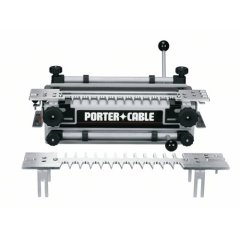
The Porter-Cable 4212 is a solid, mid-level dovetail jig. It makes excellent joints, but only the standard evenly-spaced variety. The more expensive brands with adjustable fingers will make random joints that look hand-made (sort of). They will also allow for different spacing for drawer fronts and rears, a common design.
The PC is solid and well-made, far more substantial and better designed than the budget models I have seen and used. The price is fair for what you get.
Some reviewers have complained about less than perfect components. All tools made for the garage workshop must be adjusted, checked, rechecked and sometimes tweaked. If you are going to do nice work on a semblance of a budget, you just have to "tune" all of your tools.
The manual really is not very good. The photos are murky and don't show the details they are supposed to. Simple line drawings would have been better. The text is all over the place and topics appear to be randomly placed on the pages. The Super Collider manual is probably easier to figure out.
I do not like the proprietary router bits. That is not doing the consumer any favors. Amazon does not even sell them. Check with Google to see how far away these thing are. I had to drive 20 miles to a specialty woodworking place to get one, and paid dearly for it.
This jig has no dust collection system. Expect a shop full of dust. You will be absolutely covered in dust and chips. You will have to wear real eye protection, the best mask possible and ear protection. This is all uncomfortable stuff. We all hate it, but you will be sorry, or worse, if you don't. You might as well go out and get the best and most comfortable protection possible or you will just be miserable.
Things that may help you work with this jig (and maybe others):
1. Making dovetails is an extremely precise endeavor, perhaps the most close-tolerance thing you will do in making furniture and such. You have to measure and re-measure, work slowly and recheck every setting at regular intervals. One change in the way the boards are clamped in or the adjustment of the router leads to disaster. The manual even says that a one degree deviation from square will ruin things.
2. Practice on scrap wood of the same exact thickness as your final project.
3. It does not hurt to mill up a couple of extra boards in case you screw up and have to re-do something.
4. Fluted dovetail bits, not the straight ones, act like wedges and tend to pull down and out of the router, or put a strain on the depth adjustment. You have to really crank down on the clamping nut. And it may still pull out.
5. You will have less of this pulling if the bit is sharp. Get it over with and buy spares. Figure at least one dovetail bit per 10 or more ply drawer sets. This is not an inexpensive hobby or job, so don't try to save $25 by using dull bits. New, sharp bits are a requirement for doing this properly!
6. To make sure your bit depth is constant for the entire project, score a line with the dovetail bit the whole width of the drawer side before you plunge it into the slots to actually cut out the slots. This acts like a reference line that allows you to see if the bit is getting out of adjustment so you can stop before any big damage is done. You have to actually see this, so you have to kneel down to eye level. This makes the eye protection mentioned above all the more important.
7. Putting a little silicon spray on a rag and wiping the top guide and the router base will make it easier to slide around. Don't get any silicon on the wood, hence the rag and not a direct spray. The plastic router base does not slide on the aluminum very well.
8. Try, try, try to not use plywood. Routing dovetails in plywood is not a fun or satisfying experience. It is a nasty splintery product that is simply not suitable for this at all. I bought some "drawer grade" ply that had a reasonably attractive finish. I found that even this "specialized" product was awful stuff, almost impossible to use. The veneer was actually thinner than paper, amazing that this is possible.
I guess I won't get an invite to the Plywood Cartel Association Gala Ball, but this is a product that is best used for structural sheathing and boarding up vacant buildings.
Try to use actual wood. It isn't all that hard to get boards down to a half-inch, it looks better and it is a far more satisfying experience. You don't have to hide the edges, either, so you save that time. The bits last far longer, too.
Lastly, think about not using a jig at all. The occasional small drawer project can be done by hand just as well. All you need is a chisel and a dovetail saw. And, as your mother will tell you, it is good for you.
I'll bet those old cabinet makers could chop out a drawer or three in less time than it takes to set up, test and then finally turn out machined joints. The couple of old dressers I have use clearly hand-made dovetail joints. They used hand-made dovetails on an assembly line when machine tools were readily available. It was probably faster. Today, they would use a computer-controlled mill to make them and they would be absolutely perfect.
Interestingly, the quality of the joints is less than what many people would expect. They clearly were done quickly. They are a fine way to hold things together for a few hundred years, but would never make it to the cover of a woodworker magazine. So, think about the need for absolute and total perfection on some of your projects.
So, I recommend a jig only if you are going to make an entire set of kitchen drawers, or more.
Even then, look into the excellent modern manufactured metal drawer systems by Blum and others. You just add simple wood, or other material, rectangles and get options like full-extension, soft-close sliders as well. This is a super high-end way to go and will that cost you more than buying jigs, routers, real wood, nice sliders, etc?
Also, there are custom, pre-made drawers available through catalogues. Their dovetails are obviously made with expensive machinery and are perfect. Again, this may be cheaper and better. You can add your own fronts and concentrate your efforts on what shows.
This review began with the allure of dovetail joints. I snuck into a high-end, appointment-only cabinet "studio" and played with all the drawers. Not a dovetail in sight. Is this the end of them, or is it an opportunity to make stuff that is more distinctive that what even rich people enjoy in their $200K designer kitchens?
I went the dovetail route for my kitchen re-do, even made ply look good (I have impressive hacking skills thanks to having terrible or no tools for most of my life). If someone opens a drawer they will see dovetails and the too-expensive sliders will ease it back with impressive precision. The 4212 is about the least expensive way to do this with about about as much ease as a garage-shop woodworker can expect. |