
"Masterpiece" | 2008-08-27 |
| - Reviewed By nativeroses |
| i was one of the few among my peers who had never read one of the Maus books. When i finally got around to it, i was blown away by its excellence. This is a masterpiece (and i do not use the term lightly). Do yourself a favor and don't miss it. |
| |
"Interesting" | 2008-07-29 |
| - Reviewed By User: A3SJBGPUAXIXP |
I must say that I find this work hard to properly describe in terms of how I feel about it. I think that it was a fascinating look at one man's experience in the Holocaust, but an equally important aspect is Art's interaction with his father during their conversations. This seems like an honest portrayal, especially since Art isn't afraid to include things that may make him look bad (he isn't always the most sympathetic son). I think connecting the story of what happened then, and how it's effects are apparent for the rest of a person's life (although different people reacted in different ways) is interesting. The way this is written is especially effective, because it truly feels like Vladek is telling you his story first hand. As for the artwork, although it isn't my favorite style, it seems to fit for this story. The simple, unpolished look is compatible with this story which is honest and raw. Finally, I would like to add that the second installment of this comic is darker, and more depressing and sad at times, but once you read Maus I, you must (and will want to) read Maus II in order to feel any closure with the story. |
| |
"Masterpiece!" | 2008-07-17 |
| - Reviewed By User: ARWZ4H1UB0FC8 |
As a Jew Living in Israel, holocaust related books are important to read, but it's hard to do it actually. I can remember several holocaust-era semi-biographic novels which are great but those are the exceptions. Most of the books are a bit bothersome though true. Maus just captured me.I consider it one of the best books I've ever read in my life. It was just breath-taking, adding to that the fact that this was my first graphic novel ever, not to say first comic ever. I gave it to my wife, her parents, brother and so on. The book came back to me after 6 month. all worn out. The book touched me in the deepest levels, and was able to do what many other holocaust books tried to do and failed. Take you inside one of the the darkest eras of human kind. You NEED to read to. You have to read it. |
| |
"Poignant" | 2008-06-04 |
| - Reviewed By tapestry100 |
Maus, A Survivor's Tale is a son's pictorial version of his father's story of survival during WWII.
Both haunting and mesmerizing, sometimes funny and touching, this is a story of perseverance and about what the Jews had to suffer through at the hands of the Nazis in WWII Poland. Spiegleman never sugar-coats what his father had to endure in order to keep he and his wife alive. A true work of art. |
| |
"Personlizing the Holocaust" | 2008-04-21 |
| - Reviewed By tlangholff |
| One (two actually since there are two volumes) of the best submissions about the Holocaust which is designed to reach a broad audience. Maus and Maus II are written in the vernacular, personalizing the experiences of a camp survivor who is interviewed by his son. Excellent supplement to any Holocaust discussion. |
| |
"Borders in store buy 4 get on free offer" | 2008-01-26 |
| - Reviewed By slgoulden |
| When I included this and Perseplos & Maus 2 I was informed that they are not graphic novels and that I could not have one free. AMAZING! Of course after I asked for the distric manager's name/number there was a sudden change of heart BUT NOT a good instore experience from BORDERS at ALL. The GRAPHIC NOVEL is great. Borders are not. |
| |
"The true story of the holocaust" | 2008-01-13 |
| - Reviewed By User: A2IB5BBN79MS0S |
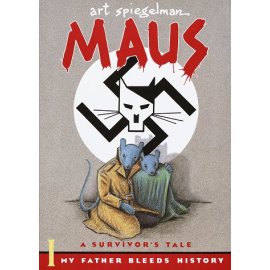
This book is a survivors tale of being a Jew in Nazi Germany. The author tells his father's memories of the horrors of the holocaust. It is written in the form of a comic book. The author uses a metaphor for the people in WW2. The Jews are mice and the Germans are cats. The book talks about the author's father being a succesful person and then being captured by the Germans and finally freed from his POW camp, but forced to live in the Ghettos and hide from the Nazis who want to send them to Austwitch. The book leaves off as he is being shipped to Austwitch (a Nazi Concentation/death Camp). This is one of the best books I've read about the Jewish experience in Nazi Germany. It's easy to read and surprisingly informative. I would most defenintely recommend this book for someone else to read. |
| |
"surprise" | 2007-12-17 |
| - Reviewed By mjb5178 |
| This graphic novel in no way cheapens the magnitude of it's subject. Metaphors are rich and overall a solid read. |
| |
"Amazing" | 2007-12-02 |
| - Reviewed By ryner12 |
| In Maus, Art Spiegelman illustrates his father Vladek's story -- of growing up as a Jew in Poland, persecuted and eventually captured and sent to Auschwitz during WWII. While portraying tragedy, Maus manages to have a certain amount of beauty and humor, due partly to the various types of characters being rendered as different animals (e.g. Jews are drawn as mice, Germans as cats, Poles as pigs, etc.). Whenever Vladek and his wife attempt to pass as Poles, they are charmingly drawn wearing pig masks. The scenes portraying Art's relationship with his father are touching and feel very authentic. I'm looking forward to reading Maus II. |
| |
"Maus: Explores the ineffable with creativity and ease" | 2007-09-18 |
| - Reviewed By cei1030 |
The book is adumbrated in the form of a graphic novel, giving a seemingly new perspective on the holocaust. The issue itself is nothing spectactularly new, although it approaches the holocaust in such a way that the most acerbic of events are bearable. Most simply stated, the visual aid that accompanies the text allows for the reader to fully understand the author's stance, or viewpoint on the touchy issues of the holocaust. One does not need to have any sort of historical acumen, to grasp the concepts and ideas of the story. The facade, of animals, instead of humans, used by the author also makes the events seem a little less human. However, throughout the novel, the thought doesn't escape your mind, that this was actually happening, to real people. The reader is also easily captivated by the father-son presentation of the story, as Art (the author), interviews his father. With nothing but acrimony polluting the stories told by his father, a bond is formed between the reader, Art, and his father, as you must approbate anyone who braves these hardships, more specifically, the characters. Overall, this story makes something new, that has been done so many times. It entertains, as well as informs. However, it isn't something I'd recommend for casual reading, as time must be set aside to truly appreciate the events in this book. |
| |