
"Graphic literature at its best" | 2008-10-08 |
| - Reviewed By User: A2FHVIV0XN60ML |
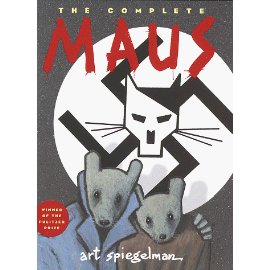
| The Complete Maus: A Survivor's Tale collects both volumes of Art Spiegelman's Pulitzer Prize winning graphic novel. The complete collection is how the book called the "first masterpiece in comic book history" is meant to be appreciated. A haunting piece of work, this story is part autobiography, part family history, and part personal and historical reflection on the Holocaust. This tale relates the effect the Holocaust had on the persons who survived it as well as their descendants.br /br /Maus tells the story of Vladek Spiegelman, the author's father, who survived the Holocaust in Poland and how his son, the cartoonist, comes to terms with his father and his tale. This is a paramount example of how the graphic form can be used more effectively to accessibly capture a horrific story. In Maus, the various persons and groups are drawn as anthropomorphic animals (the Jews are mice, the Nazi's cats, etc.) which gives the story an almost fairy tale quality, but by no means detracts from the story's haunting poignance. In some ways, the fairy tale is more painful in the fact that it all really did happen. Vladek's tale of survival, told slowly over the course of the almost 300 page novel, is layered with the author's own story of father as he knew him and his own personal feelings of guilt. Despite the use of animals as characters, the human qualities of these characters shines through and creates a tale that will linger with you long after you've finished the last page.br /br /If you have never read a graphic novel, dismissing them as "comic book stories for kids," you owe it to yourself to read this book and to see the scope of what graphic fiction is able to accomplish. Likewise, if you are a fan of graphic novels, you owe it to yourself to read this book as it remains one of the greatest graphic novels of all time. |
| |
"Yes." | 2008-09-07 |
| - Reviewed By queenmeowth |
| I went to a exhibition on the history of comics a couple of years ago. They had all kinds, from Little Nemo to Jack Kirby, and many things in between. One of the things featured was several pages from Art Speigelman's Maus. I was so intrigued by what I saw that I had to buy it off Amazon, and I have not regretted it. Don't be fooled by Speigelman's seemingly simplistic black and white work. His storytelling is powerful stuff, I tell you. |
| |
"For any who doubt what graphic fiction can do, this is the revelation." | 2008-08-23 |
| - Reviewed By User: A73QPH7NGI0DJ |
The Holocaust hangs over western society in the second half of the twentieth century. One man said that poetry was impossible after Auschwitz, but great artists in numerous mediums have dedicated themselves ot proving this wrong. The great crime has provided a great canvas for stories of humanity in the face of evil, such as Steven Spielberg's film "Schindler's List". "Maus" is the comics world's prime entry in this difficult field of literature. Writer and artist Art Spiegelman brings us the story of his father (and mother, by times), two Polish Jews who narrowly survived the war. Having already chosen to tell his story in the form of a comic, a medium often looked down upon as inherently childish by those who don't know any better, he further chooses to cast his characters as anthropomorphic animal, in the manner of an animal fable.
This choice has attracted some controversy (on display in many of the reviews on this site), in some cases because they believe it trivializes the subject-matter (to which I would say "Animal Farm"), or, more commonly, because they take issue with the seeming racialist use of different animals for different nationalities (Jews are mice, regardless of nationality, other Poles are pigs; Germans cats, the French frogs, Americans dogs, etc.). Spiegelman actually discusses the implications of the latter thing within the narrative, which includes an extensive b-story set in the then-present (from the 70s to the 80s), following Art, his wife Francoise, and his elderly father as Art writes "Maus". Francoise is a French Christian who converted to Judaism, and wonders what animal she should be cast as (he chooses a mouse, for the record). Spiegelman never casts all of one group as behaving the same way.
"Maus" reminds me a bit of Paul Verhoeven's "Black Book" in its depiction of wartime Europe's complexity, including the now-uncomfortable degree of collaboration or prejudice found in the occupied countries. Vladek and Anja encounter everything but solidarity with their fellow Poles on the journey through the war; fellow Jews rat them out to the Nazis, others require payment to help Jews avoid death, something that Art expresses amazement at, but Vladek seems to see as very reasonable. Spiegelman doesn't paint his father as a saint, indeed, expressing concern that his father comes across as a stereotypical miserly Jew; at one point, Vladek is shown to be strongly racist against blacks, again to Art and Francoise's amazement. The animal characterizations are never binding; for all Spiegelman's concern over France's history of anti-Semitism, the one French frog we see is an amiable fellow-inimate of Vladek's; even among the German cats we find a Polish Jew married to a German woman, the product of this union being peculiar cat/mouse hybrids.
"Maus" is ultimately a very affecting, personal work from Art Spiegelman, and does a fantastic job of communicating the life story of his father. it is a shining example of what the graphic novel form is capable of achieving. |
| |
"Brilliant" | 2008-08-21 |
| - Reviewed By User: A30149HB0ZCS5C |
Not to sound too cliche, but there really is no other way to describe Maus and brilliant. Using the medium of comic strips (often regarded as childish and immature) to tell a real life, adult tragedy impacts the reader in a different way from if it was just in print.
Do not dismiss this book as irrelevant because of the panels with pictures in them. A must read. However, I wouldn't recommend young children to read this very adult themed novel. Wait until they are a little older so they can fully (or even partially) understand the beauty and tragedy presented. |
| |
"Important Educational Information with Range, Good Creativity and Comic-Style Art" | 2008-07-16 |
| - Reviewed By bargain_deals |
Although I am not Jewish I feel the same as the Jews that Holocaust books MUST be read. I was horrified to learn recently that a 37-year-old cousin did not know what a fascist was. This is NOT okay. Already thing are happening in the U.S. that mirror what happened in Germany before World War II, but that is not what you will find in this book.
What you will find in this book is the story from one man's experience and memory. It is both touchingly and brutally honest, written by the son of Holocaust survivors -- the story told to him only by his father.
Spiegelman's use of the comic media to draw Jews as mice, Nazis as cats, Poles as Pigs, French as Frogs, Americans as Dogs and the Swiss as Elk was ingenious. There are some VERY disturbing things that happen in this story which come as no surprise to those who have read other books on the Holocaust, and which make it so difficult to read more on the subject. Somehow reading about it through the comic medium creates an artificial distance from the topic that makes it easier to bear.
I read the whole thing in one day -- would have taken longer if I did not dedicate myself to reading the entire day, but still, that is not bad. It was "just right." I also found the depictions of some of his father's neuroses depicted as very interesting. He sure hated to spend money, but no matter how much money he had you just can't blame him when you see what he has gone through.
Good book. I would recommend this book for ages 12 and up. |
| |
"Masterpiece!" | 2008-07-04 |
| - Reviewed By User: ARWZ4H1UB0FC8 |
As a Jew Living in Israel, holocaust related books are important to read, but it's hard to do it actually. I can remember several holocaust-era semi-biographic novels which are great but those are the exceptions. Most of the books are a bit bothersome though true. Maus just captured me.I consider it one of the best books I've ever read in my life. It was just breath-taking, adding to that the fact that this was my first graphic novel ever, not to say first comic ever. I gave it to my wife, her parents, brother and so on. The book came back to me after 6 month. all worn out. The book touched me in the deepest levels, and was able to do what many other holocaust books tried to do and failed. Take you inside one of the the darkest eras of human kind. You NEED to read to. You have to read it. |
| |
"A stunning testament to survival, forgiveness, and the human spirit" | 2008-06-17 |
| - Reviewed By User: A3LU1MYWEA1S2L |
| Putting something as unbelievably tragic and indescribable as the Holocaust into comic book form with the Jews portrayed as mice and the Nazis as cats sounds as kitschy as it gets and even a little insulting. But Art Spiegelman manages to pull it off. The Nazi's labelling of Jews as "vermin" puts the allegory on a new level with each nationality represented by a different animal. The story is incredibly personal weaving in and out of WWII Poland and the author struggling with his irritable father in 1980s America. It also dabbles in the metafictional, referencing other comics Spiegelman has done, his mother's suicide, and his own disbelief that writing about the Holocaust will change anything, especially after so many books and films have already addressed the subject. Don't be fooled by the comic appearance. Spiegelman takes the graphic novel into new territory with "Maus." Whether or not you read comics, this is a stunning testament to survival, forgiveness, and the human spirit. |
| |
"Maus I and II" | 2008-06-02 |
| - Reviewed By katja2644 |
| This set of books was a read for our book club. It is a poignant, revealing look at the holocaust. Spiegelman maintains the respect that is due when discussing the holocaust and it's many victims; while still conveying a very personal story. It amazed me how graphic and detailed the story could be told through the use of characters/animals. You would think there would be a certain detachment when using animals to portray humans, when in fact it was a very poignant, personal, private story of survival. The story makes you re-think your views on survival, and what it really means to survive. I highly recommend this set of books. |
| |
"A masterpiece" | 2008-05-10 |
| - Reviewed By User: A1J97BH3SL54VP |
| Elegant and bittersweet. Humorous and horrifying. Astonishing original and intuitive. The author poured his soul and marrow into interpreting the nightmare his parents endured and survived, showing also that that the genocide of WWII continued its reach far past 1945. |
| |
"A landmark work in many ways" | 2008-05-03 |
| - Reviewed By rolandgarton |
Schools are beginning to assign this work as serious literature worthy of serious study, which it is. The "comic book" approach is highly accessible, yet retains a great deal of subtlety and nuance in illustrating (literally and figuratively) the far-reach psychological impacts wrought by the holocaust.
The book has also advanced the state of comic books from the status of children's pap toward a medium with power and artistic merit for all ages. |
| |