

"We Want More Ike" | 2008-07-19 |
| - Reviewed By burmadom04 |
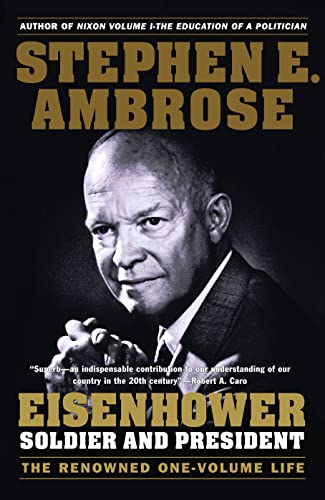
This is a great biography on an underrated president, and a very easy read. Ambrose is wonderful in being able to pick out the key incidents and describe the Ike's policies without delving into the everyday details that bog down Robert Caro's biographies. Also, while Ambrose doesn't hide his admiration for Ike, he does reflect critically upon his subject, particularly his slow reaction to civil rights and McCarthy, and his inability to stem the arms race.
Part of Ike's genius was projecting a reassuring calm, while acting to keep all of his options open. For example, he never ruled out using atomic weapons against China in the Korean War or Quemoy Island dispute, but because he kept this option open the Chinese backed down. He was tough, but always left a way out for opponents to back down and save face. Some have wondered whether he truly ranks as a great president because he had no major crisis to face, but I believe Ambrose is right when he says preventing war and managing crises well is perhaps an even greater achievement. I have read many presidential biographies, but have rarely felt that any other president matches the maturity and self-confidence of Ike (George H.W. Bush is another president I think had Ike's maturity in managing the presidency). The difference between Ike in Ambrose's book and the childish pronouncements and discussions of the current Bush administration is startling.
Having said that, I would have been interested in a bit of a longer biography, particularly more details on Ike's use of the CIA in Iran (very relevant today). This has been a very controversial aspect of his presidency and seems somewhat out of character for someone who opposed Israel and Britain during the Suez Canal crisis. Also, we get very little of the cabinet, perhaps because Ike relied on them less than other presidents did - even John Foster Dulles is discussed only where necessary. Ike seems to largely have used his cabinet to give him information, not make decisions. (can you imagine a book about Johnson without a central role for McNamara or Nixon without Kissinger?)
Overall, this is a great book, and will hopeful get more Americans to ponder the presidency and whom we want to sit in the Oval Office. |
| |
"Thorough Biography of a General and a Statesman" | 2008-07-04 |
| - Reviewed By clay091270 |
This is a very good biography of one of our greatest generals and our 34th president. It begins with Dwight Eisenhower's upbringing in turn-of-the-century Kansas. Ike attended West Point, but did not see combat in World War I. His commanding officers in the Army during the interwar years saw that he had great talent, and Eisenhower was ultimately given command of the Allied forces in World War II. The sense of confidence and optimism that Ike was able to engender in those he commanded helped make D-Day a success.
After the war, he became president of Columbia University. He was elected president in 1952, and gained an armistice in the Korean War six months after he took office. While he was in the White House, Ike presided over many years of peace and prosperity, maintaining a growing economy while avoiding budget deficits and inflation. He instituted the Interstate Highway System, but did not act as strongly as he could have on civil rights. Ambrose believed that Eisenhower's caution was an asset in foreign policy but was problematic for his domestic policy.
The book relates that after he left the presidency, Eisenhower was hawkish on Vietnam and advised LBJ to be more aggressive in his attempts to win the war.
Ambrose made no secret of the fact that he was an Eisenhower admirer, but managed to cover pretty fairly both the strengths and weaknesses of Ike's service as general and president. Americans should be grateful for Eisenhower's hand in ending the sinister Nazi regime and for keeping America safe and prosperous during a decade, the Fifties, that was far more dangerous than most members of Generations X and Y realize. |
| |
"We like Ike!" | 2008-06-16 |
| - Reviewed By User: A18GLRANBT6S6G |
Unless John McCain wins in November, it will be too long before we have our next military hero turned president. They used to all be this way, especially following the Civil War---Democrat and Republican.
Not sure about those reviewers who deemed this a hagiogrpahy or the writing "pedestrian"; the book is thorough, balanced and erudite. I commend the late Mr. Ambrose for such a wonderful portrait of one of America's great leaders in the two most important places: the battlefields and the Oval Office. They surely don't make 'em like Ike anymore (Barack H. Obama?).
The book is long but not exhaustingly long, goes through his humble heartland childhood, early military life, wartime commands, presidency and beyond. Ambrose looks deep into Ike with letters and meetings never read or seen before. What more can one ask for, especially for me as a military historian? Even the descriptions of battles in WW2 are dead on.
I also admire Ambrose for dedicating this book "TO THE MEN OF D-DAY." Again, if even a professor alive today could scribe so eloquently, these losers would be more likely to dedicate a book to Malcolm X or some Hollywood leftist who fought for "the rights of the oppressed." No respect for America or the military, but I digress...
Read the book. It's objective, analytical and important. I will pass it on to my friends and family, so they can better understand our world and thus make the correct judgments and decisions down the road.
Some Americans like to forget history. Shame on them. As Peggy Noonan said of Sen. Obama recently:
America is Mr. Obama's problem. He has been tagged as a snooty lefty, as the glamorous, ambivalent candidate from Men's Vogue, the candidate who loves America because of the great progress it has made in terms of racial fairness. Fine, good. But has he ever gotten misty-eyed over . . . the Wright Brothers and what kind of country allowed them to go off on their own and change everything? How about D-Day, or George Washington, or Henry Ford, or the losers and brigands who flocked to Sutter's Mill, who pushed their way west because there was gold in them thar hills? There's gold in that history.
|
| |
"A great work" | 2007-12-10 |
| - Reviewed By User: A14EVLEXI93VZ |
Informative and easy to read.
He looks at the subject from many angles and delivers a complete picture of the realities in IKE's world. I personally learned a lot not only about Eisenhower but about WWII, about the times at which he served and about the Cold War. A great book. |
| |
"A Fine, One Volume Biography" | 2007-12-05 |
| - Reviewed By santhonyatwindstreamdotnet |
Stephen Ambrose is certainly among the finest contemporary historians in print. And while he has authored several very good biographies, in my opinion, his best work has been chronicling historic events as opposed to the lives of the participants. His works on the Lewis and Clark expedition and the construction of the transcontinental railroad far surpass any of his biographies. Perhaps this is merely coincidence, though there is certainly a difference in each endeavor.
This particular work is a condensation of an earlier two volume effort. In that respect, it is perfectly adequate and probably more enjoyable than the longer and more detailed work. I can't imagine anything that was not included that I would need to know.
Ambrose is certainly an Eisenhower fan, however this does not prevent him from clearly pointing out many of his mistakes and errors, both in the context of his life as Army general and as President. But, while he points out these instances, and many are quite glaring, he nevertheless, unhesitantly, seems to give him an over all pass.
Leadership is a word used quite often by Ambrose in describing Eisenhower. However, in many instances, it is not leadership, but effective administration that proved to be his strongest suit. His ability to serve effectively as Supreme Allied Commander in Europe was more a reflection of his ability to compromise and placate the many different factions involved than it was an indication of leadership, though leadership was certainly involved.
This differentiation became more stark when Eisenhower became President. Leadership becomes more difficult when the followers aren't required by law and army regulations to comply. As President, Eisenhower many times not only failed to display leadership, he quite clearly abrogated responsibility entirely.
In my opinion, Eisenhower's most lasting legacy was steering the country through some of the most turbulent periods of the Cold War without ever having to resort to military power. This at a time when many, if not most, of his advisors were counseling nuclear attack!
It was in the area of civil rights, however, that Ike was most suspect. I try to be very careful in judging historical personages by current standards. To do so is usually unfair. In this case, however, at a time when very many political and social contemporaries were taking stands, Eisenhower disappeared. A case can be made for finessing the issue during the 1956 Presidential campaign, but his failure to "lead" thereafter can only be a tacit endorsement of segregation. Instead of "leading", Eisenhower tried to compromise and bring the parties together, using the same methods that had worked for him in Europe. This was not "leadership", it was abrogation of responsibility.
Perhaps the most distasteful areas of he book are those that attempt to whitewash Eisenhower's relationship with his Army secretary Kay Sommersby. No intelligent human being can doubt that Eisenhower had a sexual relationship with Sommersby, however Ambrose goes through great pains and historical gymnastics to argue that though Ike was infatuated with Sommersby, had multiple opportunities to pursue her sexually, that she was undoubtedly willing and that all the officers around him were conducting extra marital affairs, Ike was innocent of adultery. One of his most laughable assertions was that he simply didn't have time or opportunity to have sex with Sommersby. Shortly thereafter, he documents a train trip to a Mediterranian resort on which Sommersby and several other "army girlfriends" accompanied the staff. At one point, he cites as proof, the fact that he attempted intercourse, but was "flaccid". Please. Simply acknowledge the fact and move on. I don't think any less of Ike's achievements because he had a girlfriend while at war. Ambrose seems to believe that doing so would somehow diminish him in the eyes of many, when instead it would more likely paint him as more human and subject to the same desires and faults as everyone else. I suspect very few will swallow Ambrose's assertions in this area.
Nevertheless, if you're interested in a comprehensive biography on Eisenhower, this is a very good place to go for it. |
| |
"excellent" | 2007-09-27 |
| - Reviewed By User: A3NFG00ELQ11AB |
| Excellent account of Eisenhower's life. Very easy to read. Didn't wnt to put it down. |
| |
"Eisenhower - From Beginning to End" | 2007-05-26 |
| - Reviewed By streetcop |
I was 9 years old when "IKE" was elected to the highest office of our land. At that age all I knew was "IKE" was the hero of WWII and collected his campaign buttons, which I wish I still had. At 63 I saw Mr. Ambrose's book and thought it time to acquaint myself with the man who had been my President through my formative years. "I was not disappointed." Mr. Ambrose, though being very pro-Eisenhower, had a handle on the soldier and statesman. There were things that "IKE" did, according to Ambrose, that I didn't agree with but that no less was his decsions. Living in the 50's and during "IKE'S" tenure, I was no worse for the wear. The biography gave me a better insight into those years. It was my conclusion that Eisenhower did more to keep this counrty solvent and from war, which cannot be said of most of his sucessors. Excellent read from page one to the last page..... |
| |
"Ike, Ike, Baby" | 2007-05-25 |
| - Reviewed By nicksarantakes |
When Dwight David Eisenhower left the presidency he was one the few men to leave more popular than when he entered, but most observes believed that he had abdicated nearly all his duties to his subordinates. Since then things have changed. With access to the declassified papers of the Eisenhower Presidential Library, historians now see Ike as a man in control of the decision making process, delegating only the implementation of his policies. The dean of these revisionist historians was the late Stephen E. Ambrose. A military historian and a former editor of "The Papers of Dwight David Eisenhower" who was recruited to this project by the former President himself, Ambrose was well-qualified to write this study.
Ambrose originally wrote a two-volume account that was published in the early 1980s to a good deal of public acclaim. This one volume work is a condensed version. Despite suffering some controversy towards the end of his life over his slipshod citations methods (a long-time characteristic of his work), Ambrose has produced an important and original work of history. Although new work in the field has dated potions of this book (Carlo D'Este's military biography, which concludes with the end of World War II, is better and more detailed on the first half of Ike's life) this book is still the best single volume biography on Eisenhower.
In the presidential years it is no surprise that Ambrose concentrates on world affairs. Ending the Korean war was the first foreign policy issue that Ike had to address. Despite the unsatisfactory end of this conflict, many American leaders still favored the use of military force in other hot spots. Each time a crisis broke out, be it Dien Bien Phu, the repeated incidents in the Strait of Taiwan, or Berlin, Eisenhower opted for a peaceful resolution. Ambrose gives him good grades for his sound judgment but also for keeping his diplomatic options open during these tense moments.
The civil-military relationship is another area where Ambrose gives Eisenhower a positive assessment. The President was reluctant to approve massive new arms appropriation programs, fearing the damage deficit financing would due to the economy. He also worried that a huge military-industrial complex would turn the United States into a police state. If that happened it would not really matter who won the Cold War. In order to achieve the proper balance between ends and means, Eisenhower came to depend on nuclear weapons, getting "more bang for the buck." Depending on nukes resulted in his administration favoring the Air Force, which led to stringent criticisms from the other services. Ike ended up firing Matthew Ridgway as Army Chief of Staff. Another Chief-of-Staff Maxwell Taylor wrote a critical book about Eisenhower's defense policy after he retired. Civil-military relations were actually quite polarized in the 1950s and I think Ambrose is wrong in giving Eisenhower good marks on this topic.
Domestic politics was an issue Eisenhower had to address one way or another and Ambrose covers this topic as well. In these matters, he tends to be more critical of his subject. At a conference I attended, I saw Ambrose discuss his writing. He said he "loved" Eisenhower and knew that he had to be critical of him in some area for anyone to take his book seriously. That criticism comes mainly in the area of civil rights. The President met with black leaders only once during this eight years in office. He never understood the desires of black Americans for full access to the privileges of citizenship and sympathized more with white southerners. Still, he did his job and finished desegregating the military, signed the first civil rights bill since reconstruction, and enforced a court order to integrate Central High School in Little Rock, Arkansas. Ambrose, though, is right when he argues that Eisenhower could have done more if he had wanted to do more.
Economics receives little attention in this book, even though Ambrose approves of what Eisenhower did. The American economy grew and Ambrose believes it was because Ike kept the budget balanced. In the end, Eisenhower gave the people what they wanted: peace and prosperity. Something they had not had since 1929. Given the importance of economics to Ike's success--the absence of an in-depth study is serious weakness.
Ambrose's admiration of Eisenhower is readily apparent and sometimes gets in the way. His biography of Richard Nixon is better, because Ambrose did not like his subject and that forced him to concentrate on his professional objectivity.
These issues aside, this biography is a wonderful study of Eisenhower. Ambrose says we were "damned luck to have him." Indeed, we were.
|
| |
"The Best on Eisenhower" | 2006-11-03 |
| - Reviewed By chickadeewood |
| The 1950's were definitely NOT boring. Read EISENHOWER and see what they were all about. Ambrose writes beautifully. FIRST RATE! |
| |
"Somewhat lacking in what made Eisenhower so great" | 2006-01-02 |
| - Reviewed By illini012 |
If you are looking for a biography which describes a development of a great individual, this book leaves a lot wanting. For example, only about 10 pages are dedicated to Eisenhower's all important West Point years. His years at West Point were extraordinarily dear and important to his development, as indicated by his desire to be buried at West Point. What made Eisenhower such an extraordinary General and President despite not having extraordinary intelligence and talent? I do not think the book answers this question clearly.
The book, however, is comprehensive. His important relationships with key individuals in his life are well contemplated and analyzed. Finally, Stephen Ambrose is a fluid writer and reading this book was a pleasant experience. Overall, this is worthwhile book if you want to know most things about Eisenhower. Just don't think it will allow you to have an intimate understanding of the development of an extraordinary individual. |
| |