

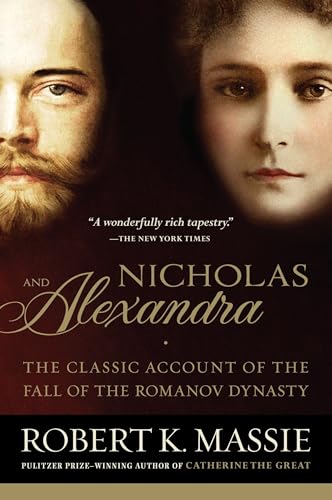
Nicholas and Alexandra
Nicholas and Alexandra

Manufacturer:
Ballantine Books

UPC:
978034543831

Retail Price:
$18.95

#Deals:

Avg. Rating:

Available from 7 stores
Click any of the offers below to purchase and view accessories on the merchant's website.
StoreRatingBase PriceShipping Your PriceAvailabilityBuy Link
caimanoutlet
[Store Info & Reviews]
Covered by A-Z Guarantee
5 Star Rating
302 Reviews
$10.80
New
$3.99
Expedited Shipping Available Expedited Available
$14.79 In Stock. Usually ships in 1-2 business days
1 Available
Brand new book, all days low price !
Buy from caimanoutlet
from caimanoutlet
Buy it now
[Store Info & Reviews]
Covered by A-Z Guarantee
GoSale Trusted Store$12.89
New
$3.99
Expedited Shipping Available Expedited Available
International Shipping Available International Available
$16.88 In Stock. Usually ships in 24 hours Buy from Amazon.com
from Amazon.com
Fantastic_Shopping
[Store Info & Reviews]
Covered by A-Z Guarantee
5 Star Rating
464 Reviews
$11.88
New
$3.99 $15.87 In Stock. Usually ships in 1-2 business days
500 Available
Absolutely brand new & in stock. 100% 30-day money back. direct from our warehouse. ships by usps. 1+ million customers served-in business since 1986. happy customers is our #1 goal. toll free support
Buy from Fantastic_Shopping
from Fantastic_Shopping
A1Books
[Store Info & Reviews]
Covered by A-Z Guarantee
5 Star Rating
881 Reviews
$10.81
New
$3.99 $14.80 In Stock. Usually ships in 1-2 business days
50 Available
Brand new item. over 4 million customers served. order now. selling online since 1995. order with confidence. code: b20090105231050t
Buy from A1Books
from A1Books
Indoo New
[Store Info & Reviews]
Covered by A-Z Guarantee
4 Star Rating
583 Reviews
$12.29
New
$3.99 $16.28 In Stock. Usually ships in 1-2 business days
50 Available
Brand new
Buy from Indoo New
from Indoo New
SuperBookDeals.com
[Store Info & Reviews]
Covered by A-Z Guarantee
4 Star Rating
500 Reviews
$11.86
New
$3.99 $15.85 In Stock. Usually ships in 1-2 business days
Brand new, perfect condition, please allow 4-14 business days for delivery. 100% money back guarantee, over 1,000,000 customers served.
Buy from SuperBookDeals.com
from SuperBookDeals.com
TheBookRackRH
[Store Info & Reviews]
Covered by A-Z Guarantee
5 Star Rating
455 Reviews
$11.85
New
See Site See Site In Stock. Usually ships in 1-2 business days
30 Available
Buy from TheBookRackRH
from TheBookRackRH
* Shipping estimates are based on Ground shipment within the continental U.S.
   To report a pricing error or problem, Click Here.
Overview of current deals for the Nicholas and Alexandra:
  • 1 merchant offers International Shipping.
  • 2 merchants have Express Shipping options.

Product Specifications
Product NameNicholas and Alexandra
ManufacturerBallantine Books
Product Number MPN0345438310
Retail Price $18.95
EAN-1409780345438317
UPC978034543831
Specifications 
TitleNicholas and Alexandra
ISBN0345438310
Author(s)Robert K. Massie
Release Date2000-02-01
FormatPaperback
Num of Pages640
Num. of Items1
EAN9780345438317
Weight0.5 lbs.

Tags

Find other products that have similar tags to the Nicholas and Alexandra
History Historical - General Biography & Autobiography Biography / Autobiography Europe - Russia & the Former Soviet Union Nicholas Political royalty Russia - History 1868-1918 Alexandra II Emperor of Russia
Similar Products
The 48 Laws of PowerThe 48 Laws of Power18.00$10.18Check Prices on The 48 Laws of Power
at 6 stores
Maus a Survivors Tale: My Father Bleeds HistoryMaus a Survivors Tale: My Father Bleeds History14.00$8.42Check Prices on Maus a Survivors Tale: My Father Bleeds History
at 10 stores
Georgiana : Duchess of Devonshire (Modern Library (Paperback))Georgiana : Duchess of Devonshire (Modern Library (Paperback))15.95$8.00Check Prices on Georgiana : Duchess of Devonshire (Modern Library (Paperback))
at 9 stores
Survival In AuschwitzSurvival In Auschwitz14.00$3.98Check Prices on Survival In Auschwitz
at 6 stores
Six Wives of Henry VIIISix Wives of Henry VIII15.00$10.14Check Prices on Six Wives of Henry VIII
at 8 stores
TrumanTruman22.00$7.65Check Prices on Truman
at 5 stores
No Ordinary Time: Franklin and Eleanor Roosevelt: The Home Front in World War IINo Ordinary Time: Franklin and Eleanor Roosevelt: The Home Front in World War II18.95$6.71Check Prices on No Ordinary Time: Franklin and Eleanor Roosevelt: The Home Front in World War II
at 8 stores
Anne Frank: The Diary of a Young GirlAnne Frank: The Diary of a Young Girl5.99$2.52Check Prices on Anne Frank: The Diary of a Young Girl
at 9 stores

Reviews
5 Star Rating  "A Transformative Reading Experience"2008-09-28
- Reviewed By jdcofield
I first read Nicholas and Alexandra many years ago as a 14 year old. It was a transformative experience for me, awakening what has been a lifelong passionate interest in royal biography and Russian history. Now that I'm in my early fifties, I recently reread Nicholas and Alexandra for the first time in about twenty years, and it continues to have the same magic. br /br /Robert K. Massie became interested in the last Tsar of Russia because he, like Nicholas, was the father of a hemophiliac boy. Massie spent long hours reading about hemophilia and famous hemophiliacs, and he was fascinated by the way Russian and world twentieth century history turned on a chance genetic defect. Had Tsarevich Alexis not had hemophilia, it is probable that Tsar Nicholas II and his wife Alexandra would not have come under the malign influence of Gregory Rasputin, the Siberian faith healer who had a catastrophic effect on the Russian government before and during World War I; leading to the Russian Revolution, the rise of Communism, and the deaths of Nicholas, Alexandra, and their children. Its an interesting thesis that still holds up well, though Massie's focus on the inner tragedy of the Tsar's family tends to make him discount the many other problems from which pre-revolutionary Russia suffered. Massie also has a natural tendency to whitewash Nicholas and Alexandra (parents of hemophiliacs have a special bond with those who share their trauma, after all), by barely mentioning such negative traits as the Tsar's anti-Semitism and the Empress' many neuroses.br /br /The book remains an extraordinary work of art. Massie's descriptions of the Russian landscape and his finely drawn character sketches are wonderfully rich and detailed. He is able to explain the political and social complexities of the era colorfully and wittily, even when dealing with such abstractions as the differences between Social Democrats, Social Revolutionaries, and Bolsheviks. Most of all, Massie is able to make us weep for the Romanovs: a man who was a bad Tsar but a good husband and father, a woman who destroyed her family while trying to keep her son alive, and five innocent young people who never had a chance to lead happy, productive lives. Every time I read Nicholas and Alexandra I tremble again at the thought of their last awful moments, but I am enriched still more by the chance to read such a magnificent work of art and scholarship.
 
5 Star Rating  "The Tragedy of The Twentieth Century"2008-08-07
- Reviewed By jeff_minde
In 2000, there was much talk about the "most important person of the 20th Century." My choice was always Gavrilo Princip, the young Bosnian assassin who killed Archduke Ferdinand of Austria-Hungary, igniting World War I, which caused the Russian Revolution, Communism, and the Treaty of Versailles, which led to Naziism, World War II, atomic bombs, and the Cold War.

Of course, there were other factors which formed the tragedy of the twentieth century, and perhaps some of these historical events would have happened anyway. Almost for certain, the Romanov Monarchy would have fallen or been transformed out of recognition without the help of Gavrilo Princip's bullets.

Although the Ottoman Empire was always referred to as "the sick man of Europe," Robert K. Massie illustrates that Russia was not very well either, despite appearances. An obsolescent autocracy, the Russian Empire was mired in time at the dawn of the twentieth century, the great mass of its people existing much as they had 100 years earlier.

Massie's theory, that the hemophilia of Alexis, the young Tsarevich, had an inordinate influence of Russian and subsequent world history, is well thought-out, though perhaps an oversimplification. Yet, it cannot be discounted. The Romanov Dynasty had ruled Russia then for 300 years, and brought the country, by fits and starts, slowly into the orbit of the modern world. Despite this, there is much truth in the observation that "Lenin inherited a nation playing beside a manure pile and Stalin bequeathed a nation playing with an atomic pile." This is not to defend Stalinism, but only to say how little the Romanovs did overall to modernize their State.

When Nicholas II inherited the throne after his father's untimely death, he was woefully unprepared to rule. Dominated for years by archconservative and anti-modernist members of his family, he did little to educate his people, provide health care, build infrastructure, or lift the heavy cloak of official repression that lay over all but ethnic Russians in his realm, or the cloak of cultural repression that lay over the ethnic Russians.

Yet Massie shows us a man and a family of uncommonly kind nature in Nicholas II and his family. His daughter Olga paid personally for the care of a handicapped subject she spied from her carriage one day. The Tsaritsa, Alexandra, despite a reputation as an uncaring woman, herself nursed sick friends before the war and horribly wounded soldiers during the war. The family built hospitals and schools in and around the various cities wherein lay the royal estates. They acted to ameliorate suffering wherever they saw it, without reservation.

Of course, this was the problem. They acted only on what they saw with their own eyes, never recognizing that these sufferings were endemic throughout the realm. Their myopia was part and parcel of the lives of the citified upper classes, completely divorced from the mass of agrarian peasants in the countryside, magnified by the hermetically sealed nature of being an Imperial Family, aided and abetted by sycophants and the self-serving, who kept the real world at a very long arm's length, in order to maintain their own privileged positions. Living in a bubble within a bubble, they were just not aware of conditions in most of Russia.

Nicholas II ruled over the largest domain on earth. Russia today is still the world's largest nation, even shorn of Finland, Poland, the Baltic States, Belarus, the Ukraine, the Central Asian provinces, and (in 1867) Alaska. Sunset in Vladivostok was dawn in Brest-Litovsk. His hundred million subjects included hundreds of peoples speaking hundreds of languages, linked together by a shockingly small road and rail system. The sensitive Nicholas, had he been really cognizant of the shape of things, could have, by a single order, vastly improved the lives of each and every Russian (of course, as he noted, being an autocrat and giving orders does not ensure that they are carried out properly). His greatest failings, as a ruler, all had to do with his decisions to outwardly maintain his Imperial hautre and his autocracy at all costs in the face of cataclysmic change.

This bubble-within-a-bubble existence however, could not spare them from the fact of the Tsarevich's hemophilia. A genetic disorder inherited through the female line (Alexis' Great-Grandmother was Queen Victoria, whose progeny were ravaged by the disease), it prevents the clotting of the blood. When Alexis was born in 1904, the world was a full lifespan away from the development of a usable clotting factor; most hemophiliacs simply bled out and died. The Tsarevich was protected by a full retinue, but this did not help him, and the boy was often in screaming agony and close to death from what might in another child, be a bad bruise. The Heir, therefore lived in a bubble within a bubble within a bubble.

The Tsaritsa, Alexandra, was a solemn, shy, but deeply emotional and loving woman, nicknamed "Sunny" by her husband. To the world, she presented an aloof exterior, and was extremely unpopular with her subjects. Had they known the sorrows and agonies she suffered through with Alexis, her realm, and history, might have treated her far better. But the Imperial Family decided to keep Alexis' condition a closely guarded secret, fearing the destabilization of the Monarchy and Russia in the face of a physically frail Heir. This may have been the Imperial Family's worst error, as it robbed them of an outpouring of sympathy and support from a passionate populace.

Alexandra turned to religion, and ultimately, to Gregory Rasputin, a filthy, degenerate, sexually perverse and personally dissolute monk of peasant extraction. Although derided by most, and called a charlatan by many, Rasputin was perhaps one of the most charismatic men in history, had a devoted following (largely comprised of Society women he'd seduced), did have the power, somehow, to control Alexis' bleeding episodes, and therefore, had the Empress's full and unwavering support in all things.

The feared and hated Rasputin may have indeed been a seer or had mystical powers of some sort, judging from circumstances. Rasputin was not really political, but as his influence over the Romanovs grew, his power expanded commensurately, and he was able to have Ministers dismissed, Generals reassigned to sinecures, and policies changed according to his own whims (expressed as messages from God) or concerns. Capable Russian leaders, who did not know the basis of Rasputin's power, suspected the worst of Alexandra, and in challenging Rasputin found themselves toppled from power. As World War I dawned, Russia was upside-down, its best men in internal exile, and woefully unprepared for war. Rasputin himself counseled against war, stating that Russia would collapse from within. Nonetheless, the British, German and Russian grandsons of Queen Victoria went to war.In that war, millions died, empires fell, nations were born, ideological political systems triumphed, and the stage was set for a darker and yet bloodier future.

The Tsar and his genteel family were consumed, ending their days against a wall before a Bolshevik firing squad, probably not understanding, until the end, that they had been in the eye of a hurricane that remade the world.
 
5 Star Rating  "best book on royal couple"2008-04-28
- Reviewed By User: A2Z5W10AO6P516
nicholas and alexandra should never had become czar and crazina of russia.nicholas was just to weak spirit and alexandra to strong without know the real russia people.she saw russian as childern who needed to be told how to run their lives by the papa czar.she hide her son illness and brought in a sexual twisted man of god into her family,ruin the romanov's relationship with it's people.stopping changes that would give citzen russian say in their country.in the end the people turn on the romanov's every thing end tragical.
 
5 Star Rating  "Among my Top 20 Books"2008-02-15
- Reviewed By dragonladyjan
I read this book many years ago and have never forgotten it, and I just recently purchased a copy of my own. Robert Massie is an excellent writer who makes this book memorable for the fun and loving family that the Romanovs were and their terrible, tragic end. I'm now collecting more books on the Romanov dynasty and the individual people who made up this fascinating family. For anyone with an interest, this is the place to start.
 
5 Star Rating  "Wonderful biography of the last of the Romanov dynasty"2008-01-22
- Reviewed By allie2026
Far and away one of the best biographies I have ever read. Massie masterfully gives life to the doomed, tragic last Russian Tsar, Nicholas II, and his family. I was absolutely rivetted from page one by this outstanding work. The book gives a sympathetic portrait of Tsar Nicholas, his wife Empress Alexandra, and their ongoing struggle to cope with their haemophiliac son, Alexei, heir to the Russian throne. Alexei's illness indirectly leads to the downfall of the Romanov dynasty and the family's murder. An astonishingly good read, and one I highly recommend to all who are interested in this era of history.
 
5 Star Rating  "Suicide of a Dynasty"2008-01-08
- Reviewed By User: A37FTN36O59QLO
Robert Massie's "Nicholas and Alexandra" is a biographical study centered on the lives of the last Tsar and Tsarina of Russia. Massie's portrayal of the last ruling Romanavs is like many other works on the subject in that it is poignant, dramatic, and vibrant; but never dull. However, Massie's work stands out above other works on the subject for its thorough account of the lives of the imperial couple and most of all, its sympathetic portrayal of them.

Nearly all works of the period agree that Tsar Nicholas II was not the blood-drenched despot the Bolshevik revolutionaries claimed him to be, and although he may not have been as benevolent as his contemporary Franz Josef of Austria-Hungary, he at least lacked the bellicose nature of his German counterpart (and early advisor), Wilhelm II. Massie's account demonstrates how Nicholas II was ill-prepared to ascend the throne in after Alexander III, but unlike the contention of other historians, Massie makes a reasonable case in defending the intelligence of the fallen autocrat.

Massie's account of Nicholas and Alexandra does not absolve the couple from their failure to prevent the collapse of the reign and ultimately their country, but it does partially excuse their inflexibility and fatalism on the serious of misfortunes that continued to plague Nicholas from the very day of his coronation; when hundred of Russian peasants were stampeded to death in a overzealous crowd on Khodynka Meadow. Yet, no Romanov apologist can ignore the detrimental influences on Nicholas's reign, including his wife Alexandra, a German Kaiser, and especially a corrupt starets. That such an array of persons from various strata of society could at times impose their will on a man raised to be an autocrat was a tarnish on Nicholas' character.

Despite his habit of being easily swayed at times, Nicholas is not one-dimensional in Massie's account. It is noted how Nicholas ignored the advice of able ministers and most of all; remained unyielding to grant the masses of his subjects the representation and constitution they desired--until it was too late. Even Massie can be counted among the historians who muse whether the Romanov dynasty might have survived had the Tsar been more accommadating to the popular demands of his people--or if war had not erupted in the manner it did in 1914.

Although Massie's work is very thorough, it only briefly touches the clandestine operations of the Tsarist police state in rooting out revolutionaries and assassins from its masses prior to 1917. Indeed, other works (e.g. Edmond Taylor's "The Fall of the Dynasties") are careful to point out that Tsarist police included a host of known double agents whose loyalties were perpetually in doubt. While Massie makes note of that insecurity in his account of Prime Minister Peter Stolypin's assassination in 1911 by a Tsarist agent, he fails to explain how widespread the problem actually was. Indeed, Taylor describes as monarchy's slide to collapse as a "suicide", not because they were unable to stop that slide, but rather because they were unwilling.

Just as it is difficult to excuse the corrupt system of Tsarist counter-revolutionary activity, historians are also unable to justify the Russia's policy in WWI of placing the needs of France above that of her own. The disaster at Tannenburg early in the war is described in detail by Massie, and is correctly portrayed as a premature offensive launched by Russia (with the support of Nicholas) to rescue its beleagured ally from the German onslaught through northern France. Indeed, even after his abdication and arrest, Massie notes how Nicholas pleaded with Kerensky to continue to support the Russia's allies in the war effort--a mission with which the Provisional Government leader would complete in the summer of 1917 with disastrous consequences. Although Massie's "Nicholas and Alexandra" does not outright label the monarchy as a principle agent of its own destruction, his book nevertheless provides a strong case to the conclusion that the last rulers (and their ministers) of the Romanov dynasty practiced an inexplicable policy of self-immolation.

It is perhaps this mystery--or lunacy--of the Romanovs that continues to fascinate so many readers 90 years after their unglorious deaths in their Siberian imprisonment. Undoubtedly, the story of the last Romanovs will continue to perplex students of history for decades to come, and Robert Massie's work will will remain the foremost account of the twilight of Imperial Russia.
 
5 Star Rating  "Nicholas and Alexandra"2007-12-25
- Reviewed By User: A2CQZSS2T48JDQ
Massie has written a masterpiece.
Graceful, informative ,never boring.
One of the best introductions into the insanity
of the Red Revolution and the rise of communism.
 
4 Star Rating  "George R. R. Martin couldn't have done better..."2007-08-21
- Reviewed By User: AQFC1DCS1JXG0
This is not a "history book" so if you're seeking a remedy for insomnia, try somewhere else. You won't find dry, soulless lists of dates and facts or be patronized with tedious analyses of cause and effect. Nor will you be handed summary value judgments regarding each individual's contribution to history.

You will instead be taken into the confidence of the Romanovs and hear their story as it would be told by a dear friend of the family. Massie, himself the father of a hemophiliac, writes with a touching sympathy toward Tsar Nicholas, Empress Alexandra, and their son, Alexis, who suffered from hemophilia all of his tragically short life. Ample quotations from personal letters and diaries portray each character with the sort of intimacy and detail one expects in a well-written, character-driven novel.

The book is paced in a manor that keeps the interest of the reader. Dramatic events like the beer riot at Nicholas's coronation or the assassination of Rasputin are described in clear, stark detail that makes them memorable enough to be retold by the reader. Historical events tangential to the Romanov story, like the assassination of Archduke Ferdinand, are told quickly but thoroughly. The story is kept firmly in historical context without being drowned out by historical events.

Massie shows a movie director's ability to choose vivid, emotional images. I can almost see the hazy, orange cast to the scenes of little Alexis in his soldier's uniform charming all of the officers into joining in his games. I can imagine Alexandra reaching a pale, thin hand out of a train window. She accepts a proffered cornflower from one of her captors as the train begins to move, taking the disgraced family to Siberia. My mental movie screen fades to black before showing the bleak, dilapidated house that would be the family's prison.

The beauty of this book, however, is its unique presentation of the people involved. Nicholas and Alexandra come to life as undeniably good, and yet tragically flawed, human beings. More surprisingly, their family and its difficulties are entirely relatable. Nicholas's struggle to choose between his own judgment, his uncles' advice, his Mother's urgings, and his wife's effusively expressed opinions makes him a sympathetic "everyman" despite his wealth and power. And no author could create a character more colorful than Alexandra. Her blind acceptance of Rasputin's self-described holiness and her incessant meddling in politics make her an unwitting villain in the story. However, one can only admire her sincere faith and devotion to country and family. Unwilling to sit in luxury while Russia was at war, she and her daughters became nurses, braving the filth and stench to help the wounded men. The reader cannot help but sympathize with her, despite feeling a measure of contempt at her naiveté.

The main antagonist of the story is the infamous Rasputin. As I read about this rough, unwashed peasant and his rise to power, I frequently checked the spine of the book to verify that I was indeed reading a work of "nonfiction". Everything about the man, from his mysteriously hypnotic gaze to his inexplicable power over the Empress, belongs in the realm of fantasy fiction. His ability to ease the suffering of little Alexis can be explained by hypnotism, a psychological phenomenon that is much more understood today than it was when the book was written. However, the spell he cast over Alexandra and many of the other nobles defies reason. The passages about Rasputin, all rigorously documented, add a touch of surrealism to this drama that will fascinate those of us who delight in the unexplained.

The chief weakness of this work is its all-too-brief treatment of Lenin, the ultimate nemesis of Tsarism and of the Romanov family. It can certainly be argued that the life of Lenin belongs in a different book. However, Massie's brief passages about Lenin were so well written and intriguing that I wished there were more. If Rasputin is a fairy-tale black mage, Lenin is a comic book supervillian- brilliant, ruthless, and bitter. Moreover, Nicholas and Lenin provide for the perfect juxtaposition. It is quite easy to feel affection for the Tsar who loved his country more than his crown and his family more still. At the same time, Nicholas's neurotic unwillingness to assert himself and spectacularly poor judgment make him an object of pity. Lenin, in contrast, is cold and clever. One cannot help but admire his Machiavellian machinations while detesting him personally.

This entirely true story is more entertaining than many works of historical fiction. Whether you are a fan of drama, intrigue, war, fantasy, history, or romance, you will find something to keep you turning the pages. It is unusual to find a book that could be recommended to so broad an audience.
 
5 Star Rating  "Fantastic History Lesson"2007-06-13
- Reviewed By kelbow1600
I loved this book. It was well-written, interesting, and a real page-turner. I have recommended it to many of my friends. I didn't know I could be so interested in Russian history. This book has it all, intrigue, love, tragedy. I enjoyed it immensely.
 
5 Star Rating  "An excellent book"2007-06-03
- Reviewed By sandstorm936
I have read this book many times and love it more every time I read it. Massie captures the times of Nicholas and Alexandra wonderfully. Massie captures Nicholas's and Alexandra's personalities and temperments wonderfully. Nicholas did not have the capability to rule over Russia and made huge mistakes. It did not help that some of these bad descisions were egged on by Alexandra. You feel Alexandra's grief over Alexei's hemophilia. She mourned it even more because this was their only son and heir. This was kept secret from the Russian people and most of the court and was disasterous. Massie gives a sympathetic light to the last tsar and tsarina, but doesn't leave out what went wrong.
 
Quick Links


Pricing information is provided by the listed merchants. GoSale.com is not responsible for the accuracy of pricing information, product information or the images provided. As always, be sure to visit the merchant's site to review and verify product information, price, and shipping costs. Product and merchant reviews are submitted by online shoppers. GoSale.com is not responsible for the content and opinions contained in these reviews.
© 2009 GoSale.com (S2)


Home > Books > Biographies & Memoirs > Historical