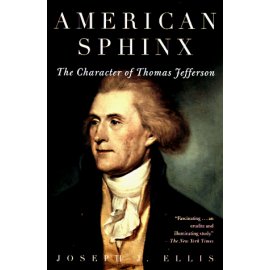

"Great book!" | 2008-07-24 |
| - Reviewed By angelapi |
| This book is quite pleasing, it is well argued and well written. If you like "juicy" biographies full of details and trivia you will be disappointed, nonetheless, it still has a wealth of biographical data that makes the book interesting and instructive. The main focus of the book is on Jefferson's achievements and legacy. The man (Jefferson) was an intellectual colossus and was never short on peculiar and original ideas; he remains an icon for all Americans that are wary of big government and all Americans that defend the sovereignty of the individual. I am glad I picked up this book as my starter on Jefferson. |
| |
"Excellent as far as it went, but ultimately incomplete" | 2008-07-19 |
| - Reviewed By mheath02 |
Ardent students of Jefferson and America's founding will love this book. Readers of narrative history too often get short shrift on character development during this era given all the critical incidents that are necessarily included to provide an adequate narrative of the time, leaving authors little space to flesh-out the nuances of even their chief protagonists. Biographies on the other hand too often provide so many events on their subject's history that deriving a conclusion about the subject's character and their development over time gets lost in the mix. This creates a niche demand to develop books that provide only enough history and biography to support the description of a person's character; Ellis' book on Jefferson is a somewhat adequate, though not great, effort.
A common theme amongst many reader reviews that appeared to be neophytes to American history was that this book is painfully slow and lacking a compelling narrative. While I disagree with the former claim, I agree with the latter. I believe this is a book that best serves students of history who've already studied Jefferson and are more than willing to wade through a lot of uneventful anecdotes to get to know the man better, which Ellis does a great job on the subjects he covers except Jefferson's position on religion - so for those that want to go deep into history, this is a very interesting, worthy book. Ellis purposefully strips out much of the narrative by design, it is a character analysis (see subtitle of book for goodness sakes!), and therefore a narrative would threaten the very purpose of the book.
Ellis' Jefferson comes off as perfectly brilliant, utopian, progressive, somewhat dogmatic, impractical, subversive, and most importantly - all too human. Ellis does a wonderful job of describing the events where Jefferson was obviously on the wrong side of history as we look back in time - e.g., Jefferson's belief that the states would better defend individual liberty rather than the federal government, especially the Supreme Court which has ultimately become our greatest defender, along with eloquently analyzing his greatest accomplishments and contributions to mankind. Ellis brings Madison and Adams into this study in just the right amounts to provide an understanding of how Jefferson interacted with the other framers along with how Jefferson viewed the Revolution and ratification of the Constitution vs. their very different perspectives.
Ellis's treatment of Jefferson's contributions to promoting the limits of government and its obligation to defend its citizens' liberty rights was well covered from a philosophical perspective but completely lacking from a constitutional perspective. While Ellis covered Jefferson's firm position on the importance of secular government if men were to fully enjoy liberty was noted, this analysis was all too brief given the current times where the religious right continuously mischaracterize Jefferson's position on religious freedom, e.g., President Bush's 2008 Independence Day speech is a good example of a modern day character distorting Jefferson's writings to achieve a political objective perfectly contrary to Jefferson's clearly stated position. Given that Jefferson believed that individual freedom is only possible with a secular government with zero evidence to date he was incorrect; Ellis shortchanges his readers by not spending more time on this critical contribution, especially given Jefferson's radical position, and in hindsight his genius on this subject. In fact, Jefferson's position is still so radical there is no way a modern-day politician could espouse views like Jefferson's and get elected in America.
Ellis also leaves out some out critical time periods in Jefferson's life, like Jefferson's second term as President. Given the paperback's main body comes in at 367 pages, I felt one hundred fifty more pages to include more on Jefferson's religious viewpoints and his second presidential term was well deserved given the importance of Jefferson relative to America's founding ideals passed down by him and the other framers.
|
| |
"`He did not always speak exactly as he felt either towards his friends or his enemies.'" | 2008-05-30 |
| - Reviewed By jc-s |
I thoroughly enjoyed Professor Ellis's book about that enigmatic man: Thomas Jefferson. It is not a biography of Jefferson nor is it a complete history and those of us who want to know more about this period in American history will need to look to other sources.
For me, the value of this book is the articulation of some of the perceived contradictions between Jefferson's idealism and his actions as a man of his time. Regardless of Jefferson's likeability as a man, he had a profound influence over the shape of the emerging American republic. In exploring the character of Thomas Jefferson, Professor Ellis provides an historical and social context as a prism through which to view the man and his actions. It is ironic that a man with the vision to work with others to set in place the foundations of a great nation was unable to manage his own affairs so successfully. Public life is so often accompanied by significant personal cost.
It may be true that `The tree of liberty must be refreshed from time to time with the blood of patriots and tyrants.' I doubt that in 1787, when Jefferson uttered those words, he could foresee how thirsty the tree of liberty would prove to be.
Jennifer Cameron-Smith
|
| |
"Great introduction to Jefferson" | 2008-05-26 |
| - Reviewed By molowe |
| As someone with a limited knowledge of Jefferson, I found this to be a well rounded account of his life. At about 375 pages, it was very manageable and well written. I only wish the author had included photos as he did in his Washington book. In the end, I found myself neither loving or hating Jefferson, but mostly disappointed in him and the contradictions of his character. |
| |
"Intriguing and penetrating portrait of Jefferson" | 2008-05-14 |
| - Reviewed By User: A26CEOII995JPF |
I have become a big fan of Joseph Ellis. I loved Founding Brothers. I thought His Excellency, on George Washington, was extremely good. I just finished his book on Jefferson. I think he explains Jefferson better than anyone has before.
This is not a conventional biography. It makes no effort to tell the whole story of Jefferson's life. It is thus not a good first book to read for those unfamiliar with the basic story.
For those who are familiar with the basics of Jefferson's life, and who can not make any sense of the man -- which is to say, anyone paying attention -- Ellis makes a heroic effort to explain Jefferson as a coherent person. The contradictions in Jefferson's life and career are many. He was the great apostle of liberty, yet he held slaves. He was utterly opposed to executive power, yet a dynamic and forceful President, particularly when he engineered the Louisiana Purchase. He hated confrontation and cultivated philosophic detachment, yet he was one of the most ruthless party leaders of his time, going so far as to put people on the federal payroll (when he was Washington's Secretary of State) who published newspapers filled with slander directed at Washington and Adams.
Ellis explains all of this in basically psychological terms. His Jefferson is a complex man, an idealist with an almost infinite capacity for denying inconvenient truths. The larger importance of Jefferson, however, is that he stated in classic terms some soaring idealistic statements about freedom and democracy which, ever after, have served as inspiration and rallying points for those in America and around the world who seek to increase freedom. Jefferson, the man, was a complicated mess. Jefferson, the symbol, has enduring value and great power. |
| |
"Jefferson's mind explored" | 2008-03-22 |
| - Reviewed By User: A2OA8XSRSBECQ3 |
This book by Ellis is a good read on the elusive character of Thomas Jefferson. American Sphinx is not the standard biography, but delves deep into certain aspects of Jefferson.
Ellis assumes that the reader has a good background in Jeffersonian history along with Revolutionary era history. These assumptions may get in the way of some, but did not affect me. The real point of this book was to look at the man Thomas Jefferson, and the way he thought. Joseph Ellis explores Thomas Jeffersons political ideas and his ideas on pressing issues of the time. Interestingly Ellis does not "pick a side" which is so often done in Jefferson books. It is a level headed view of a very complex man.
This would be a good book to read, but should not be the first Jefferson biography you read. It is better suited for a second or possibly third biography of Jefferson. Jeffersonian ideas are clearly presented.
Ellis is an outstanding historian and his other works are highly recommended, including Founding Brothers which takes an indepth look at 6 events that shaped America during the Revolutionary period. |
| |
"An Incomplete Character Study" | 2008-01-13 |
| - Reviewed By User: A1FIFW7HU7WFVG |
This book purports to address the character of Thomas Jefferson, but Ellis seems to season his work with a profusion of subjective negativity, perhaps to bolster his statement in the prologue that Jefferson "is not a statue".
Just a few examples of Ellis's speculative negativity are underlined:
p. 59 "During the debate (on the Declaration) Jefferson sat silently and sullenly..."
p. 69 "...Jefferson's political vision was more radical than liberal, driven as it was by a youthful romanticism unwilling to negotiate..."
p. 170 "...Jefferson's irrational decision to redesign and rebuild Monticello..."
Ellis does not exemplify Jefferson's willful optimism, his basis for enlightenment thinking- unlimited freedom of thought, his cultivation of friends, music, food, and his spirit of hospitality. Ellis even describes Jefferson as distraught by many visitors to Monticello, rather than using this to show that Jefferson was most hospitable and engaging.
Ellis's framework for describing Jefferson is alluded to on pg. 69: "[Jefferson's] mind instinctively created dichotomies and derived its moral energy from juxtaposing the privileged side of any case or cause with the contaminated side. While his language was often colorful, the underlying message was nearly always painted in black and white."
Also, p. 151 "...a view of American politics that was also moralistic in tone and populated with clearly delineated villains and heroes."
Yet this characterization of Jefferson is simplistic. Ellis seems to contradict himself when he states:
p. 11 "The genius of his rhetoric is to articulate irreconcilable human urges at a sufficiently abstract level to mask their mutual exclusiveness." And "The Jeffersonian magic works because we permit it to function at a rarefied region where real-life choices do not have to be made."
As President of the US, Jefferson could not have chosen a bolder, more public stage upon which to share his vision. This biography of Jefferson attempts to reduce his character to a framework of principles, but Ellis's framework is not consistent. Ellis describes Jefferson as `moral and binary' (pg. 323), with "primal categories of his political imagination."
American Sphinx has a great analysis of the Adams - Jefferson correspondence, and Ellis's history of Jefferson's first Presidency from 1801-1804 is excellent. With respect to these phases, I gleaned more about Jefferson's character from Ellis than from Merrill Peterson's biography, Thomas Jefferson and the New Nation.
The last sentence of the chapter on Jefferson's Presidency, 1801-1804, Ellis inexplicably dismisses Jefferson's second Presidency as a "...headlong fall from grace." Ellis's next chapter is "Monticello, 1816-1826". Though Ellis does later briefly address some aspects of Jefferson's 2nd term, he does not describe Jefferson's struggles, or the rationale of his goal of keeping the US neutral and out of the war between Britain and France. Ellis does not mention that though many urged Jefferson to run for a third term, he chose to follow George Washington's example and retire after two terms.
Ellis omits examples of Jefferson's character: his "Decalogue -10 point coda of life", his spiritual side - his philosophy of deism. Jefferson's sense of harmony, his passion for gardening, his love of nature, his curiosity of about science, his intellectual side, his correspondence with Priestly, his heroes, Bacon, Locke, and Newton, are not addressed. Thus American Sphinx does not describe the complexity of the character his elusive subject. Ellis does have some fine examples of Jefferson's philosophy of leadership. On pg. 220, for example, Ellis writes "Jefferson's first instinct was to share with his fellow survivors and sharers of that experience - outsiders and the younger generation could not understand - that the true `spirit of `76' was back." But there are not enough of such descriptive insights. Ellis slams Jefferson for his relationship with Sally Hemings, and faults him for not manumitting his slaves upon his death.
American Sphinx is a great but limited study, for it is biased and does not describe many dimensions of Jefferson's character. Ellis does not bolster his framework of Jefferson's nature as simplistic and dichotomous with examples. Ellis casts aspersions about Jefferson's character in a snide, derogatory and judgmental tone. Ellis concludes with the assertion that if Jefferson were alive today, "If we could ever persuade him to run, he would remain a formidable candidate for national office." This statement is not explained. Ellis might have speculated more about how Jefferson would view the US of the early 21st century, and in doing so, he might have illuminated more of Jefferson's character.
|
| |
"Come to know Jefferson the man" | 2007-10-31 |
| - Reviewed By lclare |
Rather than churning out a full-scale biography, Ellis explores several crucial periods of Jefferson's life in depth, showing how each of them enables us to understand the complexities of the man and what made him tick. This book is a slow read because there is so much to think about on every page. A man of ideas and vision, Jefferson was an incredibly complex and conflicted individual, capable of carrying out multiple levels of deception and subterfuge even from himself. I never realized what a radical libertarian Jefferson was before I read this book. It was a good thing he had the other Founding Fathers around to curb his revolutionary spirit! In spite of the reverence which most people feel for him today, he died feeling his life had been a tragedy. A great book for anyone who wants to come away feeling they now know Jefferson the man.
|
| |
"Entry point for Jefferson" | 2007-09-21 |
| - Reviewed By jvdworak |
This book is a good entry point for a look into the man who was Thomas Jefferson. He is one of the most influential founding fathers of the USA and any serious historian cannot get through American history without studying Jefferson.
Jefferson was a man who wanted to free slaves, but still owned slaves. He wanted personal freedom to trump government intervention, but used the government for the Louisiana purchase. He thought a revolution was good every once in a while but did not like the turns that the French revolution took. Contradictions, brilliance all were a part of this man.
This book is well written. Ellis is a master-historian and I enjoy his books. I can't say I formed a stronger opinion of Jefferson after reading this book, but I can relate to him more after studying his life. We all have contradictions in what we believe, we all are not perfect, same as Jefferson.
Good book - JVD |
| |
"The title of the book says it all." | 2007-09-02 |
| - Reviewed By User: A2A5YLI3VGM4RH |
| Having grown up learning by rote the pablum that was taught in our school system's about our founding fathers, I was a "Founding Fathers" fan. Thinking my entire life that Jefferson penned "The Declaration of Independence" by himself, without any editing and in his own words and finding out that this is false as Washington cutting down the cherry tree is a slap in the face of our educational system. I did not care for Jefferson after having read the book on John Adams by David McCullough. My thinking was turned around 180 degrees about Adams in that book as well as Jefferson. This book merely confirmed my beliefs. In later years Jefferson let others do his dirty work behind the scenes to allow people to believe in his legacy of 1776. Adams was the real hero of the revolution and The Treaty of Paris. What this book proves is that our heroes are fallible and have feet of clay. The reason Jefferson did not free his slaves was because it was not convienent for him and his plantation. Not out of any moral obligation to keep them from the cruel white (and free) world. Jefferson is like another Virginian ,Robert E. Lee, whose myth has grown over the years. Lee was thought invincible until Lincoln found some real generals like U.S. Grant who showed Lee what "total war" was all about. Anyone who fought for the South as a sense of duty to his "country", i.e. Virginia, and the cause of slavery should be labeled what he his, a flawed character much like Jefferson. it is hard to realize that the truths you grew up with were false, but the facts are the facts |
| |