

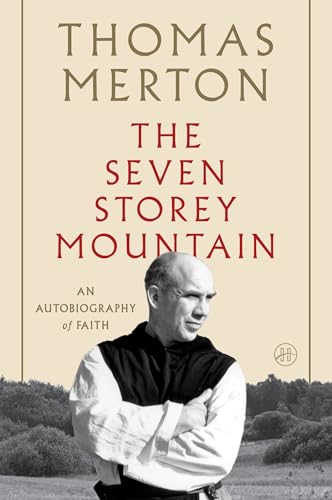
" Storey Mountain" | 2008-08-10 |
| - Reviewed By User: A2ZUKL6KZJQJ0Y |
| I would strongly recommend this book - especially to individuals interested in entering to individuals contemplating religious life. |
| |
"After "The Confessions," maybe the best-ever 'autobiography of Faith'" | 2008-06-28 |
| - Reviewed By markbla |
Today I delivered a gift copy of this book to a widow, "Grace" whose husband had been my late father's closest childhood friend. A week earlier, Grace had asked: "Have you ever read Thomas Merton's SEVEN STOREY MOUNTAIN? I read it in 1953; and found it very moving. I'd love to find a copy and read it again."
When I presented her with a new copy of this edition, I asked if I could read aloud my favorite passage (early in the book) concerning Thomas Merton's `little brother' John Paul (five years younger) who, like his older brother was a French-born, American citizen.
Late in the book Thomas Merton tells us how John Paul was compelled early in WWII to join the Royal Canadian Air Force (and trained right here in Manitoba! John Paul Merton had been flying bombing runs over a real sandy desert on the prairie just outside nearby Camp Shilo, where today's Canadian Artillery Officers still train. My late father was flown at Canadian Army expense each year, late in life, to address the graduating officers at that camp: Small world!)
Just before leaving for overseas, John Paul flew to see his older brother Thomas and, not incidentally, be Baptized, and welcomed into the Catholic faith. Then he left for England (and was killed in action the next year, when his RAF bomber went down over the English Channel).
His death provides the moving culmination to this book - bringing the reader `full circle' from the moment (back on page 25) when Thomas Merton introduces us to John Paul. (What follows is the passage that moves me to tears when I read it aloud to a friend.)
------
"One thing I would say about my brother, John Paul: My most vivid memories of him, in our childhood, all fill me with poignant compunction at the thought of my own hard-heartedness, and his natural humility and love.
"I suppose it's usual for elder brothers, when they are still children, to feel themselves demeaned by the company of a brother, four or five years younger, whom they regard as a baby, and tend to patronize and look down upon.
"So when Russ and Bill and I (older brothers all) made huts in the woods out of boards and tar paper . . . we severely prohibited John Paul, and Russ' younger brother Tommy and their friends from coming anywhere near us. If they did try to come and get into our hut, or even to look at it, we would chase them away with stones.
"When I think now about that part of my childhood, the picture I get of my brother John Paul is this: standing in a field a hundred yards away from our hut, is this little perplexed five-year-old kid in short pants and a kind of leather jacket, standing quite still; his arms hanging down at his sides.
"He is gazing in our direction, afraid to come any nearer on account of the stones, as insulted as he is saddened, and his eyes full of indignation and sorrow. And yet he does not go away. We shout at him to go away, beat it, go home, and wing a couple more rocks in that direction. We tell him to play some other place. He does not move.
"And there he stands, not sobbing, not crying, but angry and unhappy and offended and tremendously sad. And yet he is fascinated by what we are doing, nailing shingles all over our new hut. And his tremendous desire to be with us and to do what we are doing will not permit him to go away.
"The law written in his nature tells him he must be with his elder brother and do what he is doing, and he cannot understand why this law of love is being so wildly and unjustly violated in his case.
"Many times are like that, and in a sense, this terrible situation is the pattern and prototype of all sin: the deliberate and formal will to reject disinterested love for us, for the purely arbitrary reason that we simply do not want it. We `will' to separate ourselves from that love; we reject it entirely and absolutely, and will not acknowledge it, because it does not please us to be loved . . . "
[Thomas Merton immediately recalls an astounding event] "when our `gang' tried to antagonize the extremely tough Polish kids who had formed a gang in nearby Little Neck (approaching their headquarters) and "from a very safe distance we would challenge them to come out and fight" (but) "nobody came out - perhaps (that day) there was nobody home."
But then came the day, Merton recalls, "one cold and rainy afternoon, when we observed that numbers of large and small figures, varying in age from 10 to 16, most of them very brawny" gathered outside the Merton home, "20 or 25 of them. There were four of us."[hiding inside].
"The climax of the situation came when Frieda, our German maid, told us that she was very busy with housecleaning and we must all get out of the house immediately. Without listening to our extremely nervous protests, she chased us out the back way . . . we made our way through back yards to the safety of Bill's house" [a block away, with a clear view across a field, of the Merton home].
"And then an extraordinary thing happened. The front door of our house opened. My little brother John Paul came walking down the steps with a certain amount of dignity and calm. He crossed the street (and) walked toward the Little Neck gang. They all turned towards him. He kept on walking and walked right into the middle of them.
"One or two of them took their hands out of their pockets. John Paul just looked at them, turning his head to one side and then the other. And he walked through the middle of them and no one ever touched him.
"And so he came to the house where we were. We did not chase him away."
-------
The book closes with a poem written by Thomas Merton upon learning of his brother's death in the North Sea: "I learned that John Paul was severely injured in the crash but managed to keep himself afloat, even tried to support the pilot who was already dead.
"He was very badly hurt; maybe his neck was broken. He lay in the bottom of the dinghy in delirium. He was terribly thirsty. He kept asking for water. But they didn't have any. It didn't last too long. He had three hours of it and then he died. His companions had more to suffer, and were finally picked up and taken to safety five days later. On the fourth day they had buried John Paul at sea."
The chapter concludes with Thomas Merton's poetic requiem for his "dear brother" asking their Maker to,
"Take my breath . . . and buy yourself a better death . . . And buy you back to your own land The silence of Whose tears shall fall Like bells upon your alien tomb. Hear them and come, They call you home."
Thomas Merton died 40 years ago (on the 20th anniversary of his book's first publishing) while attending a conference of Eastern and Western monks in Thailand (electrocuted by a faulty table lamp in his Bangkok hotel room).
This "Fiftieth Anniversary Edition" includes a delightful "Note to the Reader" from William H. Shannon, founding president of the International Thomas Merton Society, who recalls that, from the very first day in print (October 4, 1948) the book was "an instant success: Hailed as a modern day version of the `CONFESSIONS' of St. Augustine, it has continued to sell and sell and sell."
As Evelyn Waugh, no easy critic, wrote prophetically: It "might well prove to be of permanent interest in the history of religious experience."
Buy a copy and see for yourself (I highly recommend this edition).
Mark Blackburn Winnipeg Canada
|
| |
"a treasure, and immortal" | 2008-06-07 |
| - Reviewed By gnossie |
"The Seven Storey Mountain" is that rarest of gems: an articulate book about a lifelong spiritual quest.
Its author, Thomas Merton, tells the story of his life, how his vague unease about spiritual questions eventually led him not only to Catholicism but to the narrow walls of a Trappist monastery in Kentucky.
The writing is rich and thoughtful. Whatever your opinion of Merton's conclusions, you find yourself admiring his bravery and honesty.
Surprisingly, the book is actually quite the multi-textured rumination on life in America in mid-century as much as it is the story of Merton's life. His gallery of characters and evocative prose never disappoint. Here's a sample:
"It was a bright, icy-cold afternoon when, having passed Nantucket Light, we first saw the long, low, yellow shoreline of Long Island shining palely in the December sun. But when we entered New York harbor the lights were already coming on, glittering like jewels in the hard, clear buildings. The great, debonair city that was both young and old, and wise and innocent, shouted in the winter night as we passed the Battery and started up the North River. And I was glad, very glad to be an immigrant once again." (p. 151)
I would recommend "The Seven Storey Mountain" to anybody who finds himself restless about spiritual matters, even if he has no particular interest in Catholicism or even Christianity. The book's reach is much deeper than that. |
| |
"The Seven Storey Mountain" | 2008-05-14 |
| - Reviewed By User: A1HD48A5EHWSI2 |
This excellent book has been on my 'must-buy'list for some time. It is beautifully written - goes straight to the heart. I have read it twice, and always find something new, and interesting. ( I had the advantage of a borrowed copy). I read in the'Note to the reader'at the beginning of the book that some would have difficulty in understanding the 'outdated religious atmosphere' that pervades the book. I think that the reader would find it a part of its charm (if that is the word). |
| |
"Beautiful, beautiful book!" | 2008-04-04 |
| - Reviewed By eborde1 |
I just bought a copy of this book. It is so beautiful I finished reading it word for word from cover to cover in 2 days. I am hooked on Thomas Merton! Looking forward to more of his works. |
| |
"better with time" | 2008-03-02 |
| - Reviewed By gm2mullins |
The Seven Storey Mountain is a true classic written by a humble genius. It is extremely well written and laid out. Thomas Merton being a highly intelligent man wrote it is a highly intelligent manner, and you can not help but sink into his wonderful narrative style and logical manner. It was written over half a century though and I at times had to reread sections because his writing style and use of words was not very familiar to me, and I wanted to insure I was understanding what he was saying.
What really sets the Seven Storey Mountain apart is it gets better after reading it. It is often times in the years after my first read where idea and seeds that were planted when I first read the novel make themselves known. Thomas' search and discovery for religion and purpose will appeal to a wide audience, not just the uber religious. It is a wonderful novel of self discovery and change. |
| |
"Should be made mandatory reading" | 2008-02-23 |
| - Reviewed By User: A194MZIIFBZV07 |
As an Eastern Catholic who is in the midst of discerning a call to the monastic life (a very serious call), I thought that reading the written account of Merton's own journey might be helpful. I was not disappointed. More than that, I think that all sophomores in high school should be made to read it, with a mandatory repeat in their senior year.
Why?
Because Merton so eloquently describes his involvement for the first 30 years of his life in what the Bible speaks of as "the vanity of this world." He carefully takes the reader through the journey of an ordinary childhood, his college years, and the inner sense of dissatisfaction he felt with all the things that the world calls "important". This gnawing sense within his soul led to his eventual conversion to the Catholic Faith. His expressions of joy at his conversion are lovely to read, and, for me, reflect my similar experience in entering our Lord's Church 7 years ago.
I think therefore it would be good for young people to read this book on the threshold of their adulthood so that they could see that there is more indeed to life than the pursuit of wealth and fame. They would also read the read conversion of a soul from discontent to peace, from questioning to assurance, from boredom to joy. I think too many people associate the conscrated life with austerity and joylessness. One simply does not get that feeling from Merton's conversion to the Church, and then to the Trappist monastery. If one is truly called to the consecrated life, there is joy in responding to that call, and Merton makes this clear as he writes.
Fr. Merton has a wonderful style of writing and, except for a few parts which got a little tedious for me to plow through, I found the book flows well and is easily readable. Merton has sections where he describes in clear detail his thoughts regarding the vanity of the passing world and his attraction to that which is eternal and timeless --the spiritual world. As we know from his later writings, there was a special call on his life which kept him from finding peace and rest within until he responded to it.
This is a well written and easy to read story of one man's early life and spiritual journey. Once you pick it up, you will find it hard to put down until you finish it. |
| |
"Inspiring book" | 2008-02-15 |
| - Reviewed By User: AMW16BJXVAY0Q |
Having been a fan of Thomas Merton for years, I purchased 2 copies for 2 friends who were on a conversion journey themselves. Both declared that they were unable to put the book down and found it inspiring.
Almost all of us struggle with the pull of material things, physical things, and spiritual things. Merton talks frankly about his struggles and his failures as well as his eventual feelings of the rightness of his decision to choose the spiritual life. |
| |
"A Story of Providence" | 2007-09-27 |
| - Reviewed By cmstep |
Few writers of spiritual books ever reach the high literary mark that Thomas Merton sets in The Seven Storey Mountain. At its core, The Seven Storey Mountain is pure memoir. Merton accounts for his life up to the time of writing when he was about 30 years old. Within this account, he places insights on spirituality, and the account on the whole offers a grand lesson on God's providence and mankind's undying need for reconciliation with God through Jesus Christ.
Merton's life story unfolds with tragedy upon tragedy. His mother died from cancer when he was 5 years old, and then less than 12 years later his father died from cancer. Merton was left with a guardian and grandparents who cared for him from arm's length.
Merton's education is vast. He is as well read and learned as any writer of memoir that I have read. Unfortunately, as a teenager his education led him away from God and to an attitude of atheism or agnosticism at times. As he pursues greater education, God pursues him through authors and teachers.
Merton credits William Blake's writings and art with playing a significant role in his salvation. Merton then begins reading a book on Catholic Philosophy that also has a profound impact on his perception of God and the religion. Mostly, Merton credits the intercession of others for his salvation, "Who prayed for me? One day I shall know. But in the economy of God's love, it is through the prayers of other men that these graces are given. It was through the prayers of someone who loved God that I was one day, to be delivered out of that hell where I was already confined without knowing it." (109) Merton takes no credit for his salvation or spiritual growth. He gives all credit to the gracious work of God.
His book illustrates the journey of a young man from enlightened atheism to humble faith in God. Merton's faith and learning are complimentary not contradictory. He shows readers that true enlightenment and learning leads to the ultimate truth, and this truth gives hope not fear, assurance not doubt, and salvation not annihilation.
Merton writes to his readers of this truth he has learned that I think is the message of his book, "And yet now I tell you, you who are now what I once was, unbelievers, it is that Sacrament, and that alone, the Christ living in our midst, and sacrificed by us, and for us and with us, in the clean and perpetual Sacrifice, it is He alone Who holds our world together, and keeps us all from being poured headlong and immediately into the pit of our eternal destruction. And I tell you there is a power that goes forth from that Sacrament, a power of light and truth into the hearts of those who have heard nothing of Him and seem to be incapable of belief." (41)
As expressed in the above quote, Merton's faith is rooted in the Catholic religion. This causes some trouble to me as he exalts Mary the mother of Jesus to a place alongside her son as a mediator and advocate for people. Merton asserts Mary is as responsible for his coming to God as Jesus. At times of trouble, he prays to Mary and a litany of saints for help. He discusses praying for souls in purgatory and wiping out sins through almsgiving. In addition to few slights at Protestant religions, these items may be stumbling blocks to some readers.
Merton reveals a spiritual journey that takes him eventually to his desired home in a Trappist monastery where he, at his Director's urging, continues to write and publish while seeking God in solitude. His is a process engineered by the hand of Providence, as it led his steps and transformed his heart. I think any sincere reader who approaches Merton with an open mind and heart will find insights applicable to him or her at the current time of life. |
| |
"Thomas" | 2007-08-05 |
| - Reviewed By User: A3E5UQLQAV9WK5 |
| I bought this for a 30 year old man who is searching for meaning in his life. |
| |