
"Inspirational but Flawed" | 2008-03-01 |
| - Reviewed By litr8r |
One day, the daughter of a Khampa chieftain, seventeen-year-old Ani Lemdha Pachen, ran away from home to avoid marrying. It wasn't that she disapproved of the match her parents' had arranged, but rather that she preferred the cerebral and peaceful world of a Buddhist nun to the physical demands of traditional married life.
Runaway Pachen had spent little time at the monastery, before she returned to her parents. Despite the shame of what she had done, they not only forgave her but agreed she would not have to marry. Before she could return to the monastery to complete her training, Pachen's father tells her of their country's dire political situation. The Chinese are coming to "liberate" them. As a Khampa princess, she will be expected to lead their people through this situation, especially if the Chief should die. So the young lady received a different type of training instead.
For all her bravery, Pachen was unable to resist for long. She was captured by the Chinese army and spent 21 years imprisoned. This true story focuses on how Pachen's spirituality kept her hopeful and sane during her confinement and during the many tortures she endured. The book is sprinkled with the Buddhist teachings that helped her maintain both her sanity and will to live through these dark days and features an introduction by the Dalai Lama himself.
Apparently Richard Gere also advocated this book's creation and publication. He contributed his own introduction and story of how the book idea was born. He speaks of Pachen's life as a "beautiful, disturbing, and deeply inspiring story." He argues that no "serious literature" in the form of narratives or the "Great Tibetan novel" had emerged from the "Tibetan Holocaust, so a book like this one would be a great boon to the Tibetan cause. Gere, of course, had become a Buddhist and was studying in Tibet at this time.
The story's merits include its insights into the life of a Tibetan woman seeking nunhood during the Mao era, it offers inspiration through triumph against extreme adversity, it draws attention to Tibet's political and cultural situation and the ways in which they have suffered in recent history, and it provides lamanistic teachings.
Despite Pachen's, Donnelly's, Gere's, the Dalai Lama's, and many others' good intentions, however, this book probably has fallen short of its intended goal. The storyline does little to sustain the reader's interest because it is patchy and doesn't flow well (When Gere called it "a miracle of simplicity," he wasn't kidding! Something is clearly lost in translation here.). Although the author supposedly consulted many reliable resources, oddly very little of Pachen's story is put into historical context and few of the sources are used to draw insights into Tibet's situation. Considering the book committee's intentions, I would have expected to find a list of support organizations for Tibet in the appendices. Because of the sketchiness of the writing, it was difficult for me to find the book an inspiration, though other readers might find it so. Those looking for a story of spiritual stamina and female courage may enjoy Pachen's story, while those seeking a new perspective on Tibet should borrow it from a friend or a library rather than spending the money to buy it. Everyone else, just skip it. Sorry Richard, this one's not the great Tibetan novel, either.
|
| |
"The dream that could never die." | 2008-02-03 |
| - Reviewed By tigerbuck |
This book tells the remarkable story of Ani Panchen, a Tibetan nun, who led the resistance to the ruthless Red Chinese occupation of Tibet, after her father's death in 1958.
For 21 years she was imprisoned in hellish Chinese prison camps, only surviving because of her strong will and faith.
After her release she continued to lead the struggle against the Red Chinese occupation and genocide of Tibet's people. In 1988 she was forced into exile in India, where she has continued to devote her life to the dream of Tibetan freedom, even after it has been forgotten by the world.
She begins by her peaceful childhood in pre-occupation Tibet:
In 1950 she describes how "Our country was still at peace, though on the eastern bank of the Yangtze River Chinese troops were gathering. In a few short years, they would sweep over my country, changing it forever. In the name of liberating Tibet from 'imperialist' powers they would destroy monasteries, plunder homes, burn sacred texts, and drive our people to poverty and despair."
Babies were removed from their parents in their thousands to be relocated to Red Chinese 're-education' centers were they were to be brought up in Communist doctrine. Over a million Tibetans were to be anihilated in the Chinese holocaust that followed, and even the animal life of Tibet destroyed in order to force the Tibetans to give up their reverence for life.
Ani Panchen tells of her experiences fleeing from Red Chinese forces, and of seeing small Tibetan children gunned down by Chinese snipers.
It also tells of Panchen's deep Tibetan Buddhist faith underpinned by her will to 'Let all beings be free of suffering, let all being find peace.'
While the book hopes to expose the horrors of the Chinese destruction of Tibet, in actions paralleling those of the Nazis during World War II, Richard Gere in his forward expresses his wish this book may help to "dispel the darkness of this darkest night of Tibetan history and be of benefit to all beings everywhere".
Will the world re-awaken to the suffering of the Tibetan people mand the destruction of their civilization, and not least their dream of the re-birth of their culture and self-determination.
|
| |
"Reality-check - read this book" | 2004-04-23 |
| - Reviewed By bgoodman33 |
| Need a reality check? Feeling sorry for your life? Then read Sorrow Mountain and experience life at it's best and worst. It will lift one out of ordinary existence into the realm of compassion and tolerance. One will begin to experience the essence of the Tibetan region and the mystical struggles of one held prisoner by torturous bandits who tried to steal the Heart of Compassion and failed. Turn off the tv "reality" shows and experience the real-ness of Ani Pachen and her Sorrow Mountain. I guarantee it will become your Sorrow Mountain too. |
| |
"Inspiring story, beautifully written" | 2003-05-22 |
| - Reviewed By doriyang |
| I just finished reading this book and didn't want to put it down. The story of Ani Pachen is both horrifying and inspiring, how she against all odds not only survived but kept her faith, battling against her own anger at her captors to try to reach a higher spirit of generosity. The writing of Adelaide Donnelley is gorgeous and poetic, capturing the inner spirit and the mystical beauty of the land in words that lift this book to a high literary level. This book deserves to be widely read over many years. But it! Read it! It will move you. |
| |
"Two Women of Genius" | 2002-01-19 |
| - Reviewed By grannygold |
| Sorrow Mountain is both a novel and a woman's life story. As Adelaide Donnelley explains in an afterword, "It is as much narrative as strict biography." Stories of the "life" of Ani Pachen, including her spiritual power to transcend torture and twenty-one years of imprisonment, and to transform destruction into hope, were the BASIS for this remarkable book. Ani Pachen wanted to be a nun, living peacefully and not killing (many Tibetan people have a religious calling); the circumstances of her birth forced her to become a warrior against the Chinese (again, this echoes the history of those of her generation). Captured, imprisoned, and tortured, she preserved her spiritual beliefs and her integrity (again, read the story of many her generation; the difference is that so many did not survive). Ani Pachen survived, made it to Dharamsala, and finally lives a life of meditation and spiritual focus. Thousands of Tibetans have escaped; many of those now live in northern India with His Holiness. The spiritual example they set: certainty of impermanence, compassion, forgiveness, and detachment--works for everyone on the planet. All of this matters. But there is something more which matters. This book, like the story of its subject, transcends and crosses boundaries: in form, in approach. It is a novel, a spiritual guidebook, a history of Tibet and Tibetan Buddhism. The tone is mythic: "My country was once at the roof of the world, a place where the great spirits lived." The tone is cinematic: "In a darkened corner of my mind, a small patch of green appears. I watch it grow brighter, larger, until a vast green meadow stretches out at my feet. The meadow is dotted with clusters of flowers and is treeless, except for a willow or two." The tone is intensely personal, acutely descriptive: in prison, "The lice were so bad that I could see them crawling all over the heads in front of me. So thick I could sweep them off with my hand and not make a difference in their numbers." The story is woven of dreams, memories, Buddhist teachings, horrors re-lived or imagined, and above all details that give it taste, sound, texture, and breath. As a work of art, it breaks all prior boundaries and should be studied by all writers who ever consider telling life stories--their own or anyone else's. If there is any drawback to the book, it is only that we cannot know what is Ani Pachen's voice and what is Adelaide Donnelley's. A Buddhist would assure us that the illusion of separation is unimportant, temporary, superficial. A Buddhist would tell us that Ani Pachen's story, and Adelaide Donnelley's storytelling genius, have become one voice for all of us. As the editor of another woman's life story, I come to this book to learn. I look back at my work and see how much trouble I took to leave Mpho Nthunya's voice exactly as it was, to be merely a secretary, taking dictation from her. I tried to keep my white privilege and sensibility out of the way of her African experience and her African ways of seeing. I think that was a good thing to do. But I deeply admire the merging of voices in the Pachen/Donnelley collaboration. It is a miracle to read, to study, to learn from. I am deeply grateful for it. |
| |
"Sorrow Mountain: The Journey of a Tibetan Warrior" | 2001-07-06 |
| - Reviewed By Anonymous |
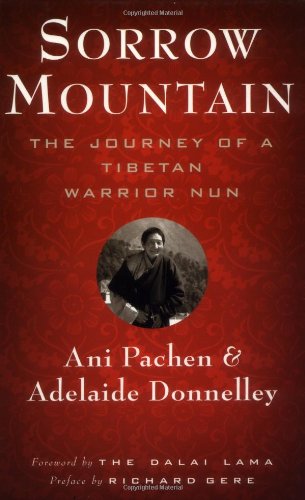
| Ani Pachen & Adelaide Donnelly (2000), Sorrow Mountain: The Journey of a Tibetan Warrior-Nun, New York: Kodansha International, pp 293. Foreword by the Dalai Lama and preface by Richard Gere. Some people live lives of such difficulty and suffering that it is hard to imagine how they carry on. Other people live lives in which they inflict so much suffering and difficulty that it is hard to imagine how they carry on. This book is a story of both kinds of lives. It is primarily the story of Ani Pachen: a Tibetan woman born to a privileged life who lost everything when the Chinese invaded, became a resistance leader, was captured, tortured and endured 21 years of horrific imprisonment. When finally released she took part in protest movements before fleeing to India where she became a nun. It is also a larger story of the Tibetan people and their Chinese oppressors. Invaded, oppressed, mistreated and murdered, the Tibetan people have endured for almost half a century their own holocaust in which 1 million of their 6 million people have been killed. This book puts a personal face on their suffering. As such it is a moving monument to the courage and forbearance of a person and a people. A moving foreword by the Dalai Lama and an equally moving preface by Richard Gere add further perspectives to the book. As Richard Gere concludes "May this book help to dispel the darkness of this darkest night of Tibetan history and be of benefit to all beings everywhere. May the hearts of our Chinese brothers and sisters be opened and may they quickly come to their senses." |
| |
"A Great Discovery" | 2000-08-25 |
| - Reviewed By amtaaca |
| I first came across this compelling book when attending some talks from His Holiness the Fourteenth Dalai Lama. My boyfriend comes back from the bookstore and tells me that he found a book he knows I'd be interested in. Well, he was right! Sorrow Mountain is a story about a woman torn between her religious beliefs and her duty to fight for country. Dedicated to both, the book describes the trials and tribulations Ani Panchen goes through and how she survives by believing one day she will be able to be near her religious leader His Holiness. There is a great introduction by Richard Gere and by the Dalai Lama himself. I am fortunate I was able to purchase a signed copy and will treasure it for a long time. |
| |
"A Book of Great Courage and Magesty" | 2000-06-07 |
| - Reviewed By janelancellotti |
| The story of Ani Pachen resonates with the kind of courage and spiritual certainty that perhaps very few of us our capable, but all of us admire. In contrast to her indomitable strength, the Chinese occupation of Tibet takes on outrageous dimensions -- an ugliness and brutality hard to bear. For one nine-month period during her twenty-one years of imprisonment, Ani Pachen endured a dark, earthen cell slightly larger than her body where she spent her time praying, accomplishing one hundred thousand prostrations devoted to the well-being of all. When released by the Chinese, she took up the cause of a free Tibet in Lhasa, demonstrating against the torture and murder of her people and country, putting herself in the greatest possible peril. Ani Pachen has lived at the very depths of the soul and sorrow of Tibet and emerged triumphant, a woman of compassion and beauty who will inspire all who read her magnificent story. |
| |
"Another blot on China's human rights record" | 2000-04-27 |
| - Reviewed By User: A27L1RHX51A67F |
| Ani Panchen, the only daughter of a Tibetan Cheiftan was looking forward to a life of contemplation after narrowly escaping an arranged marriage. However, after the invasion of Chinese Communist forces & the death of her father, Ani is compelled to carry on the wishes of her father & help lead rebel Tibetans defending their homeland. For her involvement in the resistance, Ani spends the next 21 years of her life in prison. Living from day to day with the hope that in time she will meet with his Holiness the Dalai Lama. Her courage & spirit to fight & survive are astounding. This is her testimony for all the thousands of political prisoners still being held in Chinese prisons for 'crimes' such as 'waving a Tibetan flag' or shouting for independence. This book is another blot on China's human rights record. For similar reading try 'Fire under the Snow' by Palden Gyatso. |
| |
"Memoir, History, Politics, Geography, Spirit -- All in One" | |
| - Reviewed By Anonymous |
| This story is appealing on many levels, not the least of which is its thoughtful, powerful, flowing prose. The writers bring us the dramatic history and culture of the expansive country of Tibet through the personal oddyssey of the amazing Ani Pachen. An early surprise is learning about the day-to-day life of a Tibetan town and its culture prior to the Chinese invasion. Quite poignant is the Tibetan perspective of the Chinese Great Leap Forward and Cultural Revolution. Far from being merely a catalogue of the long string of horrific abuses on the part of her captors, Donnelley sensitively narrates the details of Ani Pachen's 21-year imprisonment and torture by weaving the narrative with the gems of Ani's faith. While it is emotionally-draining, the reader is provided opportunities to regain strength. You cannot avoid being deeply moved by the power of this woman and her fellow Tibetans -- and moved to help save her culture. Read this book! |
| |