
"Compelling, chilling, and a bit one-sided (3.5 stars)" | 2009-10-07 |
| - Reviewed By jsg16 |
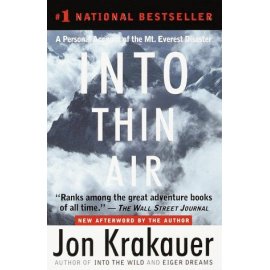
In May 1996 a number of climbers and guides found themselves caught near the summit of Mt Everest during an afternoon blizzard. Five of them died in the worst disaster in Everest climbing history. Krakauer, a writer who was one of the climbers who managed to summit the mountain early, tells the events of the ill-fated expeditions and the people involved. Additionally, he gives a bit of history on climbing Everest and discusses - in chilling detail - the effects such high altitude has on the human body.
I came upon this book in a vacation beach house we rented some years ago. After I finished the book I had brought I picked this one up - and couldn't put it down! From the details of altitude sickness to the account of the tragedy itself, this book is gripping and a real page-turner. In his book Krakauer comes across as objective and believable in his telling of the events as he places much of the blame on too many people on the mountain and on Scott Fisher, the main guide of another expedition group, for not turning around early enough (Rob Hall, the lead guide of Krakauer's group, also perished).
However, I later found Left for Dead by Beck Weathers, another member of Krakauer's expedition, who was left for dead by Krakauer and another climber when they decided he wouldn't make it and would only endanger their lives if they helped further. Weathers eventually wandered into camp on his own and later lost his nose and parts of his arms and feet to severe frostbite. His account, while perhaps not as compelling, was somewhat critical toward Krakauer's book (as are several others). So, while I recommend this book as an exciting read, I wish to emphasize that there is a fair amount of controversy surrounding the tragedy and Krakauer probably shouldn't be taken as the definitive authority or history. |
| |
"treats Pittman with kid gloves" | 2009-09-20 |
| - Reviewed By gnossie |
I admit I read this book for one cruel reason: to read about the horrid Sandy Pittman (now living in London and going by the name of Sandy Hill). She was a prominent New York socialite (married, I think, to the president of MTV) who doubled as a free-lance journalist exploring exotic places. So she joins this team of climbers ascending Mount Everest, all the while sending regular dispatches back to, I think, MSNBC.
But, as was mentioned in the crushing "Vanity Fair" article (August 96) that first exposed her, Pittman did not climb mountains as others did. Instead she paid a team of sherpas to haul to the crest her photocopier, fax machine, cappucino makers, juicers, dough mixers, etc. (I'm only slightly exaggerating here.)
But on this particular ill-fated expedition, an unusually fierce storm hit the climbers. The sherpas, however, were so exhausted from carrying lugging all her equipment up the slope that they didn't have the strength to convey many of the climbers to safety, and several died -- arguably as a result of her excesses. As one blogger recently wrote, "Pittman epitomizes for me the ignoble decline of Everest into what it is now -- a meaningless symbol of what money can buy you in this world."
Fortunately for readers, the author of this book, Jon Krakauer, was actually along for the ride: he climbed with Pittman on that expedition and relates the events firsthand.
Unfortunately for me, there's scant dope on Pittman herein. I'm guessing this was because Krakauer was afraid of some sort of legal action on her part and didn't want to go to court over it. Thus, throughout the book he deals with her gingerly -- and sparingly, something I feel weakens the punch of the book since her dinginess was the obvious elephant in the room.
Such that, if you'd like the most exoriating expose available on the woman who has been called "the worst that America has to offer," you're much better served by looking up the "Vanity Fair" article I mention above. |
| |
"My personal favourite mountaineering book of all time - a chilling and harrowing story of the tragedies on Everest in May 1996" | 2009-09-18 |
| - Reviewed By User: AN4TJXMH8QVEV |
My personal favourite mountaineering book of all time. Krakauer provides a day-by-day journal to tell the chilling, harrowing and controversial story about the 1996 Everest season when 12 climbers were killed. He describes the trek to Everest Base Camp, the acclimatization climbs to Camps One, Two and Three, the final climb by 34 climbers towards the Everest Summit, the descent to the South Col, the killer storm, the rescues and failed rescues, and the descent off the mountain. The Illustrated Edition contains almost 250 b/w photos to bring the story to visual life. The photos are by Jon Krakauer, Neil Beidleman, Klev Schoening, Scott Fisher and others.
"In March 1996, Outside magazine sent [Jon Krakauer] to participate in, and write about a guided ascent of Mount Everest", on Rob Hall's Adventure Consultants expedition. In addition to Hall's eight clients, Scott Fisher's Mountain Madness guided expedition also had eight clients. Scott Fisher: "We've got the big E figured out ... we've built a yellow brick road to the summit." Krakauer did reach the Everest summit on May 10, 1996 at 13:10. Worrying about his dwindling oxygen, he left the summit after just five minutes, finally making it back to his tent on the South Col at about 18:45, "more exhausted than I'd ever been in my life." "The storm abruptly metastasized into a full-blown hurricane, and the visibility dropped to less than twenty feet ... nineteen men and women were stranded up on the mountain by the storm, caught in a desperate struggle for their lives."
Two guides, two Sherpas, and seven clients had reached the South Col, but "staggered blindly around in the storm, growing ever more exhausted and hypothermic." In a small break in the storm, Camp Four was slightly visible. "Pittman, Fox, Weathers, and Namba were too feeble to walk", so Neil Beidleman, Klev Schoening, Lene Gammelgard, the two Sherpas, and Mike Groom stumbled off into the storm, making it back to the tents on May 11 at 00:45. Fisher's guide Anatoli Boukreev had descended to Camp Four in advance of his clients, and was the only strong climber left. Boukreev courageously single-handedly attempted to brave the storm to rescue the missing climbers, but had to return to the tents. But Boukreev didn't give up. He went out again by himself and was able to find the climbers, and brought back first Charlotte Fox and then Sandy Pittman and Tim Madsen. Yasuko Namba was dead and Beck was a lost cause.
Rob Hall waited for Doug Hansen to reach the summit at around 16:00, but Hansen turned into a "zombie" on the descent. Andy Harris picked up oxygen from the South Summit and walked back up towards Hall and Hansen. "at 4:43 on the morning of May 11 ... [Hall] had descended to the South Summit. And at that point neither Hansen nor Harris was with him." The continuing storm on May 11 stopped the Sherpa's rescue attempt. Rob's pregnant wife in New Zealand was patched through to speak to Rob late on May 11, " 'I love you. Sleep well, my sweetheart. Please don't worry too much.' These would be the last words anyone would her him speak."
Scott Fisher was not very strong on summit day, and reached the summit late at 15:40. Lopsang Jangbu Sherpa was able to help Fisher descend, but he collapsed just below the Balcony about 400m above the South Col. Anatoli Boukreev reached Fisher late on the evening of May 11. "Down suit is unzipped, pulled off his shoulder, one arm is outside clothing. There is nothing I can do. Scott is dead."
Amongst the tragedy, there was a ray of joy. Beck Weathers collapsed on the South Col late on May 10 and was left for dead. Miraculously he regained consciousness on May 11 and stumbled back to Camp Four at 16:35 with his "bare right hand, naked to the frigid wind and grotesquely frostbitten ... outstretched ... [looking like] a mummy in a low-budget horror film." Beck miraculously survived the night and the IMAX team with David Breashears and Ed Viesturs helped him descend to Camp Two the next day. Lt. Colonel Madan Khatri Chhetri rescued Beck from Camp Two in his helicopter on May 13.
Krakauer's writing is excellent, providing enough information, but keeping the story tight and to the point. He provides his inner thoughts and comments candidly on his own performance and mistakes, and the other clients and guides. Rob Hall's last minutes speaking to his wife are almost too heartbreaking to read. The photos are absolutely excellent. Although Krakauer is critical of Anatoli Boukreev's guiding practices, he fully acknowledges Toli's extraordinary performance in single handedly rescuing three clients during the storm. For a rebuttal from Anatoli Boukreev, read The Climb. |
| |
"Excellent" | 2009-09-09 |
| - Reviewed By User: A13DUWAF2TXNRG |
| Great book, a tragic story made into an edge of your seat thriller. I couldnt put it down. |
| |
"Great Book, but the Postscript is Belittling" | 2009-09-01 |
| - Reviewed By User: A26BVUB2YJMGB7 |
An outstanding and harrowing adventure story, full of heroism and tragedy at the top of the world...But...
...But the Postscript takes away the whole story, the whole book, and belittles the effort, even the deaths, of those Krakauker sought to honor.
It descends into a childish (on both parts) "I'm right-No, I'm right, You're wrong" wrangle between two authors.
What does it matter who is right and who is wrong at times like this? What happened on Everest in 1996 was a true human tragedy. Yes, heroic and good decisons were made, but so were bad and stupid decisions. It was what it was. And there's nothing wrong with two men who were there having different versions (and perspectives) of what is true.
It's that way in every aspect of life, in every human endeavor. No two people see the same thing in the same way...so why get down in the gutter trying to say who's right and who's wrong? Truth--the real truth--is somewhere in the middle.
Future editions should leave out the postscript. Those who died deserve better than to have two survivors arguing over who is the "most" right and who is wrong.
An epic story...it's in the arguing--after the retelling--that the story loses focus. Too much pride of authorship there on both parts. Just tell the story and let it stand for itself. |
| |
"Pros and cons" | 2009-08-13 |
| - Reviewed By User: A3TY42DNMEOHTT |
| Synopsis: Disaster on Mount Everest leaves eight people dead. Pros: The dramatic human drama motivating this book made it so successful that it continues to fuel interest in the market for adventure-travel books. Cons: Krakauer has problems dealing with issues beyond his training as a journalist. For example, he tries not to blame any of the climbers; however, Krakauer's personal involvement leads the reader to expect more insight to his thoughts and feelings. |
| |