
"brilliant but kind of sloppy" | 2008-08-15 |
| - Reviewed By User: AR86B5PBTYC4E |
To the author's credit, the book overall is provocative, very interesting, and somewhat compelling. Raymond makes arguments throughout about the benefits of open source over closed for the software industry. What's impressive about these arguments is how many of them are made independent of any open source ideology; instead he draws from political theory, economics, and game theory to illustrate how open source is actually in many cases the rational choice for a self-interested entity, and consequently inevitable (in his opinion). Raymond also paints a colorful picture of hacker culture that conveys the group's fascinating dynamic, while enough of his own character and achievements are revealed to suggest why he's so qualified to be speaking: his title essay is widely credited as a primary inspiration for the transformation of Netscape Navigator into Mozilla Firefox; he helped charter the Mozilla Public License; in "Revenge of the Hackers", he admits (without much modesty) that "by late 1993, many people (including myself) had come to think of me as the hacker culture's tribal historian and resident ethnographer"; etc.
But the book has weaknesses as well. Raymond frequently comes off as abrasively egotistical, and it's disconcerting how many typos you can find. Moreover, his system of endnotes is misnumbered in some places and completely confounding in others; I still don't understand it fully, though I've made corrections to some of the numbering mistakes and will be happy to pass them on. In addition, all of the examples he cites are dated by at least eight years, even in this revised text (though that's not to say they aren't still instructive). He keeps the most updated version of the text on his website at [...], where many of these criticisms may be addressed; I haven't checked. |
| |
"Simply a Great Book" | 2008-07-22 |
| - Reviewed By User: A14XYP1TGLYU88 |
I could not put this book down. In a nutshell: it's is about software and development models. Don't yawn just yet - this book definitely held onto my attention throughout. Eric Raymond has a great way of introducing the subject matter as he shares his first-hand experiences as a free software developer. If you ever tried or thought about writing software, especially free (as in speech) software, you've probably heard of this book. A must-read. |
| |
"A Collection of Essays on Open Source" | 2008-04-06 |
| - Reviewed By maxim_m |
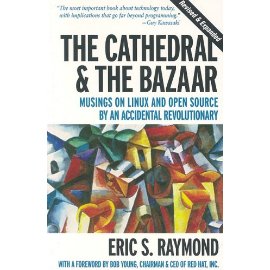
The Cathedral and the Bazaar is a collection of essays originally meant for programmers and technical managers, written by Eric S. Raymond on software engineering methods, based on his observations of the Linux kernel development process and his experiences managing an open source project, fetchmail.
I you like a deeper work on Linux development, I can recommend the book "Rebel Code" by Glyn Moody.
fetchmail, is an open-source software utility to retrieve e-mail from a remote mail server. It was developed by Eric S. Raymond from the popclient program, written by Carl Harris. Its chief significance is perhaps that its author, Eric S. Raymond, used it as a model to discuss his theories of open source software development in this book. Some programmers, including Dan Bernstein, getmail creator Charles Cazabon and FreeBSD developer Terry Lambert, have criticized fetchmail's design], its number of security holes, and that it was prematurely put into "maintenance mode". In 2004, a new team of maintainers took over fetchmail development, and laid out development plans that in some cases broke with design decisions that Eric Raymond had made in earlier versions.
The essays in the book describe open-source software, the process of systematically harnessing open develplment and decentralized peer review to lower costs and improve software quality. contrasts two different free software development models:
- The Cathedral model, in which source code is available with each software release, but code developed between releases is restricted to an exclusive group of software developers. GNU Emacs and GCC are presented as examples.
- The Bazaar model, in which the code is developed over the Internet in view of the public. Raymond credits Linus Torvalds, leader of the Linux kernel project, as the inventor of this process. Raymond also provides anecdotal accounts of his own implementation of this model for the fetchmail project.
The essay's central thesis is Raymond's proposition that "given enough eyeballs, all bugs are shallow" (which he terms Linus' law): the more widely available the source code is for public testing, scrutiny, and experimentation, the more rapidly all forms of bugs will be discovered. In contrast, Raymond claims that an inordinate amount of time and energy must be spent hunting for bugs in the Cathedral model, since the working version of the code is available only to a few developers.
When O'Reilly Media published the book in 1999, it achieved another distinction by being the first complete and commercially distributed book published under the Open Publication License.
|
| |
"Good book but definitely not a classic" | 2008-03-02 |
| - Reviewed By pottsby |
| I felt the book had some good points and then other times I was struggling to get myself to pick it back up. Overall worth the read but not in my top 5 list by any means. |
| |
"gives a "blow by blow" about how "open source decentralized software development" CAN work, with a caveat" | 2008-02-16 |
| - Reviewed By User: A31EJSWIJIPVJ |
The title says it all, however, the caveat is that if the "instigator" of the particular form of software does not have the "cache" or "credentials" in the open source community then the chances of a REALLY BIG item being developed is rather small. BUT, if the "item" can catch on, then it can be done better and faster than a "paid for development". |
| |
"Slightly breathless, front-line reporting from the Linux warfront" | 2007-12-28 |
| - Reviewed By jefft246 |
I like this book for many reasons. First of all, it uses lots of specific examples to prove a point. Two, the author was right at the front lines during the formative days of Linux and open source and he does not hide his biases. Three, he is a very insightful guy and he sure as heck knows how to turn a phrase.
That said, the book is not that far removed from a polemic. He has drawn his conclusions and moved on from contemplation to conviction. So if there is any point along the way you disagree, what follows is going to give you frustration.
I'd suggest reading this in conjunction with The Success of Open Source, which despite its title, is far more balanced and has the best history of the open source movement I have ever read. I've given that book 5 stars. The two balance each other out quite nicely. |
| |
"Good but can get Technical at times" | 2007-12-28 |
| - Reviewed By User: A2D701C05I09XF |
This book is a great and very interesting read. While you can get the collection of essays online, for free. I prefer the book, easier on my eyes. ESR (author) tries to keep it straight foreward, however at times he drifts into a technical world, which somewhat flew over my head. If you are interested in the Open Source community, namely what makes it work, and what problems it has in store, this is a great book.
He Gives personal experience which I really value, and he doesn't try and hide the short comings of Open Source Development. |
| |
"Great book in Great condition!" | 2007-11-22 |
| - Reviewed By User: A3U7EM6HRNW1CT |
| If you've ever wondered what Linux is, or what it is all about, this book covers all the bases. From the origins of opensource software to its current-day fallout, Raymond writes an easily accessible commentary. |
| |
"ESR Helps the Intermediate Software Developer Understand His Environment" | 2006-02-04 |
| - Reviewed By cburgess17 |
| This is my second experience with ESR's books, and I've been very pleased with both of them. Looking at software development from his "anthropologist" perspective, has proven extremely helpful in better understanding my experiences in the industry, and especially in seeing things about people and processes that I didn't realize were there until he'd pointed them out. I don't think this would have made much sense to me if I was new to the software development environment, but now that I've been in it for several years and experienced different people and different groups with their own different processes, ESR's conceptual insights have helped me evaluate my own way of working and thinking. I highly recommend this book to anyone who's been in software development for at least three years... I think your own experience is very important to have behind you when reading ESR's books. This kind of reading led me to the Fred Brook classic "The Mythical Man-Month", which I think is still full of applicable insights (a whopping 30 years after it was first published). |
| |
"Clearly explains the advantages of Open Source development" | 2005-11-13 |
| - Reviewed By User: A1P3UMPEKK4WD8 |
| An exquisite work of art, a well thought-out treatise on the philosophy and mechanics of "Open-Source" software. Excellent discussions on: the real definition of "hackers', comparison of "Cathedral" versus "Bazaar" methods of software development, how "Bazaar" development produces higher quality software faster than the "Cathedral" method, and how the "Bazaar" method provides longevity to software. Finally, it is shown how the spirit of software craftsmanship is nurtured by the "Bazaar" method. All of these topics are supported by very clear and understandable case histories and logical reasoning. This book is even more important now with the growing influence of Linux and other "Open Source" software such as Mozilla's Firefox. |
| |