
"A Remarkable Recorder" | 2009-10-18 |
| - Reviewed By genesrme |
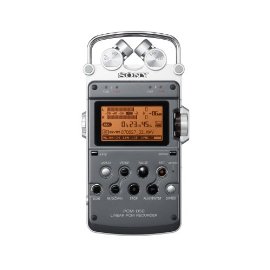
Wow! As a novice in the field this is going to be a very superficial review of this very remarkable instrument. I bought this to: 1. supplement the sound on the DVX100B camcorder. 2. Record interviews with older folk of the long ago and far away. 3. Record the odd class/ to record my thoughts and create podcasts.
I am an audiophile (or think I can tell a good recording from a poor one) and wanted to be able to record audio that was comparable to CD quality at the very least. I would have a hard time explaining the physics of analog to digital conversion, comparing 32 bit with amplitude and the sampling rate in Khz. Having said that I found the PCM D-50 able to produce recordings better than many of the CDs I have, QUITE EFFORTLESSLY. I also ended up taking it into a class I am attending and was amazed at the quality. I used to record classes in college and I could barely tell what the heck was being discussed and it sounded like it was on another planet. Not with this baby!! The recording level can be set so you can actually ratchet up the sensitivity of the mic, depending on where you may be sitting. You can also activate the -20db tandem recording feature that will effectively help in case there are huge changes in the recording level..will essentially level things out instead of distorting the recording (obviously within a 20db range).
I bought the device through Amazon/ Beach and was very pleased with the service. I did end up getting the tripod (very very well made), the windscreen, and the 4Gb memory stick. The accessories came from B&HPhoto. I found picking the memory stick confusing because if you look at the manual it is quite specific about what will and won't work and the only memory stick that works (ostensibly) is the 4Gb HG Duo type from Sony. I noticed Beach had an 8Gb (Sony memory stick but not HG Duo) stick that does supposedly work but I decided to go with strictly what was in the manual. I am therefore unsure if the larger sticks will work in the D-50. The read rate on the MS-HX4G (which is what I got) is 20MB/s. I was also surprised to find that the PCM-D50 is made in China ( I think one of the other reviewers mentions this) but is beautifully crafted and the finish is what you'd expect from a moderately high end device. The batteries last a while (probably ~8-12 hours non-stop) depending on how often you keep fussing with the instrument. My purchase came with sound forge LE. This is sound editing software from Sony (they bought another company out I think). It does require online activation and comes with some useful sound effects, if you are going to be adding soundtracks to videos and the like. Alternatively, once you have the D-50, you can create incredibly high-resolution (DVD quality) sound clips of your own. I use an Adobe product called Audition and the sound clips work seamlessly with it. The sound clips are transferred from the D-50 through a USB connection. The device also comes with a power adaptor with a very long power cord that I really appreciate so I don't have to be up against a plug point if I need to record my own voice. I also tried to record some audio (music playing through a TEAC system) and speak at the same time (essentially layering analog sounds) into the D-50. It sounds incredible; equivalent to layering it digitally in Audition (XP Professional).
I have recorded some 12 hours of audio so this review is limited to the "test drive" but I would recommend it strongly if you want archival quality recording to last you through the ages. Listening to President Kennedy's inaugural speech the other day I was struck by how far we have come in 45 odd years. A recording studio...in the palm of your hand!! |
| |
"Great recorder for musicians" | 2009-09-26 |
| - Reviewed By User: A1Z5EMV567MH1O |
| I purchased the Sony PCM-D50 linear Audio Recorder and have used it for a few weeks now. I would recommend this item to musicians who want to record themselves during practice sessions or during performances. With the built in stereo microphones it is as easy as placing the unit a few feet away and hitting the record button. A big plus is the use of AA batteries (when you are not using the power supply) as they are always easy to find. The sound is great and easy to transfer to a computer for editing and storage. |
| |
"Fabulous Unit" | 2009-06-14 |
| - Reviewed By jwhite407 |
| I have had this unit for about 18 months and it has performed excellent. It is easy to learn how to operate and produces outstanding sound quality. |
| |
"Learning to simplify and keep the stuff that you use because it always works." | 2009-04-23 |
| - Reviewed By caponsacchi |
I'm graduating from my Zoom H2 and moving up to the Sony, no doubt my last recorder. As a musician, music lover, music critic, I need, simply, a reliable, dedicated machine with no frills, no thick manuals containing the promise that "the possibilities are limitless." (I've got just one lifetime. Even the promotional literature of the new Zoom H4n is enough to scare me away.) I don't need a portable recording studio with capabilities of recording MP3s, of mixing 4 tracks, or a machine with a tiny touchpad in place of knobs and switches. Sony comes closest in keeping the average person's-- and musician's--needs in mind yet giving him all of the quality desired by anyone who isn't a record producer.
I assumed that high-quality external mics would be essential with a unit like this, but the onboard ones on this Sony are, to my ears, practically of commercial CD quality. And I don't need more than 4-5 hours of WAV file room. There's nothing plastic or cheap about this machine, and I love some of its "old-fashioned" deployment of controls that have a single function. Because it's so practical, direct, intuitive and simple, this is a machine I'm likely to use--and take more seriously than a small, light unit with gratuitous gadgetry combined with excessive miniaturization. There was a time when Sony blew me away with its mini-disc Walkman. This reduced-priced model of their top-of-the-line machine, which costs 3-4 times more, continues the same tradition that once did Sony proud in the field of cutting-edge audio reproduction from miniature technology. Rather than creating another trendy gizmo, Sony has designed a no-nonsense "hi def audio" recorder that is, above all else, "solid." Certainly, the company could have included lesser-quality recording formats, reverb effects, 4-track recording, a speaker, extra mics, but they chose to go with what is most essential--and to do it right.
In sum, the Sony is a hefty yet compact, personal machine with dedicated, clearly-labeled controls (a welcome change from tiny touch pads and deeply buried menu settings). It's not for someone who wants to run separate mics on the drums, bass, and piano or add reverb and numerous other effects. In the category of bells and whistles, the only feature that might qualify is the 5-second pre-record monitor (which seems to excite some reviewers far more than it does me--I just don't see the big advantage). In fact, if I have one major disappointment it's the lack of an automatic volume control, a feature I've come to take for granted since it's common on much less expensive machines. If you perform music and simultaneously record yourself, it can be a hassle monitoring levels so that they remain in the -12db level.
When all is said and done, what sets the Sony apart is the quality of its two onboard microphones, the accessibility of the controls, and above all the professional quality of the sound--not enhanced but so faithful that it's fair to say the recorder literally hears what the listener hears. And unlike my Zoom H2, the Sony was seen immediately by my iMac using OSX.5 (Leopard). Now if Sony would only do something about that ridiculous $50 "hat" / windscreen that's offered as an option. (The Zoom H2 still serves me well as a handy back-up, and some of the "extras" that come as standard equipment with the Zoom--e.g. a hand grip and a tripod--occasionally are useful with the Sony.)
A word on behalf of the Zoom H2, which is still #1 in Amazon sales: Admittedly the 4 mics border on "gimmickry," but's it's an unbeatable value as currently priced--weightless and small, a perfect "stealth" recorder or back-up. And often I can't distinguish its sound quality from the Sony. Unlike the Sony, it has features like MP3 as well as .WAV formatting, file conversion, normalizing, and functions usually found only on computer software programs for recording and editing audio. It even contains a metronome and tuner. And it's proven indestructible. If the user can get past the "toylike" feel of the device and learn to live with its tiny touchpad, it's a machine that someone on a budget need have no regrets about. |
| |
"Moving up from my Zoom H2, with lingering affection for the latter." | 2009-04-23 |
| - Reviewed By caponsacchi |
I'm graduating from my Zoom H2 and moving up to the Sony, no doubt my last recorder. As a musician, music lover, music critic, I need, simply, a reliable, dedicated machine with no frills, no thick manuals containing the promise that "the possibilities are limitless." (I've got just one lifetime. Even the promotional literature of the new Zoom H4n is enough to scare me away.) I don't need a portable recording studio with capabilities of recording MP3s, of mixing 4 tracks, or a machine with a tiny touchpad in place of knobs and switches. Sony comes closest in keeping the average person's-- and musician's--needs in mind yet giving him all of the quality desired by anyone who isn't a record producer.
I assumed that high-quality external mics would be essential with a unit like this, but the onboard ones on this Sony are, to my ears, practically of commercial CD quality. And I don't need more than 4-5 hours of WAV file room. There's nothing plastic or cheap about this machine, and I love some of its "old-fashioned" deployment of controls that have a single function. Because it's so practical, direct, intuitive and simple, this is a machine I'm likely to use--and take more seriously than a small, light unit with gratuitous gadgetry combined with excessive miniaturization. There was a time when Sony blew me away with its mini-disc Walkman. This reduced-priced model of their top-of-the-line machine, which costs 3-4 times more, continues the same tradition that once did Sony proud in the field of cutting-edge audio reproduction from miniature technology. Rather than creating another trendy gizmo, Sony has designed a no-nonsense "hi def audio" recorder that is, above all else, "solid." Certainly, the company could have included lesser-quality recording formats, reverb effects, 4-track recording, a speaker, extra mics, but they chose to go with what is most essential--and to do it right.
In sum, the Sony is a hefty yet compact, personal machine with dedicated, clearly-labeled controls (a welcome change from tiny touch pads and deeply buried menu settings). It's not for someone who wants to run separate mics on the drums, bass, and piano or add reverb and numerous other effects. In the category of bells and whistles, the only feature that might qualify is the 5-second pre-record monitor (which seems to excite some reviewers far more than it does me--I just don't see the big advantage). In fact, if I have one major disappointment it's the lack of an automatic volume control, a feature I've come to take for granted since it's common on much less expensive machines. If you perform music and simultaneously record yourself, it can be a hassle monitoring levels so that they remain in the -12db level.
When all is said and done, what sets the Sony apart is the quality of its two onboard microphones, the accessibility of the controls, and above all the professional quality of the sound--not enhanced but so faithful that it's fair to say the recorder literally hears what the listener hears. And unlike my Zoom H2, the Sony was seen immediately by my iMac using OSX.5 (Leopard). Now if Sony would only do something about that ridiculous $50 "hat" / windscreen that's offered as an option. (The Zoom H2 still serves me well as a handy back-up, and some of the "extras" that come as standard equipment with the Zoom--e.g. a hand grip and a tripod--occasionally are useful with the Sony.)
A word on behalf of the Zoom H2, which is still #1 in Amazon sales (I may be so immodest as to suggest with no small help from my spotlighted review, which Amazon recently decided to demote to the date of composition): Admittedly the 4 mics border on "gimmickry," but's it's an unbeatable value as currently priced--weightless and small, a perfect "stealth" recorder or back-up. And often I can't distinguish its sound quality from the Sony. Unlike the Sony, it has features like MP3 as well as .WAV formatting, file conversion, normalizing, and functions usually found only on computer software programs for recording and editing audio. It even contains a metronome and tuner. And it's proven indestructible. If the user can get past the "toylike" feel of the device and learn to live with its tiny touchpad, it's a machine that someone on a budget need have no regrets about. |
| |
"Absolutely Awesome" | 2009-01-08 |
| - Reviewed By User: A1CUJZO1H5P0V |
| Absolutely awesome. The PCM-D50 is like a recording God sent to rescue audiophiles from corporate exploitation of mediocre production. You will not be dissatisfied with the recording quality. |
| |