
"Great hiking GPS" | 2009-11-20 |
| - Reviewed By User: A3F5UIGRRQYMI6 |
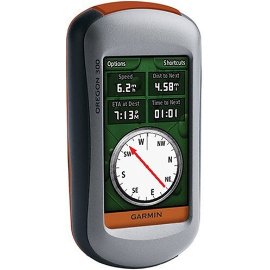
A good little hiking GPS with a nice feature set.
PROS
- relatively accurate barometric altimeter
- small footprint
- adequate touchscreen (better than Colorado rocker wheel)
- quick GPS signal seek
- multipurpose: Hiking, biking, motorcycle, and skiing
CONS
- screen brightness is very dim even at full brightness
- lack of any decent maps included. Why on earth can you get full driving maps with a bargain basement car GPS and not this hiking GPS?
- battery life, you have to buy a good set of rechargeables
- screen gets scratched (requires a screen protector)
Once you have a good set of street and topo maps this thing is a gem. It ends all arguments about how many miles and what your total elevation was. It doesn't really substitute for a real car GPS but can be used in a pinch in the car to direct you to your destination. Overall I've been very pleased with the purchase and if you're looking for a hiking GPS they're aren't a whole lot of options that are far and away better than this. |
| |
"Better than my last GPS, still room for improvement" | 2009-10-31 |
| - Reviewed By jcdoll |
| I've had the Oregon 300 for a few months and am very happy with it. I mainly use my GPS to record track logs on hikes and then use the data to geotag my photos. Signal quality is fine and battery life is about 16 hours. The backlight is weak, and you will have trouble seeing the screen if the sun is overhead. This is annoying but doesn't affect the usefulness of the device too much. If you're upgrading from a GPS more than a few years old you'll probably be quite happy with this GPS. |
| |
"Simple, fast install, strong product" | 2009-09-18 |
| - Reviewed By User: A9LKDFUHZBBEQ |
| Bought this for my Garmin 300 to attach to my KLR650. I've put it through a few rough offroad rides and have have zero problems with the mount slipping and my GPS was held securely the entire time. |
| |
"Garmin Oregon 300 for Geocaching" | 2009-09-15 |
| - Reviewed By User: A2C1Z6E3BH589B |
The touch screen on this is a definite improvement over the Colorado. When going for geocaches in the woods, you can change screens easily with one hand. And, like the Colorado, the big advantage over other Garmins for geocaching is the cache description and hints. The touch screen is also just about right - takes a definite pressure, but will not over react to slight pressures.
It does take a significantly increased time to first acquire - about the same for a Colorado, which also was definitely a lot slower than the Gpsmap 76. A definite negative that tries patience when you are going for that FTF.
As for accuracy for geocaching, well ... seems better than the Colorado, but that is not a definite. I still will sometimes get out the 76 which seems the best - but that might just be that this machine and I are more comfortable.
Anyway, bottom line - the Oregon buy was worth it to me.
Now, if only Garmin could figure out marketing, registering & and the transfer process of their map products a bit better....
|
| |
"Oregon 300: Great build quality, some minor quirks" | 2009-08-15 |
| - Reviewed By vw_ev |
I received my Oregon with firmware version 2.70. Once I installed the Mapsource software I bought from back in 2003 (Topo) I updated the firmware to version 3.10 (the latest non-beta to date).
Having owned many other GPSrs from Garmin, including the etrex, etrex venture, etrex legend, etrex vista, GPS V, GPS III+, and the GPS 90, I will say that the Oregon is a much welcomed evolution of Garmin's trail line-up. The touch screen is great, not too sensitive, not too resistant. It is resistive not capacitive (iPhone for example is capacitive). Because of this, you need to touch the screen a little harder to input something. Accuracy is on par with most modern GPSrs, about 10-20 feet on average without WAAS. Track reliability and accuracy is good. Little variation or drift that I have noticed, although some people claim that this unit drifts a bit when recording tracks. I have not seen this happen and have been on several 3-4 mile hikes so far.
Satellite lock is incredibly fast with the Oregon! Wow what a difference from my other Garmin gpsrs. By the time the unit boots up and hits the home screen the GPS will have already gained a 3D lock with about 6 satellites or more. First time lock was about 1 minute. Again, very good. Battery life is very good as well with the Oregon. With the compass turned off, WAAS off, battery save on, and backlight at about 40% I am getting about 14 hours with cheapo AA alkalines. The Oregon is said to do better with NIMH rechargeables > 2500 mAH. FYI, compass drain is about 20%, and WAAS is about 5%.
Build quality of the Oregon is one of my favorite selling points. It feels very substantial in the hand, with a very ergonomic, rounded back design and high quality plastics used throughout. The screen is solid with a thin plastic protective layer over it. It is also recessed about 1/8 inch for extra protection. There is only one hard button on the unit, the power button, so this unit should prove to resist wear and tear very well. Overall, very durable design. The battery door is also brand new for Garmin. It has a brushed aluminum latch that locks into the unit. Very nice and secure.
Feature wise, the Oregon is about on par with other GPSrs around this price range. You get full mapping capability, roads, topo, water etc. Screen is high-res. There are 4 data fields available for the map page (Garmin just added this ability in the firmware update). The altimeter works great, records pressure/time, pressure/dist, elevation/time, elevation/dist. It is self-calibrating and has the option of recording pressure with the unit off for weather predictions.
Overall, incredibly pleased with the unit. There are a few quirks with it, such as the mediocre visibility of the screen when not viewed orthogonal to the sun. It is viewable, but difficult to see. This would have been a deal breaker except for the fact that the brightness can always be turned up (does help a lot at the cost of battery life), and the unit can be tilted towards the sun for better viewing (very good visibility in direct sunlight). Also, the battery meter is not accurate. Garmin is working to fix this. As of right now, it is OK, but tends act in a non-linear fashion (first 3 bars go in about 2 hours, then the last bar lasts about 8 hours). Aside from these minor software issues (which will be ironed out with free firmware updates) the GPS is fantastic.
Pros:
+ Outstanding build quality + Lots of built-in memory for maps (850 mb) + Fits well in the hand + Battery life is good + Uses AA batteries (no sealed, rechargeables here! Thank god...) + High-res screen + Super fast satellite locks + Accuracy
Cons
- Battery meter is buggy - Screen visibility is mediocre |
| |
"Good, with flaws" | 2009-08-14 |
| - Reviewed By lilbyrdie |
We got one of these to replace an eTrex Vista CX. The high sensitivity receiver and paperless geocaching were our main points for getting it.
For those things, it works well. Being able to log caches out in the field, see all of the cache information -- including hints and logs -- is great. The screen backlight is dim, but once you get out in to full, bright sunlight the screen is perfectly readable. In fact, after getting used to this, we've started turning the screen brightness down and using sunlight to read it. That's right: it's easier to read in the sunlight! The brighter the light, the better. Adjusting the backlight is easy, but not intuitive -- tap the power key. Had to look it up the first time.
The touch screen is hard to use. It would benefit from having a stylus since it's resistive type rather than the much-easier-to-use capacitive type. It's very, very easy to accidentally hit buttons while scrolling. This has caused grief at times by canceling navigation, or other hard-to-recover-from actions. We're worried about scratching the screen, though.
The geocaching features are great. It's easy to load up hundreds of caches and find them. What's not so easy are selecting them on the map. It's hard to use with a finger to get the pin over the geocache -- very touchy. Using a pen cap as a stylus helps a LOT.
GPS-wise, it works well and is definitely better than our old unit. It locks on faster and stays put in a smaller radius. It's still not "perfect" but it's better.
The compass, however, is our biggest point of complaint: it's crappy. There are only two settings: auto and off. Auto means at speed it switching to using GPS location differencing to determine the orientation. When you slow down to walking speed, it's supposed to switch back to electronic. It doesn't. Instead, it turns off. This is unbearable and we've contacted Garmin tech support to figure this out.
Reads mini-SDHC cards just fine (we tried with an 8GB card), though it's built-in memory is sufficient for storing tracks and hundreds of geocaches.
The shaded basemap is great, but it would be nice to have some other option besides hundreds of dollars for a very detailed map -- like a slightly higher level of detail for another 25 or 50, even if it didn't include more roads.
Can't seem to figure out how to power it through USB while using the device. The Vista allowed for external power while in use, which was great for in-car use. I suspect it requires a "special" adapter, instead of just an ordinary cable.
Battery life is better than the meter implies. We've seen it drop to one bar, then go back up to 3 for another day. Goofy.
If all the issues were fixed, it'd get a solid 4 stars. As is, it's a 3.5 rounded down. |
| |