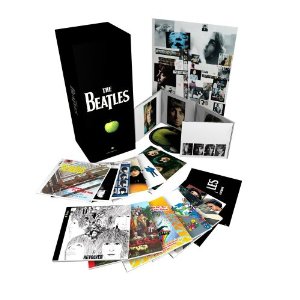

It's actually been several years since I have listened to any of the Beatles CD's released in 1987. After listening to all these remastered CD's of 2009, I will have to say, it was definitely worth the wait! I listened to all of the CD's on this stereo with a bass speaker. To me, they sound phenonmenal. You get to hear an efficient balance between the vocals and other instruments being played. Of course, the loudness of the vocals have to be sacrificed, but that's just the the way stereo versions work. Anyway, with that said, I'll talk about the albums individually:
PLEASE PLEASE ME: As we all know, this is the first Beatles' studio album. It consisted of songs that they has played previously during their Cavern and local club days. (The Cavern was one of the clubs in London, England that the Beatles' performed at prior to their stardom years.) It features Lennon and McCartney songs like "Love Me Do" and "P.S. I Love You" and well as songs written by people the Beatles' admire, such as "Chains" and "Boys"
WITH THE BEATLES: As with their debut album, this is a fine one. It features new songs by John and Paul, like "Little Child" and "Not a Second Time", songs by their heros like Chuck Berry's "Roll Over Beethoven" and Meredith Wilson's "Till There Was You", as well as George Harrison's debut for songwriting, "Don't Bother Me".
A HARD DAY'S NIGHT: These consisted of songs written for their first film of the same title. This has songs in the movie like "A Hard Day's Night" and "Can't Buy Me Love" and songs not featured in the movie like "I'll Cry Instead" and "Things We Said Today". This happens to be the only Beatles' album where all the songs are written by John Lennon and Paul McCartney.
BEATLES FOR SALE: This album was when the group started to expand their musical horizons. You have the pessimistic messages in the Lennon-McCartney song "Baby's in Black" and "I'm a Loser", which was inspired by some songs of Bob Dylan. Along with these, you have songs written by some of the group's heros, such as Chuck Berry's "Rock 'n' Roll Music", Buddy Holly's "Words of Love", and Carl Perkin's "Everybody's Trying to Be My Baby".
HELP!: The album here contained songs for their second film of the same title. It has the rocking title track, "Help!", the folk-based ballad, "You've Got to Hide Your Love Away," "Ticket to Ride", and the McCartney classic, "Yesterday", (which was originally titled, "Scrambled Eggs!"). This was also, the time when Bob Dylan had introduced them to marijuana. Therefore, you could say that some of the music and lyrics was inspired by these drug phases.
RUBBER SOUL: Once again, the Beatles were expanding their musical creativity. In the Lennon-McCartney song, "Norwegian Wood (This Bird Has Flown)", George played a sitar, an ancient Indian instrument. John also wrote songs depicting human introspection such as "In My Life" and "Nowhere Man". Paul was writing tender ballads like "Michelle" as well as more songs on a personal level such as "I'm Looking Through You". George contributed the songs "Think for Yourself" and the Byrds-flavored "If I Needed Someone". The jacket cover was taken by Robert Freemen, (who has been their photographer ever since WITH THE BEATLES was released.) This photograph happened accidentally when he was protruding slides of his photographs on a card the size of a record or LP. The card then fell backward and somewhat stretched one of them. All four members immediately insisted this one to be on the front cover of the RUBBER SOUL album. So Robert complied.
REVOLVER: The Beatles' horizons in being creative were ever-so growing. It consists of three new songs by George Harrison: The rocker, "Taxman", the Indian-inspired, "Love You To", and the moderately paced, "I Want to Tell You". It also features innovative Lennon-McCartney songs. Among them are the following: The classic-inspired, "Eleanor Rigby", the folk ballad, "Yellow Submarine", as well as the LSD-influenced songs, "She Said She Said" and "Tomorrow Never Knows". The jacket cover was unique for its time. Klaus Voormen, an art-student friend in Hamburg when the Beatles performed in the city during their early years, drew line sketches and combined them with a collage of photographs of the Beatles.
SGT. PEPPER'S LONELY HEART'S CLUB BAND: The Beatles stopped touring and playing at concerts at this time. Therefore, they wanted to put all their time and energy into the recording studio. That's exactly what they do here. Paul once replied "Let's pretend we're not the Beatles." That's how he came up with this imaginary title for the album. The group wanted to use more and more instuments; from those used in orchestras, to tape and electronics, to the guitar and drums, to the sitar. You get it all here. You hear rockers like the title track, "Sgt. Pepper's Lonely Hearts Club Band", rockers like "Getting Better" and "Good Morning Good Morning", and the sitar-inspired song, "Within You and Without You". I as well as many other people consider this album to be the epitome of the "Summer of Love" in 1967; time of the hippies, people avoiding the draft for Vietnam, Timothy Leary's "Turn On, Tune In, Drop Out" message, and free love. The jacket cover was fasioned by Peter Blake. He made it inspired by John and Paul saying to him that the group was imagining them selves as some other band, that they would perform in a park, and all these people would come and watch them. So, Peter would grab photographs to make into a collage, bring in wax figures, and well as flower and plant arrangements. All this would make as stated about Revolver, a unique album cover for its time.
MAGICAL MYSTERY TOUR: I personally don't see a large difference between this album and the "Sgt. Pepper" album because many of the sounds still sound 'psychedelic' The differences are that it consists of some new songs that were put into a television film of the same title. That's not to say that "Magical Mystery Tour" is not a great album. It was released during the end of the year of 1967, and became successful. It contains new Lennon-MCartney songs used in the movie such as "Magical Mystery Tour", "The Fool on the Hill", and "I Am the Walrus" as well as songs released previously such as "Hello Goodbye", "Strawberry Fields Forever,", "Penny Lane", and "All You Need is Love".
THE BEATLES: Also known as "The White Album", this became the first time when each member of the group started to work as individuals. Sure, they still played together. But each member would write and record songs for himself. John would bring in songs like "Dear Prudence", the rocker, "Happiness is a Warm Gun", the blues-flavored, "Yer Blues", and the folk inspired, "Cry Baby Cry". Paul would include rockers like "Back in the U.S.S.R.", "Birthday" and especially, "Helter Skelter"(which I would say was an inspiration for heavy metal). Paul would also write the folk-based, "Blackbird", the 20's English/jazz based songs, "Martha My Dear", and "Honey Pie". George would able to write and record four new songs: "While My Guitar Gently Weeps", "Piggies", "Long Long Long", and "Savory Truffle". Finally, Ringo would write and record the enjoyable song "Don't Pass Me By". The recordings were large enough to make the album a two-record set. Some people complained about this. However, the album still went No. 1 and became a gold album. Paul McCartney would retaliate by saying that since the album did extremely well, he did not see what all the fuss was about. I agree.
YELLOW SUBMARINE: This album consists of songs featured in the Beatles' fourth film, "Yellow Submarine". It consists of two new Lennon-McCartney songs, "Hey Bulldog" a rocker, and "All Together Now", a folk-based ballad. Also, it contains two the previous Lennon-McCartney songs, "Yellow Submarine" and "All You Need in Love", as well as two new songs by George Harrison, "Only a Northern Song", and "It's All Two Much". The rest of the album consists of pieces of film score, both composed and conducted by George Martin, the Beatles' album producer. Because of this, many people think that this is not a true Beatles' album. While I can understand where they are coming from, I would defend and say that's what makes this album different from the other Beatle studio records. After all, the Beatles, did not want to repeat themselves from what they did previously. Also, while the album did not reach No. 1, either in the United States or the United Kingdom, it sold well enough to give both the Beatles and George Martin comfort. Plus the film itself was well-received, unlike "Magical Mystery Tour".
ABBEY ROAD: This would prove to be the Beatles' final album that was made. This would be made since they were disheartened with the GET BACK album,(which would later be changed to LET IT BE.) Along with that, they would stop fighting with one another. John would write and record rocker songs like "Come Together" and "I Want You(She's So Heavy)", as well as the classic inspired, "Because". Paul would write and record well-paced songs like "Oh! Darling", and the black comedic,"Maxwell's Silver Hammer". George would bring in the nice ballad, "Here Comes the Sun" and the chart topping "Something". Ringo, would write and record the song "Octopus's Garden". John and Paul on the opposite side of the album would write and record songs for a medley such as "You Never Give Me Your Money", "Polythene Pam", "Golden Slumbers", and "The End". "Abbey Road" would go on to become what many would consider, (I myself included the groups' best album.) It did not feature any studio tricks or exotic instruments which were on "Sgt. Pepper". The album also proved that The Beatles could still perform rock 'n' roll as well as have their creativity at their peak!
LET IT BE: "Let It Be" is an interesting album as well as a fine one, because it was made when a lot of the tensions and fighting (which started during the "White Album" sessions) escalated. Paul's idea for the album was to make a documentary of the group rehearsing songs at Twickenham Film Studios in London and then perform them at a concert. However, all members of the group were growing tired and constantly arguing amongst themselves and found that the film studio at Twickenham to be cold and uninspiring. So they took some time off from the album, and eventually moved to the basement studio of Apple located in London's West End. George Harrison also recommended that they bring in keyboardist, Billy Preston, whom they had met in 1962. While Billy did decrease a lot of the tensions and the nonsense shown at Twickenham, it did not solve everything. After the album and film was finished in January of 1969,both got shelved. Then along came Phil Spector and (against Paul's authorization), rearranged some of the songs with both orchestras and choirs. Among them are "Let It Be", "Across the Universe", and "I Me Mine". After a lot of struggles, "Let It Be" was finally released in May 1970. Some people have a problem with Phil Spector's involvement with the album, and I repsect their opinion. But I don't. I think that's part of what makes "Let It Be" different from the other Beatles' albums. It's also a 'funner' album to listen to beacuse you get hear the members crack jokes and make false starts during some songs.
PAST MASTERS: In 1988, Capitol released this two record set that consists of songs or different versions of songs not released on the Beatles' previous studio albums in England. These songs were either released as singles or on what they calle EP's(Extended Plays). Among the collection of songs on this two CD set are the following: "Love Me Do"(The original single verion with Ringo playing drums), "She Loves You", "I Want to Hold Your Hand", "Day Tripper", "We Can Work It Out", "Get Back"(which is different from the album version on "Let It Be"), "The Ballad of John and Yoko", and "You Know My Name (Look Up the Number)" (which was featured on the U.S. flip side of the "Let It Be" single. This collection of songs are great for any casual Beatles' fan who like I said are not too familiar with the songs not released on their previous studio albums.
Each remastered album is finely packaged, (which consists of fold-in CD covers), and features a litte booklet which consists of rare photographs of the group as well as containing information about both the songs and the albums themelves. Examples, of this are the following: When the albums were recorded, when the albums were released, when the songs were written, and how each member was inspired to write the songs.
THE MINI DOCUMENTARIES: This is a DVD which consists of short documentaries about the making of each of the studio albums. They're not much more informative than the booklets, and I realize that some of the film footage and interviews are borrowed from THE BEATLES' ANTHOLOGY, but I find this DVD to be entertaining enough.
Everybody is entitled to one's own opinion about this remastered stereo box set, but I think it's a masterpiece! The music is restored well enough to be audible to the human ear and think will be remembered and studied for years to come. Anyway, that's my opinion. Take it, or leave it!
|
After the death of Michael Jackson, arguably the biggest music news of 2009 was the release of a remastered Beatles catalog. In 1987, The Beatles' albums were released for the first time on CD in groups throughout the year and have been shunned by Beatlemaniacs and audiophiles alike ever since. Compared to the original vinyl, the 1987 CDs lacked punch, clarity, and in short: didn't do The Beatles justice. Other bands from the British Invasion era like the Rolling Stones and The Who as well as later acts like AC/DC and U2 have come out with remastered versions of their classic albums, but The Beatles' discs remained untouched. Now, twenty-two years later, The Beatles have finally succumbed to the benefits of modern technology and the results are incredible.
For the first few albums, the differences are less noticeable which is most likely due to the limitations of the original recordings. However, the harshness of the lead vocal parts is gone and there is a much better balance and clarity among all of the instruments. The most noticeable change early on is in the bass and the vast improvement there is present throughout every album. For the best example of this, listen to the new remaster of "When I'm Sixty-Four" on Sgt. Pepper's Lonely Hearts Club Band. Sorry vinyl fans, until the vinyl remasters are released, this new CD version will be king of Paul McCartney's bass lines. After the first four discs, the improvements become significantly more noticeable with each album that follows. Help! opens with the title track and right away the differences between the original CDs and the remasters are staggering. The lead guitar, swallowed under the mix almost completely in 1987, is now crystal clear. Everything seems brighter, more present, and significantly more defined. For me, it felt like I had been listening to The Beatles play from the house next door for 22 years and I finally invited them over to my place to perform.
As a violinist, one of the things I was most looking forward to in the new remasters was improved string section clarity. The differences are first noticeable on tracks like "Yesterday" where the cello is especially more present, but where the string detail really shines is on Revolver. "Eleanor Rigby" was always a feature track for strings, but they never felt like the feature on the original CDs. In 1987, the CD mastering techniques forced the string section behind the vocals in such a way that they were present, but often neglected in the mix. Thanks to the efforts of Guy Massey, Steve Rooke, and Allan Rouse among others, the new remasters give the string section a new life worthy of any string player's praise and adoration.
In my opinion, the greatest difference is heard on the final chord of "A Day in the Life." The crescendo build up is legendary, but the final piano chord fade out is heard like it has never been heard before on the new remastered version of Sgt. Pepper's Lonely Hearts Club Band. There is so much more clarity in the overtones of the pianos that, with the right pair of headphones, one can hear certain notes on each of the three pianos used for the recording ring out just a bit more than others; a feat that could never be fathomed in 1987.
Die hard Beatles fans will most likely want to pick up the mono version of the box set along with the stereo set, but for the vast majority of listeners who have been listening to the 1987 CDs for the past two decades or even fans who have never updated their original vinyl collection, the stereo remasters are absolutely worth the investment. For over forty years, The Beatles have been regarded as one of the greatest bands ever and their new remasters should do nothing but further solidify that reputation. |
Ok, I haven't bought either of the box sets yet, but I have listened to them with friends on my system, and others. One of the most stupid comparisons to date, is that the Capitol Box sets sound better. Well, they do if you love over-compression, and harmonic distortion, particularly on Meet the Beatles and 2nd, (this is how we first heard the Beatles in this country by way of the Capitol engineers attempt to 'improve' the recordings for American listeners). I do own the Capitol sets, because I'm nostalgic that way, not because they were superior recordings.
If you are hearing mud out of these new re-masters, either you have a crap system, no real reference to how music should sound, or you need a Q-tip to get all of that wax out of your head.
As a RE-MASTER, NOT A REMIX, this sounds great. Granted, I would love to see the catalog remixed, ala Yellow Submarine Soundtrack, as an optional set down the road, but these are THE original two-channel mixes, pumped and filtered a bit, but not in a heavy handed way.
As to the audiophiles that sit pontificating as to how horrible this set sounds compared to the original vinyl, please remember; audiophiles only believe in vinyl and tubes and all else is false and defective audio-wise. To admit that a CD can sound better than vinyl would be an admission that they may be wrong about vinyl superiority (spending 100,000.00 on a turntable does not give you gravitas). Most are not engineers, or musicians, and don't really know what music really sounds like, they just know what they like, and take those likes as gospel. So disregard these nitwits and get this box set! If it sounds bad to you, double check your system and your ears.
I am an active recording/mastering engineer,(about 30 years now) and an active musician (about 40 years, and I play three instruments), and a die-hard audiophile (I prefer being called an audio enthusiast as audiophiles are now viewed as snobs and loonies in most circles)and I really like what I am hearing on these discs, including the Mono CD's.
I think the other complaints stem from a change from the familiar. These do sound different from the original issues, (better I think), with enough difference to put some listeners out of their comfort zone, (something like,"it should sound the way I remember, not like a new release").
Funny thing is, I used to have all but a few Beatle albums on pre-recorded open reel tape, which sounded much better than the vinyl at the time (still do), and these CD's put me in mind of the quality level of some of those tapes. The ones I still have do sound better than the original CD releases, and much better than the vinyl. My few audiophile friends have been stunned with how the old tapes sound, but are unhappy with the re-mastered CD's that sound frighteningly like those tapes, or better. Go figure.
The other stupid comments is that there are songs missing. Hello! These are Parlophone/EMI versions of the albums. Open up the Past Masters discs, and I think you'll find the missing tunes, genius.
Just by the CD's, and enjoy, Just remember, It's Getting Better All The Time! Cheers! |