
"patriots surviving the coming collapse" | 2009-10-23 |
| - Reviewed By User: ATGQ9DSH2C0RO |
| this is the newest publishing or third revision great book must read you wont be able to put it down I took the day off work to sleep since i was up all night reading have read several times great book |
| |
"Loved it so much I'll read it twice" | 2009-10-22 |
| - Reviewed By wjgilmore |
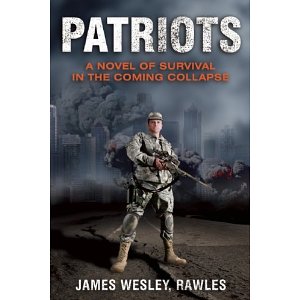
Having been on an armageddon-themed kick as of late (One Second After, Wastelands: Stories of the Apocalypse), I picked this book up in a remainder bin while on a recent vacation. Despite the rather cheesy book cover, this book has all of the elements one could want: heroes, antagonists, love, tragedy, war; all wrapped up in a fascinating story which recounts the societal collapse of the United States following a financial meltdown (sound familiar?). You'll even learn some pretty interesting survival tips along the way!
Loved it, I'd give it six stars if Amazon would let me. |
| |
"Fascinating subject matter, but no thrilling narrative to be found" | 2009-10-17 |
| - Reviewed By User: A1FN6AG539KS46 |
As an enthusiastic post-apocalypse fetishist, I was excited to get started reading this book. I'll read any kind of societal breakdown novel I can get my hands on, whether it's the superflu, nuclear holocaust, asteroid impact, zombies, or alien invasion. It's just my thing. So when this book popped up on my radar, with it's currently relevant what-if theme, I was thrilled to have something fun to read again.
Boy, was I wrong.
Now, don't get me wrong here, I think survivalist gear, methods, and guns are the coolest ever and if this book was a little heavy on technical details ONLY, I wouldn't be giving it only 2 stars. As it is, it is VERY heavy on technical details at the expense of setting, character, and plot. It's also a political and religious screed, which I personally believe has no place in a work advertised as a piece of fiction. At least be subtle with it if we must go there. The problem with this book is that it feels like the author took his first draft and all of his character research and bio information and just stacked it up in a pile and mailed it away to his editor. The editor of course, rearranged the pages so that there was something of a story there, then published it.
The cardinal sin of fiction writing is for an author to get between the action and reader. Rawles does this repeatedly in several ways that I've noticed:
1. Rawles summarizes action and conversations constantly (what action there is). Instead of putting me, the reader, in the protag's shoes and letting me experience his or her action as it happens, I get summary after summary. Then he goes on page after page explaining in minute detail exactly how to make plate steel shutters for the retreat. Page after agonizing page (my eyes are still bleeding from that one). He summarizes the action where Rose gets shot. He summarizes Doug Carlton's ENTIRE LIFE when all we really wanted was a small window into what was happening outside the compound - in fairness, we get some of that, but it's buried in page after page of character bio "I was born.. I loved Erector Sets so I guess that makes me a natural engineer and survivalist.. And Pop Tarts with sprinkles and special butter made from our organic survival cow's milk.. Etc..". Sweet Mother of God this is a hard book to read. Rawles cut and pasted Doug Carlton's character bio right into the book. In fact, he did that with all of them. The whole thing is written in the third person, which is okay, but it's so sterile and so disconnected that I honestly don't care if the characters succeed or fail.
2. Rawles constantly puts quotation marks around phrases and words. It's almost like watching that one guy you know who uses finger quotes all the time when he talks. I don't need finger quotes and I don't need sentences like this one:
When Mike bemoaned the fact that there was an "ocean of paperwork to wade through" in getting set up with an explosives permit in Illinois, Spence offered to add Mike to his blaster's permit, listing him as an "employee." (p. 50).
That line is straight from the text and all I did was open the book to a random page and scan for .01 seconds for quotation marks.
3. Rawles somehow got it in his head that not only adding a dialog tag to every line of dialog was necessary, but making every dialog tag different was what a writer was supposed to do. How his editor missed this is beyond me. Here's what I mean (my own example):
"I brought the package," declared Jerry.
"That's great. Put it over there," commanded Lou.
"Right here?" queried Jerry.
"Yes, by the car," Lou directed.
As boring and uncreative as it may seem, just putting in "said, asked, or answered" in there would have kept the author out of the interchange and maintained the suspension of disbelief, which is what good fiction is all about any way. Even better would have been to limit the tags altogether and just use ACTION:
"I brough the package."
"That's great, Jerry. Put it over there," said Lou.
Jerry walked to the garage where the others were loading the bodies. "Right here?"
"Yes, by the car."
Rawles' characters muse, snap, opine, gripe, whine, retort, snort, and on and on. Endlessly.
4. Rawles ignores the rule that says that anything that doesn't contribute to the plot must be cut. Must be. Now, I know that part of the marketing of this book is that it provides technical detail for how to set up and survive in a compound, but doesn't he also have a non-fiction title out that explains all that already? He should have included only as much information as was necessary to move the story along. He could have summarized the details of the house and the compound in three paragraphs and simply added an Appendix with links to his blog that already details how each and every little thing is done.
5. Finally, a person is a "who" not a "that." In the text, Rawles says something like, "it was Jerry that put the package by the car." Ouch, dude! C'mon, you may be an expert survivalist, why not become an expert writer and learn the craft before doing this to your poor readers.
As a result of all of this, even though I have these detailed histories of the main characters and their relationships with each other, I really couldn't care less about them. The author has not brought me into their world. He could do this by putting me in the shoes of ONE of the characters, say Mary. During one of their "hasty front, large group on foot" spider hole ambushes, where they interrogate people passing through, let it all go horribly wrong and show us how truly resourceful these people are in the heat of the action. Mary gets injured, Mary gets captured, but Mary somehow ends up saving the day, with us Readers faithfully by her side the whole time. Not in this book. I admit that I'm only halfway through it so I don't know what has happened to the Laytons (I think that's their name), nor do I care, sadly. If they are out there, we can't be halfway through the book without getting at least a little peek at what they are up to.
There's also no antagonist or opposition character(s), at least not yet anyway. The Crunch can't be the opposition. Just can't.
Again, much as I admire the labor required to produce such a book and as much as I enjoy this subject matter, I'm convinced that Rawles had no editor and that his book was published solely based on his expert survivalist credentials. (See, did you need me to write "expert survivalist credentials?" No.)
I could go on. I'm halfway through this thing and there is so far no plot and very little action. So you spent a ton of money and built the perfect retreat. That's nice. Isn't it the people that are important and not the gear? What do these resourceful people do when some of their numbers are killed or captured and the leader is mortally wounded? Heck, maybe all that happens starting in the next chapter. Isn't adventure what happens when everything goes wrong? I've learned that the best way to create compelling conflict is to stack the odds against the protagonist so high, that it's impossible to imagine that he or she could be successful. Have Mary get captured and make Todd have to leave his safe little compound, get shot in the leg so he can't move fast, fall down a ravine, lose ALL of his fancy gear except for a Hello Kitty pencil and a stick of gum, and rely on his wits instead. Heck, that might be a good way for Rawles to demonstrate some wilderness survival and field craft.
Don't advertise it as a thrilling narrative when it's nothing of the sort.
I'm going to finish it to be fair to it. But so far, it's a hard slog. |
| |
""Progressives" need not apply" | 2009-10-16 |
| - Reviewed By User: A2IEGLTFIVTTPR |
Every once in a long while a book comes along that compels the reader to rethink everything. I mean EVERYthing. This book is certainly one of the most thrilling and entertaining editions from that thought-provoking genre. Many readers will rely on the imbedded "how-to" aspects of this novel, but beware: there are far deeper and more meaningful matters brought to mind in this tale. The geo-political, moral, spiritual and personal themes the story presents are compelling issues that most younger Americans have never seriously considered, let alone dealt with during high-stakes hardship.
Modern American life features conditions made possible by the self-sacrificing efforts of generations of free people who went before us. We enjoy luxuries today that our forbears couldn't possibly dream of, let alone achieve with any durability. Hunger, disease, suffering, poverty, hard racism and violence plague our nation in fractional doses compared with a majority of our history. Unfortunately, so too many virtues eroded; society engineered away notable skills, arts and personal qualities. Common sense, character, discipline, self-reliance and practical wisdom now represent fringe vestiges of a bygone people. We see the manifest results today in our slothful, selfish, litigious and fame-infatuated culture. This book asks the reader to consider the mechanisms that led to this decadent conclusion, as well as the sacrifice, labor and valor it might take to restore the land. It does so in a very entertaining and technically riveting fashion.
Yes, some will find annoyances, and the book is not above critique. Secular readers will find it difficult to sympathize with the liturgy, though not necessarily with the morality of the subjects. Readers well-versed in the U.S. Air Force will snicker at glaring inaccuracies regarding the Service compared to the razor-sharp realistic portrayal of Army matters. This is absolutely forgivable under the circumstances of the author's service, but an honest critique must include both good and bad. In all, there is very little open to critique in my opinion.
The plot might represent a worst-case scenario, though some might find it too optimistic. As a reader who has worked for years "inside the beltway" on national security matters, I find the plot entirely plausible and not unlike periods of unrest common worldwide. All one has to do is imagine what would happen if our 21st Century society was reduced to conditions common here in the 1930s or 40s. Generally speaking, Katrina focuses the mind on the potential crisis. Specifically speaking, every person is only 7 meals away from truly becoming a savage.
I highly recommend this book for a variety of reasons: it's entertaining, practical, insightful and well-informed. The most important reason for my endorsement is the Constitutional views of the author and the remedies he proposes. One might not agree with all of them, but I find them compelling echoes of America's Founders. Every reader will certainly be a better citizen after considering the issues touched upon in this book, whether they decide to prepare to "Get Out Of Dodge" or not.
|
| |
"Instant Classic" | 2009-10-16 |
| - Reviewed By User: A3E0LFP21VR9B |
| What an awesome book. Very readable and hard to put down. I enjoyed it immensely. I now count it amongst my favorites in this category, along with Unintended Consequences, Enemies Foreign and Domestic and Molon Labe! If you enjoyed any of these books, or are interested in this subject matter, you won't be disappointed with Patriots. This book has influenced me to look at my own preparations for surviving any kind of disaster in a lot of new ways. |
| |
"To much info." | 2009-10-15 |
| - Reviewed By User: A1CSI39YF1OWLG |
While the premise for the book is great, the author gives entirely too much information. I didn't need to know the exact brand and model of the weapon{s} that the a character is carrying each time that person is mentioned. The same for knives, grenades and any other type of weapon you can think of.
A complete chapter wasted on a lesson about how transmitters and receivers (radios) work. And yet another 2 chapters wasted on a side story unrelated to any of the other characters in the book, and uncompleted. I would still like to know what happened to Matt,Chase and their family. This book could have been at least 100 pages shorter and a much better read.
|
| |