
"A great soapmaking reference for creative, teachable spirits!" | 2009-07-14 |
| - Reviewed By User: A2WVF9ZQ068DN0 |
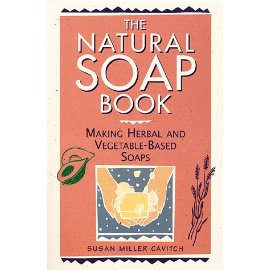
I began making my own soap about 15 years ago. I learned the basics from another soapmaker in her shop in Colorado. This was before all the many books and resources on soapmaking became readily available. I bought this book as soon as it came out. It, along with several others, were great resources for expanding my knowledge and technique with soapmaking. I see so many reviews that make these types of books "all or nothing" propositions. These books were never intended to present "the ONLY way" to do anything! NOTE: I don't superfat my soaps and I don't use GSE. I don't do much of anything EXACTLY the way anyone else does. I do keep a huge database of information (the science of soapmaking, essential and base oil information, additive information, etc.) that I've compiled from many, many sources. THAT database is my soapmaking "Bible." That's the beauty of getting a good knowledge base from many, many sources along with actually experimenting on your own! Completely uneducated, very poor people throughout the ages have been able to make perfectly servicable, even magnificent soap without reading a single book on the subject, much less having the wealth of knowledge we can get on the internet. While the science of soapmaking is fascinating to me, and you can certainly make soapmaking into rocket science if you want...it really isn't rocket science! Go make some soap! Keep notes on what went great and what didn't. Grate your failures and use them for laundry or household soap. Blaze new trails! One of your experiments may turn out to be infinitely better than any soap you could have copied from anyone else! Build yourself a nice library about ANY topic you are passionate about. Read a variety of authors, enjoy the contradictions! Then GO...GO and create your own way, your own dream, your own method. Experiment. Learn from success and failure! If you don't have the money to buy more than one book before you start a new craft or hobby, go to the library and borrow them! Stand on the shoulders of giants and the wee little people who gave you even a hint of help in achieving your goals and dreams. Write your own book and share what YOU'VE learned! |
| |
"The Natural Saop Book" | 2009-01-30 |
| - Reviewed By User: A1RWKANG9ZVUJN |
| Great book and easily understood for anyone making soap, especially for the first time. My sister-in-law suggested this book as a reading to gain understanding in the soap making process. Thanks for this resource. |
| |
"The green way to be clean..." | 2008-11-09 |
| - Reviewed By User: AKZT0PTKRV5Z8 |
| This book was definitely a huge source of information in a compact package. Great tips, well written instructions. |
| |
""Natural' isn't always better..." | 2008-08-24 |
| - Reviewed By User: A3UHJXICA21QOM |
I just finished reading Susan Miller Cavitch's The Natural Soap Book and found it lacking in several respects.
There is a pervasive preachy tone to this book that annoyed me horribly. Ms. Cavitch uses the book as a soap box (pardon the unintended pun) to promote several personal points of view, two central ones being her diatribes against the use of animal products and anything synthetic. My grandfather made soap the old-fashioned way, using the hot process method. He made his soap by boiling lye with animal fat he had rendered himself, much of it supplied by his children (including my mother). My mother always kept a coffee can in the refrigerator, and whenever she cooked any fatty meat, the grease when in the can. When it was full, it when to her father to be turned into soap. This grease probably wasn't much good for anything else, and was certainly full of unhealthy saturated fats; had it not gone into soap, it would have gone into the garbage. The vegetable oils Ms. Cavitch advocates using are mostly edible, and in many poor countries, vegetable oils are a significant source of calories. Increasingly, non-food uses of vegetable oils, most significantly an ever increasing demand for bio-diesel, have driven the price of these oils up to the point that many poorer populations around the world are being pushed dangerously close to starvation. The increased demand for these oils has also led to whole-sale destruction of virgin tropical forest, as huge plantations of oil palms are planted. So, our luxury all-vegetable soaps are made from oils that in many nations would be considered too valuable as food to be used for such a frivolous purpose as bathing, and further, the production of these soaps, although insignificant compared to the production of bio-fuels, can still not be completely divorced from the destruction of natural forest and the concurrent loss of bio-diversity inherent in the increased production of vegetable oil. So, which is better? To plow under rain forest to plant oil palms for soap, when the workers who labor on these plantations can't even afford the oil they produce for food, or to use animal fats that would otherwise go to waste? Personally, I prefer vegetable oil soaps, but I am also aware of the consequences of this preference and do not pretend that this puts me on a higher moral ground than people who bathe with tallow products. And although I also prefer `natural' products, many of these products are luxury items that are beyond the budget of most of the world's population. People who can't afford food are unlikely to spend $6.00 on a four ounce bar of pure castile soap. Synthetics, although by no means perfect and by no means lacking in potential harmful side effects, have made improved hygiene affordable to huge segments of the human population that would otherwise face much higher mortality rates due to a lack of basic cleanliness. These products have brought inestimable benefit to mankind, and although not without their faults, I would have liked to see a far more balanced discussion of them.
My final comments on Ms. Cavitch's book are technical. She doesn't discuss the use of the stick blender in home-made soap production. Many of the problems addressed in her chapter on trouble shooting can be avoided by the use of these wonderful gadgets; in fact, the 16 hour trace times she mentions for some soaps can be reduced to less than half an hour using one. Her section on trouble shooting also advises the soap maker to discard most failed batches; there is no discussion of rebatching, a technique that can be used to salvage all but the worst soap-making failures. The rescued soap might not be salable, but isn't it better to give away seconds than to throw your time and materials away?
I would advise a novice soap-maker to skip this book and buy Anne L. Watson's Smart Soapmaking instead. It is short, concise, practical, and a pleasure to read. It avoids many of the shortcomings that mar Ms. Cavitch's book.
|
| |
"The Natural Soap Book" | 2008-07-24 |
| - Reviewed By davesteffens |
| Great book. I've been making soap for over ten years and this is the first book I purchased when I started. I consider it one of my best sources of information. |
| |
"excellent" | 2008-05-19 |
| - Reviewed By numerya |
| I will try to make my own soap and this book is exactly what I was looking for : everything explained from beginning. Thank you Susan |
| |