
"Exciting read." | 2009-11-15 |
| - Reviewed By User: AJY2JAH3TW083 |
| I was pulled in from the git go. A documentary-style suspense thriller. Well done! |
| |
"Great gift" | 2009-11-09 |
| - Reviewed By User: A1Y3JQZ38DR0SY |
I purchased this for my husband's birthday. He is from Chicago. He's been reading it and has told me more than once that he loves the book and it reads almost like a novel. Once he's done with it, I'll be sure to read it, too!
|
| |
"Glorious and grizzly, Chicago's past comes alive" | 2009-11-04 |
| - Reviewed By User: AYZ2F6TZ7Z0US |
When I returned to Chicago after having been gone for decades, I looked at this remarkable city, its splendid lakefront and its vibrant architecture with new eyes. Who were the people and what were the events that founded this bigness of spirit?
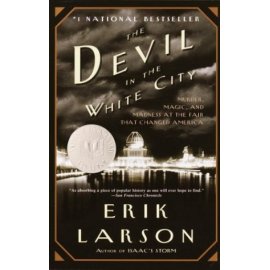
When a friend recommended "The Devil in the White City: Murder, Magic, and Madness at the Fair that Changed America" by Erik Larson, and I devoured it immediately. And I recommend this book to anyone who has become enthralled with Chicago's buildings, its culture and its optimism.
From the outset this book reads like the work of an expert journalist who did his research about Chicago around the time of the 1893 World's Fair. There is nothing like a rich treasure trove of historical photographs, maps, letters, architectural blueprints and court records from murder cases to fire one's imagination. I only wish that more of these documents were available to look at in the book. (I read the paperback.)
Two characters are drawn in detail -- Daniel Burnham, the ambitious architect and city visionary, and Henry Holmes, the maniacal and singularly effective psychopathic killer who managed to spirit trusting young women to their deaths right under the Fair's nose. The grandiose plans of both these men frame the portrait of this city on the brink of the 20th century. Sometimes the back-and-forth between their stories is awkward; but on the whole it's quick and gripping read.
The grotesque Holmes murder rampage is crime fiction based on fact, and really, you couldn't make up stuff more mesmerizing than this. It was all over the front pages of the Chicago Tribune for most of July, 1895, when the hotel that Holmes had maintained near the fair was searched for its grizzly secrets. But what the newspaper accounts don't do, and what Larson attempted a la Truman Capote, was to get inside the mind of a murderer so smooth that he was able to manipulate multiple victims like puppets dancing to their doom.
You'll find that what you repeat to your friends, though, are the dozens of fascinating details of the Fair itself, from the introduction of the zipper to the enormous Ferris Wheel. A magnificent machine that carried 60 passengers in each car and threatened disaster as it rained bolts with every revolution, it was accepted late from unproven designs on paper because leaders had come up empty-handed in their efforts to out-Eiffel the Eiffel Tower. They took a splendid gamble with that wheel, which went on to become the hit of the exhibition. Can you imagine getting that one past the lawyers now? |
| |
"A Review by Dr. Joseph Suglia" | 2009-11-04 |
| - Reviewed By User: AKP3K6EBNDGCJ |
Erik Larson's THE DEVIL IN THE WHITE CITY (2003) is an unclassifiable book. It seems to tolerate no generic distinction. Yes, it is a work of history---there are copious endnotes and a substantive bibliography; its research seems historiographically sound; every direct quotation is taken from an imposing armature of reputable sources. And yet it reads as if it were a novel.
The book is concerned with two figures who are said to be diametrically opposed to each other: Daniel Burnham, one of the chief architects of Chicago's world fair, and H.H. Holmes, murderer of young women. Both are said to be emblematical of the Gilded Age, that is, late nineetenth-century industrial America. And both are said to have converged at the World's Columbian Exposition.
The book's premise seems to be that, in America's Gilded Age, two polar energies were at work: that of technological construction and that of destabilization, the grandeur of architecture and what erodes stability and the ascent of progress. Larson further qualifies this opposition in his introductory "Note": "[I]t is a story of the ineluctable conflict between good and evil, daylight and darkness, the White City and the Black."
But are architecture and destructuring, "good" and "evil" parallel oppositions? Where can "good" and "evil" be seen in the Gilded Age outside of these two isolated figures? Are architecture and destructuring indeed opposed to each other? Where else was this vague destructuring at work in the Gilded Age? Outside of a description of what Holmes and Burnham did and said, Larson does not provide answers to these questions.
The "voice" of the work is that of the grandfatherly storyteller. Nearly every sentence is bloated with hoary bombast. Patiently, bombastically, the author recounts the stories of the murderer and the architect. And yet what is the meaning of it all?
THE DEVIL IN THE WHITE CITY never affords its readers access to the killer's mind. In the section of book entitled "Notes and Sources," Larson concedes, "Exactly what motivated Holmes may never be known." He defers to "what forensic psychiatrists have come to understand about psychopathic serial killers." But should forensic psychiatry be given the last word? Is the dossier then closed after they have spoken?
What, exactly, is the relationship, for Larson, between the architect and the murderer? Is Larson suggesting that Holmes's desire for "dominance and possession" was also the desire of Burnham? Does Burnham merely wear a more socially acceptable mask? Do they represent two variations of the same impulse?
Dr. Joseph Suglia |
| |
"More about the Expo, not much about the murders" | 2009-10-30 |
| - Reviewed By User: A1LVUP29LCELT6 |
| I won't rehash what others have said, but I'll just say the book should have been billed as being about what it took to get the Chicago World's Fair up and going with just a small side story about a murderer because there sure wasn't much about that. If you are interested in the minutae of the Fair and what it took for the architects and engineers to get the Fair running, then this is the book for you. If you are looking for something about a murderer, you will probably be disappointed looking for it here because not much of the story is dedicated to that. |
| |
"super boring!" | 2009-10-30 |
| - Reviewed By User: AM71XSL0M0KCJ |
| took all i had not to quit reading this slow book. doen't get good until the last fifty pages. |
| |