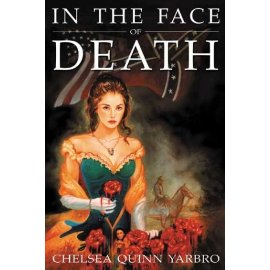

"Gratutious and Sketchy" | 2006-07-10 |
| - Reviewed By M. Post from Kenosha, WI United States |
I found this book to be one of the weakest in the series, if not the weakest of them all. Madelaine just doesn't have what it takes to be a strong character, or at least we haven't seen it yet.
The style of this book seems like Ms. Yarbo had a lot of information but no way to bring it all into a story. Research on the native American Indian tribes before their ways were lost - mentioned as the reason for Madelaine to come to America but then nothing. Journal entries to cover months and months of time - literary device for plot exposition. Staying in America during the Civil War - just not good common sense.
I don't look for great literature in this series. I like her attention to details and her ability to give the flavor and feeling for the times. But this one was just .. boring. At least Olivia had spirit - Madelaine has ennui. |
| |
"Something About General Sherman We Didn't Know About" | 2005-09-24 |
| - Reviewed By author of Children of Apollo from Houston, Texas USA |
| Madelaine de Montalia, the former lover of Comte de St. Germain, returns to San Francisco of the 19th Century and finds herself involved with a young army officer named William T. Sherman. They are seperated and, after many adventures in the American West, Madelaine encounters her beau again, in Georgia of all places. I'm somewhat unconvinced that Sherman would have taken a French vampire lady into his bed, but the book is a good read nevertheless. |
| |
"GREAT HISTORY" | 2005-08-13 |
| - Reviewed By book lover extraordinaire from Mandeville, LA USA |
| This chronicles Madelaine de Montalia's life during the Civil War. She has an affaire de cour with William Tecumseh Sherman and is present during Shermans' March to the sea. She is writing about American Indian culture, which necessitates her spending time with various tribes. This is a great book with lots of American history. There are some vivid descriptions about San Francisco and California during the era preceding the Civil War. Sherman visits Europe and reunites with Madelaine at the end. A great historical read spanning many years. |
| |
"Madelaine returns...." | 2005-03-20 |
| - Reviewed By shadodantz from Billings Mt |
It is such a pleasure to see Madelaine de Montalia again, and solo this time rather than in counterpoint with le Comte.
She emerges as a unique and complex character all her own, neither Saint-Germain (S-G) in drag, nor Olivia re-born.
Unlike S-G, who appears as a melancholy ex-warrior physician/philosopher/chemist, or feisty Olivia, who would have been in her element running a stud farm (take it as you will), Madelaine is a scholar/anthropologist/archeologist with a burning curiousity about How Things And People Work. This seems to have given her a flexibility and resilience that her seniors either don't quite have, or have lost along the way.
But I did not mean to analyze Madelaine, I meant to review the book.
It reads very quickly, the plot moving along via many entries from Madelaine's journals, differing somewhat from the format of the S-G/Olivia novels. The viewpoint switches between 1st person and 3rd, but the person is always Madelaine. While the story is not quite as deep, dark and heavy as some of the S-G chronicles it is by no means light. The painful and equivocal position of the various tribes, who had their own problems with the United States government, not to mention between their own nations is a factor that most people don't consider. The pathetic bloody aftermath of battle is not lovingly dwelt upon, but it is dealt with unflinchingly. The pain of separation from her beloved and respected friend and lover Tecumsah, all the time knowing there will be the final loss, is a sad note, a quiet undercurrent throughout the entire story.
Ms Yarbro has made her usual good effort at making people real and not dividing them into Good and Evil. An Underground Railroad conductor has a Bad Attitude when it comes to women-any woman. A dedicated, hard-working, abolitionist army nurse has some serious Issues when it comes to skin color, parentage and legitamacy. A Confederate soldier who hates Yankees (and with good reason) is Madelaine's best and most compassionate assistant at French Mill- where ANY wounded soldiers are treated. Even Madelaine is not perfect. She herself makes mistakes, becoming attracted, or 'drawn' as she says, to handsome guys who turn out to be a jerks and or possibly dangerous to her. Madelaine, unlike S-G, however, is more easily able to admit to herself that she was wrong and wonder what was she thinking. She also has the sense to take advice and to get outta Dodge BEFORE the shooting starts...at least some of the time. You can't do that TOO often (or where's the conflict in the story?) but it IS nice to have a heroine who is not stupid.
I like her. I hope there are more books about her.
I read that Ms. Yarbro's publisher thought this book wasn't going to sell as a bound book and she should just sell it via the net. Next time she should just tell her publisher where to get off and to publish the damn book. This lady knows what she is doing.
|
| |
"Not her best work, but readable" | 2005-01-12 |
| - Reviewed By bunrab@bunrab.net from MD, United States |
This is a perfectly readable novel, if you weren't expecting anything extraordinary. If you've been following the entire St. Germain series, you'll want this for the sake of completeness. And if you are already a fan of historical vampire romance, then this is a pleasant book of that kind. Particularly if you are a fan of the American Civil War, the historical aspects of this will interest you. But if you are looking for *very* vampire, this isn't it. It isn't as clever or as detailed as the St. Germain books.
This one features Madelaine de Montalia, whom we first met in Hotel Transylvania, and who has appeared in a few of the other St. Germain books.
Let's look at it from the several different genres it might fit into. It's weakest as a vampire novel, only middling as a romance, interesting as a historical. From the vampire aspect, it follows the St. Germain pattern, of course: vampires are long-lived, can be killed by severing the spinal cord or by fire, are stronger than normal but don't have "supernatural" powers as such - no fading into smoke, turning invisible, etc. For the most part, vampires are (a) rare, and (b) good guys, in Yarbro's universe. They don't necessarily drink blood itself; they absorb a life essence from shared sexual passion, although they *can* drink blood when necessary. So Yarbro's books in general, and this one in particular, do not fall into the evil, brooding blood-sucker vampire pattern. In this book in particular, one might almost not even notice that Madelaine is a vampire - the only aspect of her vampirism that's important to the story is her age. Even when she and Sherman are making love, it's not really important that she's a vampire.
From the romance side of things, certainly an affair with William T. Sherman is a fairly novel idea. Sherman is not, however, as well drawn as we might like - we don't get nearly enough of an idea of him as a person. What we do get a lot of, more than I personally needed, is his agonizing "I can't leave my wife, but I can't resist you; woe is me!" stuff - over, and over, year in and year out. Conflicted is a character trait that can be interesting, but it isn't, particularly, here. Your tastes may vary, however.
As a historical, that's where we get some of Yarbro's best efforts in this book. Not as good as her best, but that may just be because I am less interested in recent history than in ancient history; in the novels that take place before the industrial revolution, more of the cultural aspects are strange to me, and there's more new detail to find interesting. In the 19th century USA, there's not as much new to learn. But again, your opinion may vary, particularly if you like the era. Apart from our glimpses of Sherman's maneuvering, the most important things happening here are the lives of the Native Americans, and nursing/medical practice during the war, including a lot of herbal medicine. I don't know enough about Native American history to judge the accuracy of some of these things; we don't get too much of a look in depth at any one particular culture. Madelaine bounces from tribe to tribe, and I personally would have liked to see more detail about some of them. Oh, and we do get an awful lot of details about Madelaine's clothing, which I wasn't very interested in - but some people are fans of historical costume, and certainly the romance readers should enjoy the descriptions of the gowns.
Most readers will know already how the war ends, no surprises there. That, it seems to me, is also a result of it being from a period that most of us already know something about. Novels set in 10th century Poland or other exotic locales can hold many more surprises for us; we don't know ahead of time how they end.
Overall? Lighter weight than we've come to expect from the St. Germain series, but an OK read if you set your expectations down at "ordinary 300-page historical romance." |
| |
"Twentieth in the "Saint Germain" series." | 2004-11-26 |
| - Reviewed By James Yanni from Bellefontaine Neighbors, Mo. USA |
Or second in the "Madeline" offshoot series, depending on how you look at things. In any case, this is one of the best of a very good series.
For one thing, the character of Madeline de Montalia has been underexplored in the Saint Germaine novels, only a few of which have been set in time periods after Madeline was born, much less became a vampire. And unlike "Out Of The House Of Life", this is truly a novel centering on Madeline's life; that one split its focus between her adventures in Egypt and Saint Germaine's early history there.
For another thing, the time period and place setting of this one, the American Civil War, is a fascinating focus for the story, as is the character of William T. Sherman, her lover for the story.
For a third thing, the writing in this book is better than that in "Out of the House of Life", or at least the proofreading is less sloppy. There are only about a half-dozen instances of sloppy proofreading here, as opposed to the two dozen or so in that book. ("How strange that you should call white men them to me..." for instance.) Also, in this book one of the conventions of the Saint Germaine series that I've always found moderately annoying has been adjusted in a positive manner: the correspondence that has always come before and after every chapter has been replaced by entries from Madeline's journal, and instead of getting one and only one entry right where we would expect it every time (which always struck me as rather a contrived style) we get one, or two, or several; whatever better advances the plot at that point, which seems a much better system.
For those unfamiliar with the basic concept behind Yarbro's vampires, a few quick points are in order: 1) they are not (neccessarily) ravening monsters. 2) they do need the blood of the living to survive, but very little of it, little enough that they need not kill or even injure anyone to get it. 3) although mere blood itself WILL suffice to keep them going, it would be a very unsatisfying life, like a mortal living on bread and water; to truly have a satisfying "meal", they must feed on the blood of a lover. Most of the time, they make do with lovers who they hypnotize into having amorous dreams of them, but even that is barely acceptable fare. What truly nourishes them is the blood of a willing lover who knows them for what they are. Not surprisingly, this sort of fare is very rare; they may go decades between such nourishing sustenence. 4) Other than immortality and somewhat exceptional strength, stamina, and speed, (and, of course, the hypnotic ability previously mentioned, which is a very mild power not at all useful in an offensive capacity) there is little to set them apart from mortals in a positive manner; on the other hand, they are more able to offset their vampiric drawbacks than many literary vampires; so long as they have their shoes lined with their native earth, they can move about unhindered during daylight, only slightly more susceptible to sunburn than a normal person, they can cross running water with only mild discomfort (again, as long as their soles are properly lined); the only real problems are that they do not eat normally, which consistently makes for awkward situations socially, and they do not reflect in mirrors, which can also prove awkward.
If you like traditional vampire stories with lots of supernatural powers, blood and gore and seductive evil, this novel and all of the related books from Yarbro may not be to your taste (although there is plenty of blood and gore in the scenes relating to the war, of course.) But if you enjoy historical romance and are intrigued (or at least not upset) at the prospect of a main character that is a somewhat untraditional vampire, you may find the Saint Germain series fascinating, and this book is one of the best of the lot. |
| |