

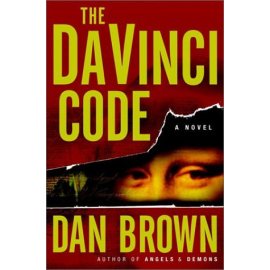
"DaVinci never looked so good" | 2009-11-05 |
| - Reviewed By User: A2IKZBS6UW69AA |
| The movie followed the book to a T. Dan Brown can write anything and turn it into a controversial best seller. He has done it before and Soon Will again, I am sure! |
| |
"Hyped to death...." | 2009-10-31 |
| - Reviewed By corrillo |
| As Edgar Allan Poe said about 'Pilgrim's Progress', "ludicrously overrated book," and also in the case of 'The Da Vinci Code' the film is even worse! |
| |
"a good thrilling read" | 2009-10-29 |
| - Reviewed By jbusman |
| A truly entertaining book. I don't understand what all the controversy was about though. The book is fiction and it treats itself as such. A quick read that will keep you on the edge of your seat. |
| |
"An excelent thriller, which does a dangerous blend of fact and fiction" | 2009-10-26 |
| - Reviewed By francistapon |
OVERALL: If you want a classic thriller, this is it.
PROS:
- Fast paced, page turner.
- Nice weaving of art and history, but....
CONS:
- Brown doesn't tell you when he is making stuff up, and sometimes presents it as fact and this can be dangerous if you read it believing everything is true.
CONCLUSION: It's a fun, entertaining yarn. Nothing more, nothing less. |
| |
"Adds another layer to the reading!" | 2009-10-15 |
| - Reviewed By User: A2XNOB1T796Y6B |
After having read & loved this book when it first came out, I finally shelled out the bucks for the illustrated edition. I wanted to see the different places, items & pictures featured in the book looked like. As such, this review is going to be more about how different a read it is than the non-illustrated version.
I'm not going to bother going over the plotline as DVC is one of the most recognizable books out right now. Now as far as the plotline goes, I really enjoyed this book the first time I read it. It's a quick & easy read, with subject matter that's intriguing... whether or not it's actually "true". My biggest problem with the book is that there's not a lot of re-readablity to DVC. Once I finished the book, I just couldn't get as involved in the plot as I did on the first reading.
So as a result, I decided to look into the illustrated edition. The pictures in this are slick & beautiful, so they give me something to look at if I get bored with Brown's book. While that's not exactly a great selling point, it brought a new layer to the book that I'd already read. After going through the illustrated edition, I decided to go ahead & purchase it. Now after doing so, I have to admit that this is really the book that should have been released in the first place. It's a much more entertaining read with the pictures & sites added in.
But bottom line? If you didn't really like the book when it first came out, you'll probably want to avoid purchasing this version of it. The pictures are nice, but if you didn't like the book to begin with, this book won't change your mind. |
| |
"Offfended, but by the writing, not the theme" | 2009-10-09 |
| - Reviewed By User: AR0VO6QBIL873 |
One of the worst, if not THE worst book I've read, ever. With Brown's new one out, I'm afraid even more people will be tempted to read this thing.
I'll admit that at first, as a conspiracy-nut since the Kennedy assassination, I was intrigued by the idea of a systematic cover-up of the feminine role in the Church. And the idea of a non-celibate Jesus is interesting in the light of abuse scandals involving the said-to-be celibate priesthood. But it didn't take long for the flat dialogue and wooden characters to put me to sleep--especially Langdon, with his pedantic lecturing to the unfortunate Sophie (if I'd have been Sophie, I'd have knocked him one upside the head when he ran on and on and on, ad nauseum). And she wasn't a whole lot more interesting, even when you find out, if you hadn't already guessed it very early on, the (gasp!) secret of her heritage. Brown couldn't seem to decide whether she is a powerful, take-charge kind of woman (one who lead the hapless Langdon to safety outside the Louvre) or an insipid, adoring girl sitting at the feet of her hero. And don't get me started on old grand pere! What a sensitive, cuddly, surrogate parent he must have been: he takes in a child traumatized by the deaths of her entire family and what does he do? All Brown tells us is that he taught her to solve puzzles and crack codes. These people have absolutely no personalities and I never could make myself care what happened to them. Even Tom Hanks, bless him, was unable to make this clown interesting in the movie.
Can we believe that Sophie was so immature that she cut off all communication with her beloved grandfather for ten years because she witnessed a weird sexual ritual? A woman smart enough to have become a cryptologist certainly would have been able to confront him at some point and deal with it. She gives up her only living relative over this? Come on! I was expecting human sacrifice or something equally horrifying.
The characters seem incredibly naïve (if not downright stupid). I could have told them not to go back into the gallery when they were already nearly safely out of the Louvre; surely they would have sensed the danger in that move. While being chased by Interpol, the French police, Opus Dei, and The Priori, shouldn't they have at least had some sense of the urgency of their situation? Instead, they seem to take a lot of cryptology breaks and indulge in more theoretical discussions, which certainly could have waited until they were safe somewhere. Having been inside Westminster Abbey, it is obvious to me that their approach to the knight's tomb could have been made in a much less conspicuous manner than straight across the massive, wide-open nave. How about down the dark aisles? Did they actually forget that they weren't the only ones looking for the Grail? Jeesh!
How neatly Brown deals with the sinister Bezu Fache (one of the few somewhat interesting characters) at the very end! Was 454 pages Brown's limit? Did he really need to tie it all up in such a tidy little package? Couldn't he have given us a clue as to Fache's epiphany? Or did he just run out of space?
My objections to this book have nothing whatever to do with the many religious, historical, or artistic arguments it seems to have ignited. I didn't find the themes the least bit offensive, and, yes, I knew it was fiction. The book simply isn't good enough to make me care.
|
| |